Shadows Over the City
The misty streets of Venice, where the plague doctor walked
In the year 1630, the city of VeniceA city in Italy built on canals and bridges instead of roads — built on shimmering canals and marble palaces — fell silent.
The air smelled of salt and smoke, and bells tolled each morning for the dead. Rumors spread faster than the rats that scurried through narrow alleys: the plagueA deadly disease that spreads quickly among people had returned.
Families barred their doors. Gondolas drifted empty across dark water. Even the pigeons avoided St. Mark's Square, as if they could sense the danger hanging in the air like fog.
Then one morning, children peered from shuttered windows to see a tall figure gliding through the mist — a man dressed head-to-toe in black, with a long beaked mask and round glass eyes.
To them, he looked like a bird from a nightmare. To others, he was a savior.
The Plague Doctor had arrived.
The Beaked Mask

A plague doctor in his protective costume (1656 engraving)
The mask was no ordinary disguise. Inside its long, curved beak was a secret: it was stuffed with herbs — rosemary, lavender, mint, and cloves.
People believed these sweet smells could protect against sickness that floated in the air. They didn't know about bacteriaTiny living things that can cause disease, too small to see without a microscope yet — that discovery wouldn't come for another 200 years. But they understood that something invisible was making people sick.
The doctor's cloak was coated in wax so the "bad air" would slide off. His leather gloves were thick and heavy. His boots echoed on stone bridges with each step.
In his hand, he carried a long wooden cane. Children whispered that he used it to chase away evil spirits. But really, he used it to lift blankets, open doors, and check pulses from a safe distance — never touching the sick directly.
Every part of the outfit was both scientific and superstitiousBased on belief or fear rather than facts or science — a strange mix of medicine and mystery.
The mask was terrifying. But it was also a symbol of hope: it meant someone was still fighting back.

A detailed view of the plague doctor's protective outfit
The Doctor's Promise
The Plague Doctor — whose real name history has forgotten — walked from house to house, street to street, canal to canal. He carried a leather journal, recording names, symptoms, and prayers.
He worked for the city government, not for money, but to keep records and help where he could. His job was to track the spread of disease, identify the sick, and mark homes for quarantineIsolation to prevent the spread of illness from one person to another.

The Bridge of Sighs, where the doctor crossed each night
Every evening, he burned bundles of herbs in brass censers, walking through the squares to "clean" the air. He didn't know about viruses or germs, but he believed in observationWatching carefully to learn or understand something and courage.
"If fear spreads faster than plagueA deadly disease that spreads quickly among people," he wrote in his journal one night by candlelight, "then courage must walk faster still."
His boots echoed on stone bridges. Gondolas floated past, piled high with empty crates meant for the dead. But he kept walking, kept writing, kept hoping.
Some families left bread outside their doors for him. Others locked their shutters tight. But everyone knew the sound of his footsteps — tap, tap, tap — echoing through the fog like a heartbeat keeping the city alive.
The Midnight Lantern
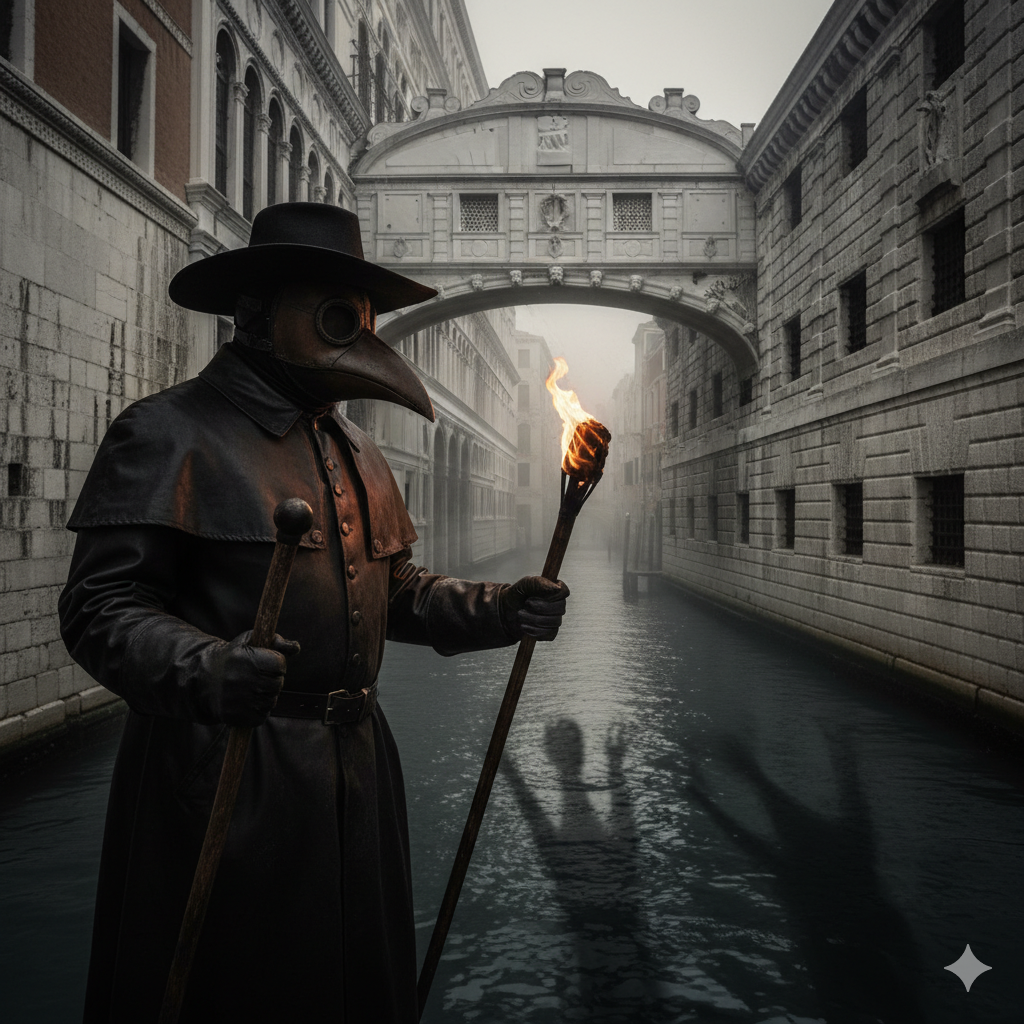
The plague doctor crosses the Bridge of Sighs with his lantern on a foggy Venetian night
One moonless night, the Plague Doctor crossed the Bridge of Sighs, his lantern glowing like a firefly in the thick fog. Most homes were dark and silent now.
He entered an abandoned villa near the canal — a place where families had fled weeks ago, leaving furniture covered in dust and bread moldy on tables.
But then he heard something: a faint cough from upstairs.
Slowly, he climbed the creaking stairs, his lantern swinging shadows across faded paintings on the walls. In a small bedroom, he found a child — pale and weak, clutching a charcoal drawing of a bird.
The doctor knelt at a distance, careful not to get too close. He left a loaf of bread, a jar of honey, and a note written in careful script: "You are not forgotten. Stay strong. Help is coming."
"The next morning, neighbors said they saw the doctor's lantern still burning in the window long after dawn — even though no one was there. Some said it was his spirit, checking on the living. Others said it was the reflection of his courage, shining over Venice forever."
That child survived. The plagueA deadly disease that spreads quickly among people eventually passed. And though the doctor's name was lost to time, his lantern — the symbol of someone who cared when others fled — became part of Venice's memory.
On foggy nights, some say you can still hear footsteps crossing the bridges. Not scary footsteps. Comforting ones. A reminder that even in the darkest times, someone is watching over us.
Legacy of the Mask

A real plague doctor costume preserved in a German museum
Today, the plague doctor's mask hangs in museums around the world — strange, a little spooky, and endlessly fascinating.
It reminds us how far medical science has come. We now know that bacteriaTiny living things that can cause disease, too small to see without a microscope and germs — not "bad air" — cause disease. We have antibiotics, vaccines, and microscopes. We wash our hands, wear masks when needed, and track diseases with computers instead of leather journals.
But the mask also reminds us of something timeless: that people once fought darkness with hope, herbs, and heart. They didn't have all the answers, but they showed up anyway.
The plague doctor walked into danger when others ran away. He kept records when chaos ruled. He left lanterns burning when all seemed lost.
And that legacyWhat someone leaves behind for future generations to remember — of courage in the face of fear, of caring when it's hardest — still matters today.
If you ever walk through Venice on a foggy night and hear footsteps echoing across a bridge, don't be afraid.
It might just be the doctor, still keeping watch.
💬 Discussion Questions
1. Why did people believe herbs could protect them?
Think about what they knew and didn't know about disease in the 1600s.
2. What parts of the outfit were practical, and what parts were based on fear?
Consider which protections actually helped and which were superstition.
3. How has our understanding of disease changed since the 1600s?
Compare what plague doctors knew to what modern doctors know.
4. Why does the plague doctor's story still fascinate people today?
What makes this historical figure both scary and inspiring?
5. If you were a scientist in 1630, what would you have invented to help?
Use your knowledge of modern medicine to imagine historical solutions.
🔬 Mini Experiment: "The Air Around Us"
Goal:
Understand why clean air and cleanliness matter in preventing disease.
What You Need:
- Two clear jars or glasses
- Two pieces of bread (same type)
- Plastic wrap
- Marker to label jars
Steps:
- Label one jar "Uncovered" and one "Covered"
- Place one piece of bread in each jar
- Leave the "Uncovered" jar completely open to the air
- Cover the other jar tightly with plastic wrap
- Place both in a warm spot and observe for 5-7 days
- Record what you see each day with drawings or photos
What You'll Learn:
The uncovered bread will grow mold faster because the air carries tiny living things called microbes. This demonstrates what the plague doctor couldn't see — that disease spreads through invisible organisms in the air and on surfaces.
This is why washing hands, covering food, and keeping clean are so important!