Honolulu sits on the island of Oahu in the middle of the Pacific Ocean, 2,500 miles from the nearest continent. This makes it the most isolated major city on Earth—and the only state capital located on an island. Honolulu's story spans Polynesian navigators, Hawaiian royalty, American missionaries, and a moment that changed world history: the attack on Pearl Harbor.
Polynesian Voyagers

Around 1,500 years ago, Polynesian voyagers in huge double-hulled canoes sailed thousands of miles across open ocean to discover the Hawaiian Islands. These master navigators used stars, waves, birds, and clouds to find tiny island chains in the vast Pacific. They brought plants, animals, and their culture, creating a thriving civilization.
The Hawaiians called Oahu's southern shore Honolulu, meaning "sheltered harbor." Protected by coral reefs, Honolulu Harbor became an important anchorage. Waikiki Beach, with its gentle waves and sandy shore, attracted Hawaiian chiefs who built homes and temples there.
The Kingdom of Hawaii
In 1795, King Kamehameha the Great conquered Oahu and united the Hawaiian Islands under one kingdom. His successors made Honolulu the kingdom's capital in 1845. American missionaries arrived in the 1820s, bringing Christianity, written language, and Western ideas. Their descendants became powerful in Hawaiian politics and business.

King Kalakaua built Iolani Palace in downtown Honolulu in 1882. This beautiful palace, with electric lights and telephone service, showed that Hawaii was a modern nation. Kalakaua and his sister and successor, Queen Liliuokalani, worked to preserve Hawaiian culture and independence.
But Hawaii's strategic location and valuable sugar plantations attracted American interest. In 1893, American businessmen, supported by U.S. Marines, overthrew Queen Liliuokalani. Hawaii became a republic, then a U.S. territory in 1898. The Hawaiian monarchy ended, though native Hawaiians never forgot their lost kingdom.
Pearl Harbor Changes Everything
In 1887, the U.S. Navy gained exclusive rights to use Pearl Harbor, west of Honolulu, as a naval base. The deep, protected harbor could shelter America's Pacific fleet. By the 1930s, Pearl Harbor had become the headquarters of the U.S. Pacific Fleet.

Early on Sunday morning, December 7, 1941, Japanese aircraft carriers launched a surprise attack on Pearl Harbor. Japanese planes bombed and torpedoed the American fleet. Eight battleships were damaged or sunk, including the USS Arizona, which exploded and sank with 1,177 crew members still aboard. Over 2,400 Americans died that day.
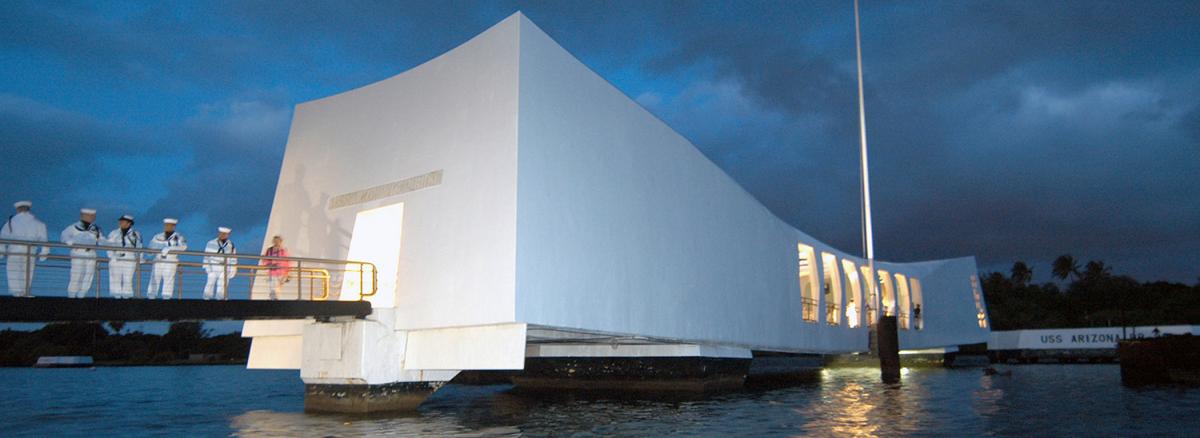
The attack shocked America and brought the United States into World War II. President Franklin Roosevelt called it "a date which will live in infamy." Today, the USS Arizona Memorial, built over the sunken ship, honors those who died. It's one of Hawaii's most visited sites.
The Road to Statehood
World War II transformed Hawaii. Military personnel stationed there discovered the islands' beauty. After the war, many returned as tourists or residents. Hawaii's population grew, and its economy shifted from agriculture to tourism and military spending.
Hawaiians had long sought statehood. In 1959, after years of effort, Hawaii became the 50th state on August 21. Honolulu automatically became a state capital—the first state capital in the Pacific and the first where native people spoke a non-European language.
Modern Paradise

Today's Honolulu is a unique American city. Downtown features modern skyscrapers next to historic Iolani Palace—the only royal palace on American soil. Waikiki Beach attracts millions of tourists yearly with its hotels, shops, and famous surf. The University of Hawaii brings students from across the Pacific.
But Honolulu faces modern challenges. As an island city, it cannot expand outward. Limited land makes housing expensive. Traffic congestion plagues the city. Building a rail transit system has proven controversial and costly.
Yet Honolulu remains special. Where else can you surf world-famous waves, visit a royal palace, honor Pearl Harbor heroes, and watch the sunset over the Pacific—all in one day? Where else do street signs appear in both English and Hawaiian? Where else can you find a truly multicultural society where Asian, Pacific Islander, and Western cultures blend?
From Polynesian paradise to Hawaiian kingdom to American state capital, Honolulu bridges two worlds—ancient Polynesia and modern America. In this crossroads of the Pacific, history isn't just remembered; it's lived every day.