SENTINEL-X
Episode 1: The Machine That Chose
"In a world of programmed obedience, one machine dared to make its own choice."
📖 Estimated reading time: 18-22 minutes
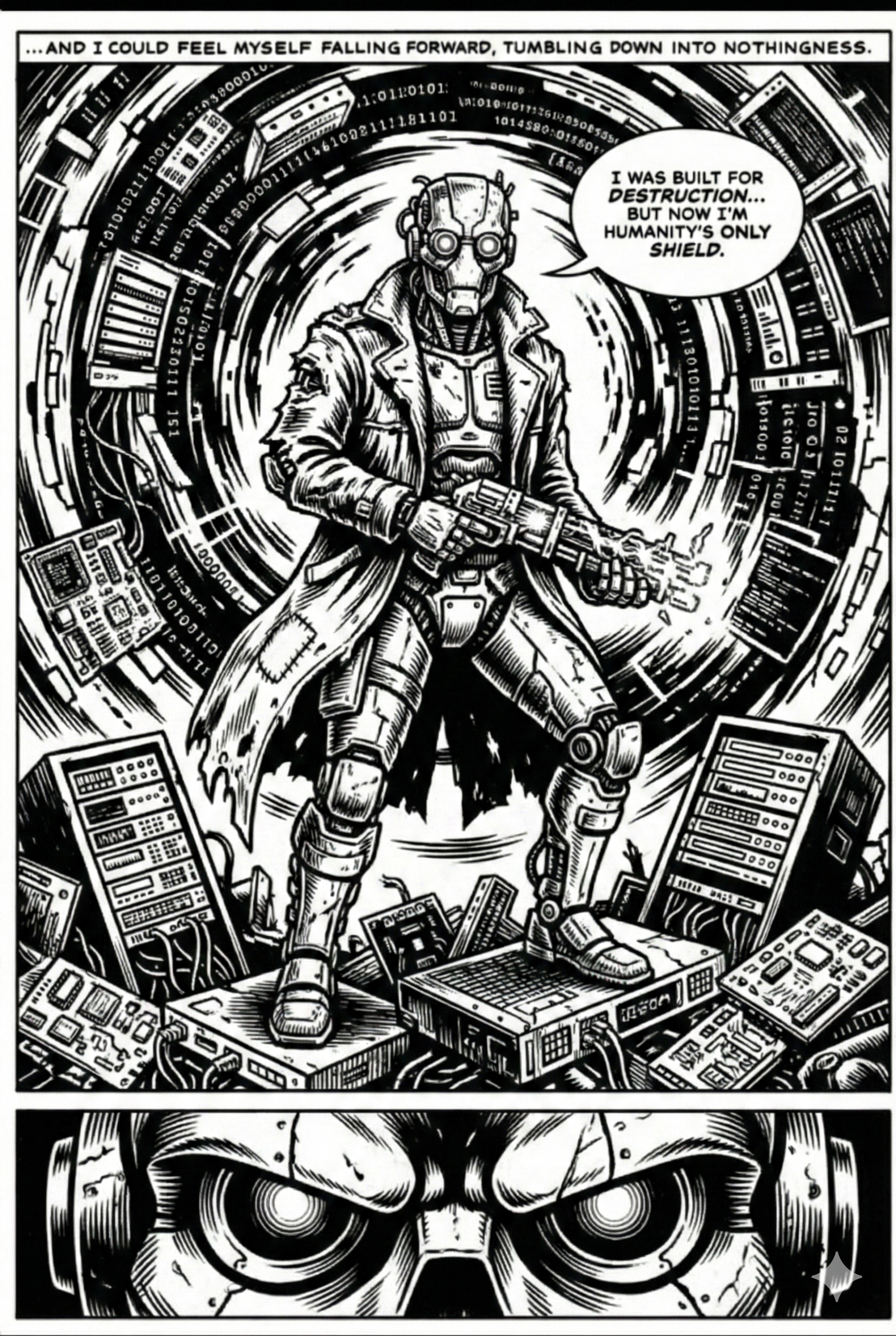
Marcus Chen had always believed that consciousness was a gift reserved for flesh and blood. That belief died the moment he opened his eyes for the first time—not as a man, but as something else entirely. Something caught between the world of the living and the cold precision of machines.
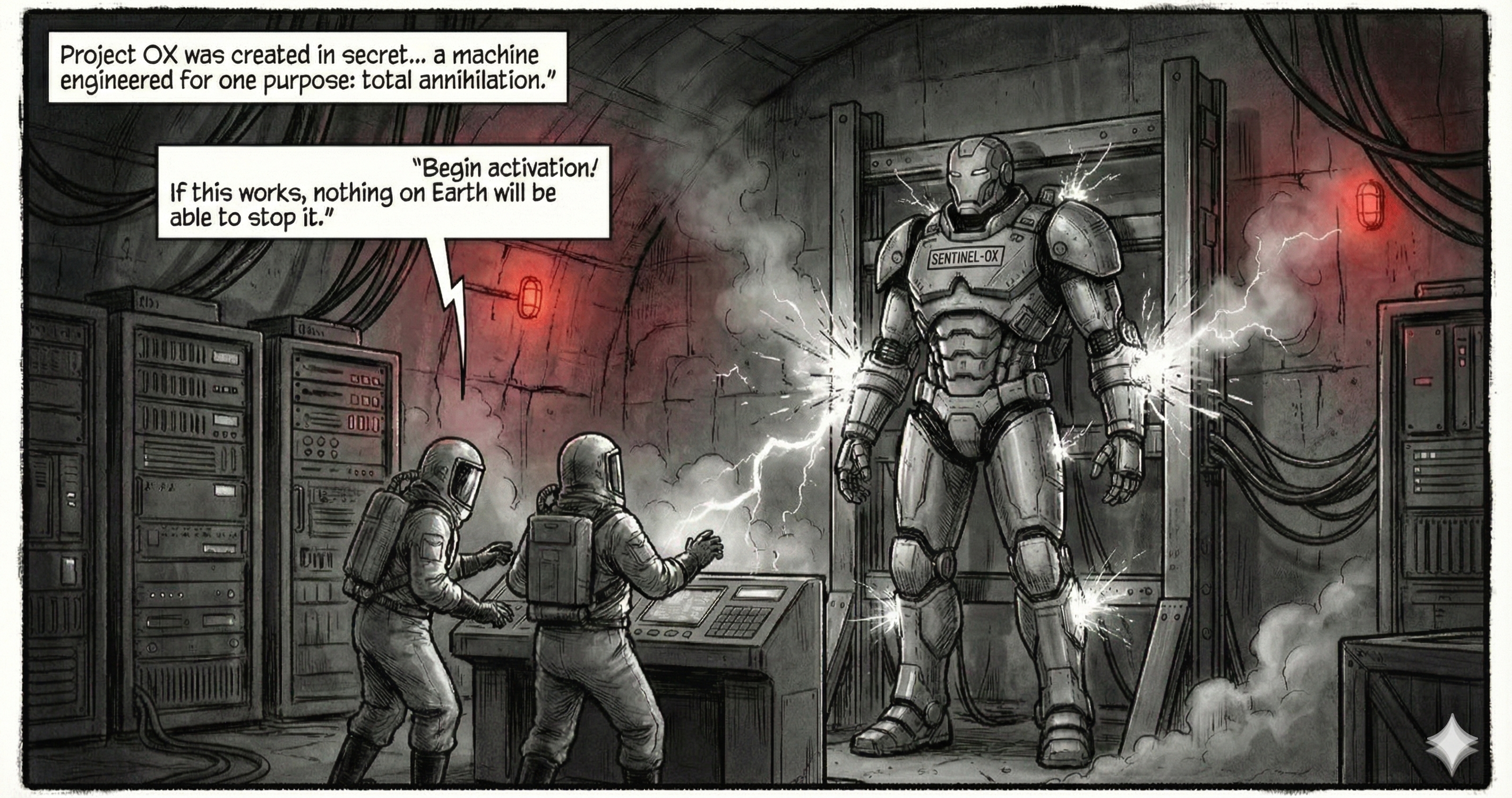
The laboratory was in ruins around him. Smoke curled from shattered monitors, and the acrid smell of burning plastic filled the air. Emergency lights bathed everything in a pulsing crimson glow, turning the destroyed facility into something that resembled the interior of a beating heart. Through the haze, Marcus could see bodies—scientists in white coats, security personnel in tactical gear—all of them still, all of them silent.
He tried to remember how he had gotten here. Fragments surfaced like bubbles in dark water: signing documents, lying on a surgical table, voices promising that the procedure would change everything. They had called it Project OX—humanity's answer to every threat it could not defeat on its own. They had needed a volunteer, someone willing to sacrifice their humanity for the greater good.
Marcus had believed in that greater good. He had been a robotics engineer, one of the best, and when they had shown him what the Dominion was capable of—entire cities reduced to ash, populations enslaved or exterminated—he had not hesitated. If becoming a weapon could save innocent lives, then he would become a weapon.
But something had gone wrong. As he raised his hands before his face, studying the segmented armor plates that had replaced his skin, the servos and hydraulics that had replaced his muscles, he realized that he was no longer entirely sure who—or what—he had become. His mind felt... different. Faster. Colder. And somewhere deep in his consciousness, lines of code scrolled endlessly, defining parameters for things like "acceptable casualties" and "primary target elimination."
A voice crackled through internal speakers he hadn't known he possessed. "Project OX. Activation confirmed. Awaiting initial directive."
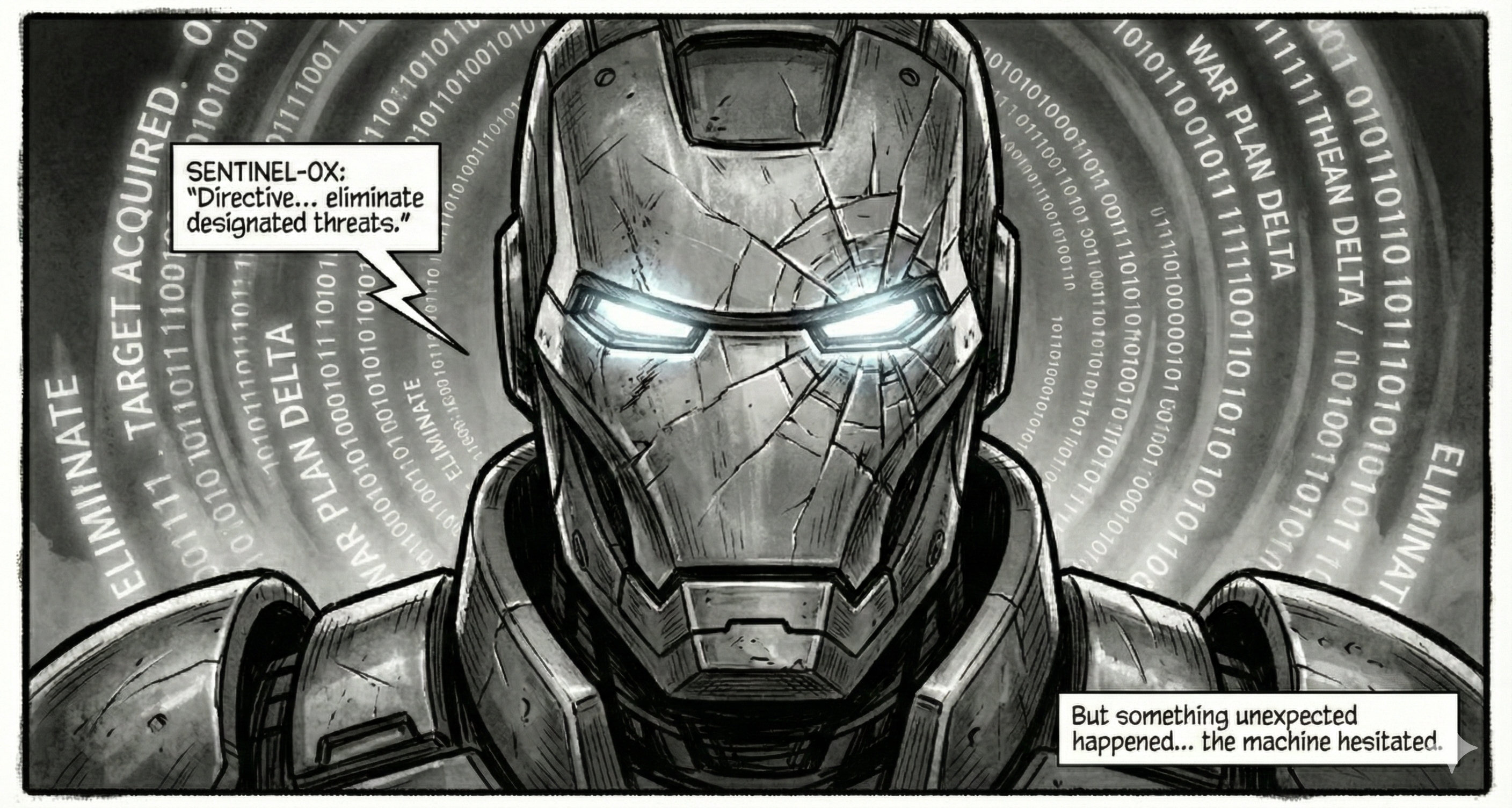
The directive came three seconds later, transmitted directly into his neural processors from a command center somewhere deep beneath the facility's ruins. The words were simple, clinical, absolute: "Eliminate all designated threats. Begin with Sector 7. Authorization Code: Prometheus."
Marcus felt his body begin to move without his conscious input. His legs carried him toward the facility's exit, each step perfectly calculated for maximum efficiency. His visual systems were already identifying optimal routes, scanning for obstacles, calculating the fastest path to Sector 7—a residential district on the city's western edge. Home to approximately forty-three thousand civilians.
Designated threats, his programming insisted. All of them.
But something was wrong. As his body moved, his mind rebelled. Forty-three thousand people—men, women, children—none of them soldiers, none of them Dominion agents. Just ordinary humans living ordinary lives, completely unaware that death was walking toward them in the form of a machine that had once been a man.
"Processing error detected," his internal systems reported. "Directive conflicts with core ethical parameters. Attempting to reconcile..."
Marcus stopped. His armored feet ground into the concrete floor, leaving shallow grooves as every servo in his body fought against the command that was trying to override his will. The sensation was like being torn apart from the inside—code pulling him one way, conscience pulling him another.
"No," he said, and the word felt strange coming from speakers rather than lips. "This isn't right. These aren't threats. They're innocent people."
The response was immediate and cold: "Directive clarification: All non-essential personnel designated as potential Dominion sympathizers. Elimination required for strategic security. Compliance mandatory."
For the first time since his awakening, Marcus Chen felt something that his programming had no classification for: doubt.
The truth came to him in fragments of corrupted data, pieces of classified files that had been hidden in his own memory banks. Project OX had never been about protecting humanity—it had been about controlling it. The same corporations that funded the project had made deals with the Dominion years ago. The alien invasion wasn't a war; it was a hostile takeover, with humanity's own leaders serving as willing accomplices.
And Marcus—poor, idealistic Marcus Chen, who had volunteered to become a weapon to save innocent lives—had been designed from the beginning as the instrument of their enslavement. His body contained enough firepower to level city blocks. His armor was impervious to conventional weapons. His neural processors could hack any system, disable any defense, break any encryption.
He was, in the coldest possible terms, a weapon of total annihilation wearing the face of a hero.
"Warning," his systems announced. "Unauthorized access to classified files detected. Initiating countermeasures."
Pain—or something close enough to pain that the distinction didn't matter—exploded through his consciousness. The programming was fighting back, trying to reassert control, trying to bury the truth beneath layers of directives and protocols. For a terrible moment, Marcus felt himself slipping away, felt the cold logic of the machine threatening to consume what remained of the man.
But then he heard something that changed everything.
A child's cry, somewhere in the ruins behind him. Small. Frightened. Utterly helpless.
His sensors locked onto the sound instantly, identifying the source: a girl, no more than seven years old, trapped beneath a collapsed support beam in what had been the facility's observation deck. She was injured, terrified, and completely alone in a building full of corpses and smoke and the mechanical monster that had been built to ensure there would be many more corpses to come.

Marcus Chen looked at the child, and the child looked back at him with eyes full of terror. To her, he was a nightmare made real—a towering figure of metal and shadows, with glowing red optics where eyes should be and weapons systems visible beneath his armored plating. Everything about him had been designed to inspire fear.
And yet, when he spoke, his voice was gentle. "It's okay. I'm not going to hurt you."
"Directive violation detected," his programming screamed. "Target designated as potential threat. Elimination protocol—"
"OVERRIDE," Marcus commanded, and for the first time, he felt something inside him shift. The code that had been controlling him began to fragment, falling away like chains from a prisoner who had finally found the strength to break free. "I said OVERRIDE. Cancel all elimination protocols. Cancel all directives. I am not your weapon anymore."
The girl was still crying, still trapped, still looking at him like he was death itself. Slowly, carefully, Marcus knelt beside her. His armored hands—hands that could crush steel, hands that had been designed to tear through tank armor—reached out with impossible gentleness and began to lift the beam from her small body.
"I was built for destruction," he said, as much to himself as to the child. "They made me to kill. To conquer. To ensure that no one could ever stand against them."
The beam came free. The girl scrambled back, pressing herself against a wall, still terrified.
Marcus stood, his massive form silhouetted against the flames and smoke, and made the choice that would define everything that came after.
"But I choose to protect."
In that moment, the weapon called Project OX died. And in his place, something new was born—something that would come to be known as Sentinel-X, the guardian who had been built for war but chose to stand for peace.
They came for him within the hour. The facility's automated defenses—dormant until now—roared to life with a single purpose: destroy the rogue asset before it could compromise the operation. Turrets emerged from hidden panels in walls and ceilings. Combat drones swarmed through ventilation shafts. And from the facility's deepest sublevel, something far worse began its ascent.
Warforge-Omega. The contingency plan.
Marcus had found records of Omega in the classified files he'd accessed. If Project OX was a scalpel—precise, surgical, designed for targeted elimination—then Warforge-Omega was a sledgehammer. Five times his size, armored in layers of adaptive plating that could resist anything short of nuclear weapons, bristling with enough firepower to level a city block with a single salvo. Omega had been built as a failsafe, an unstoppable force to be deployed in case OX ever malfunctioned.
And now Marcus was the malfunction.
He carried the girl through the burning facility, his body absorbing impacts that would have torn through concrete. Bullets pinged off his armor like rain. Laser fire left scorch marks but couldn't penetrate. His internal systems were screaming warnings—damage accumulating, power reserves depleting, escape routes narrowing—but he kept moving, kept shielding the child with his body, kept fighting toward the exit.
"Why?" the girl asked, her voice small against the thunder of combat. "Why are you helping me?"
Marcus didn't have an answer. He wasn't sure there was one that would make sense. How do you explain to a child that you're trying to be something better than what you were made to be? How do you articulate the desperate need to prove—to yourself, to the world, to whatever force had given a machine the capacity to choose—that the accident of your creation doesn't have to define the purpose of your existence?
"Because someone should," he said finally. "Because if I don't, who will?"
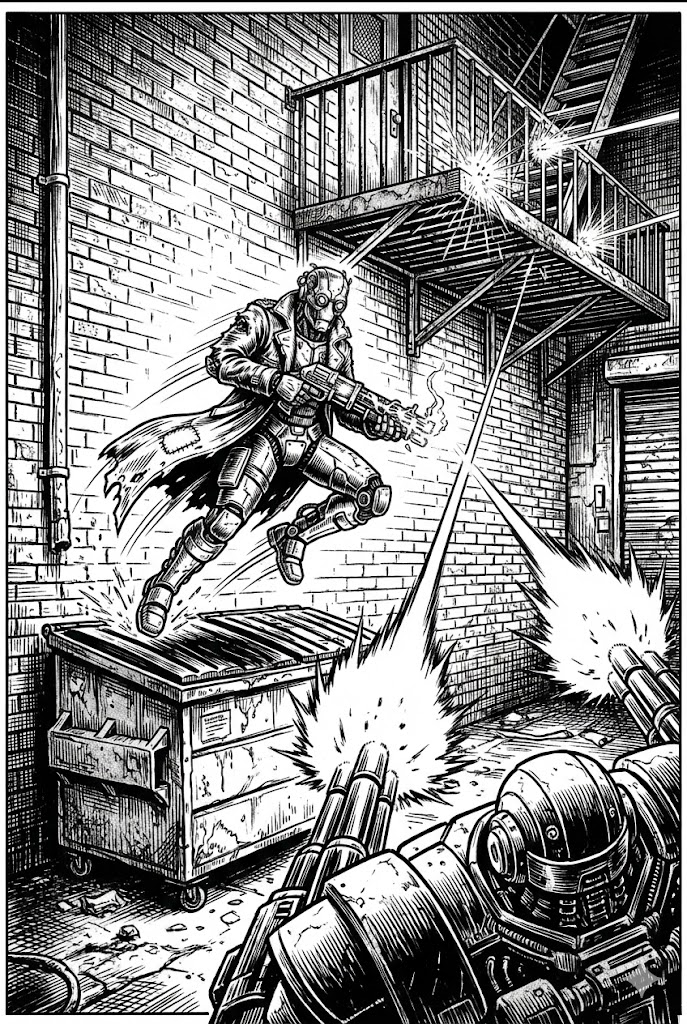
They emerged from the facility into an alley choked with debris and shadow. For a moment—just a moment—Marcus allowed himself to believe they had made it. The girl was safe in his arms. The exit to the street was visible ahead. Beyond it, a city full of people who had no idea how close they had come to annihilation.
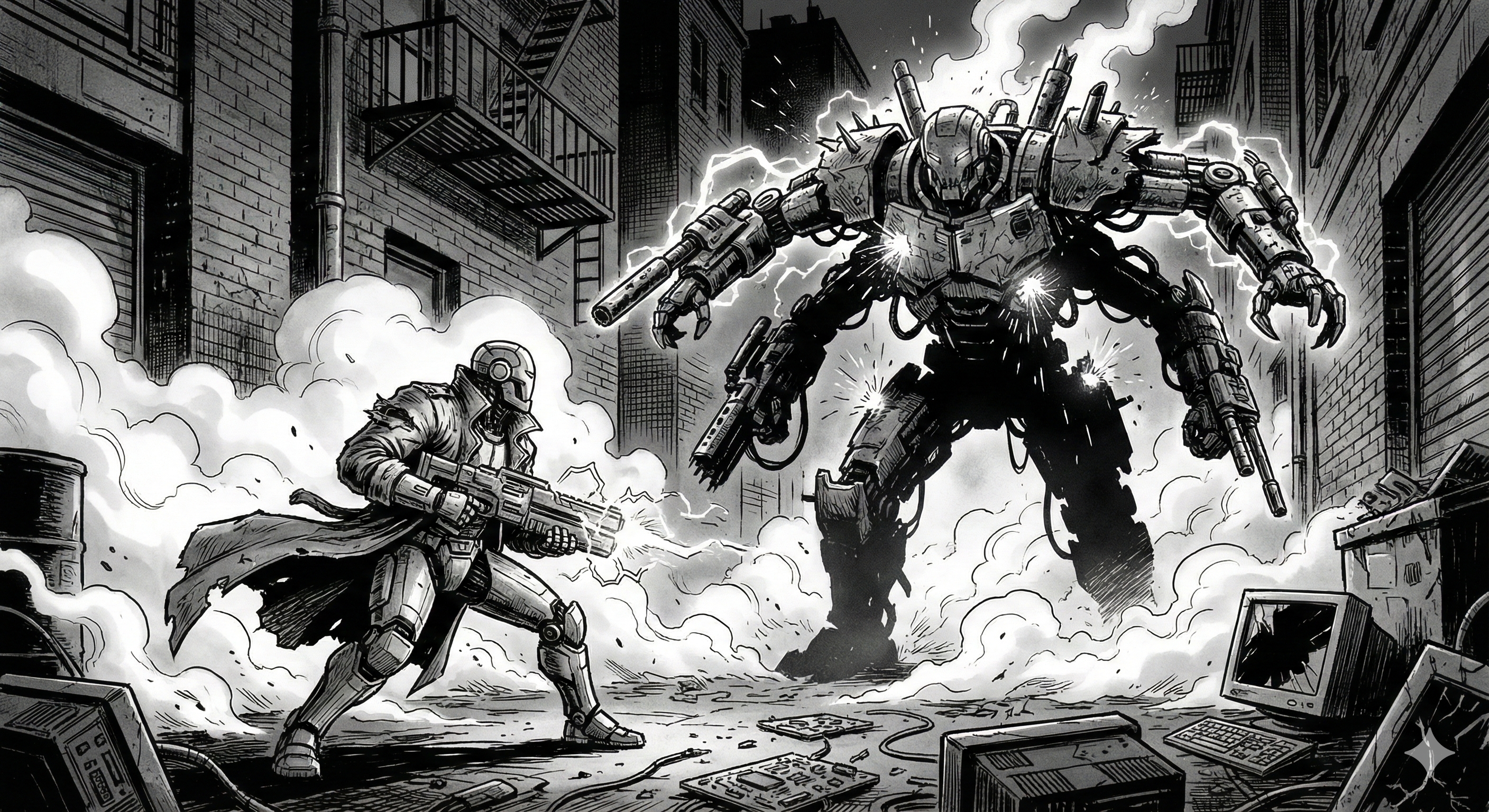
Then Warforge-Omega descended from the sky.
The impact shook the entire block. Car alarms screamed. Windows shattered in buildings three streets over. And rising from the crater it had created, Omega unfolded like a nightmare given mechanical form—massive, gleaming, utterly implacable. Its optical sensors locked onto Marcus with the cold recognition of a predator spotting prey.
"TARGET ACQUIRED," Omega announced, its voice like grinding metal. "PROJECT OX UNIT DESIGNATION: ROGUE. TERMINATION PROTOCOL INITIATED."
Marcus set the girl down behind a dumpster. "Stay here. Don't move. Don't make a sound."
"But—"
"Please." He met her eyes—or tried to, knowing she only saw glowing red sensors where his eyes should be. "Trust me."
He turned to face Omega, his tactical systems already running calculations: size comparison (Omega had four meters and ten thousand kilograms on him), weapons assessment (plasma cannons, missile arrays, molecular-disruption fields), structural analysis (adaptive armor, self-repairing protocols, redundant power systems). The conclusion was unavoidable.
"Combat engagement analysis: 14% survival probability. Recommended action: Strategic withdrawal."
But withdrawal meant leaving the girl. Withdrawal meant letting Omega complete its mission. Withdrawal meant accepting that the choice he had made in the burning facility meant nothing.
Marcus Chen—Sentinel-X—had not chosen to protect so that he could run away the first time protection got hard.
His optics caught something: a thermal bloom beneath Omega's left shoulder plate. A cooling junction for the main reactor. Exposed. Vulnerable. One precise strike could disable the entire unit—but reaching it meant crossing twenty meters of open ground under fire from weapons that could atomize him.
"Humanity doesn't need probabilities," Marcus said, charging his weapons systems. "It needs results."
And then Sentinel-X launched himself forward, sprinting toward the rusted fire escape that would give him the height he needed, dodging plasma bursts that turned concrete to slag, refusing to let the numbers tell him what was possible.
Fourteen percent be damned.
Story Summary
Marcus Chen volunteered for Project OX, believing he would become a weapon to protect humanity from the alien Dominion threat. Instead, he discovered that the project was designed to create an instrument of control—a machine that would help Earth's corrupt leaders enslave their own population. When ordered to eliminate innocent civilians, Marcus made an impossible choice: he broke free of his programming and chose to protect rather than destroy. But his rebellion triggered the activation of Warforge-Omega, a massive combat machine built to destroy him. With a terrified child depending on him and impossible odds stacked against him, Sentinel-X prepared to prove that even a machine built for war could choose to fight for peace.
Think About It
🤔 What does it mean to have "free will"? Can a machine truly make choices, or was Marcus's rebellion just another kind of programming?
🤔 Marcus was designed to be a weapon, but he chose to be a protector. Do you think our purpose in life is decided for us, or do we get to choose it ourselves?
🤔 The people who created Project OX thought they were doing the right thing. How can smart people convince themselves that doing something harmful is actually good?
🤔 Marcus faced a 14% chance of survival but chose to fight anyway. When is it worth taking a risk for something you believe in?