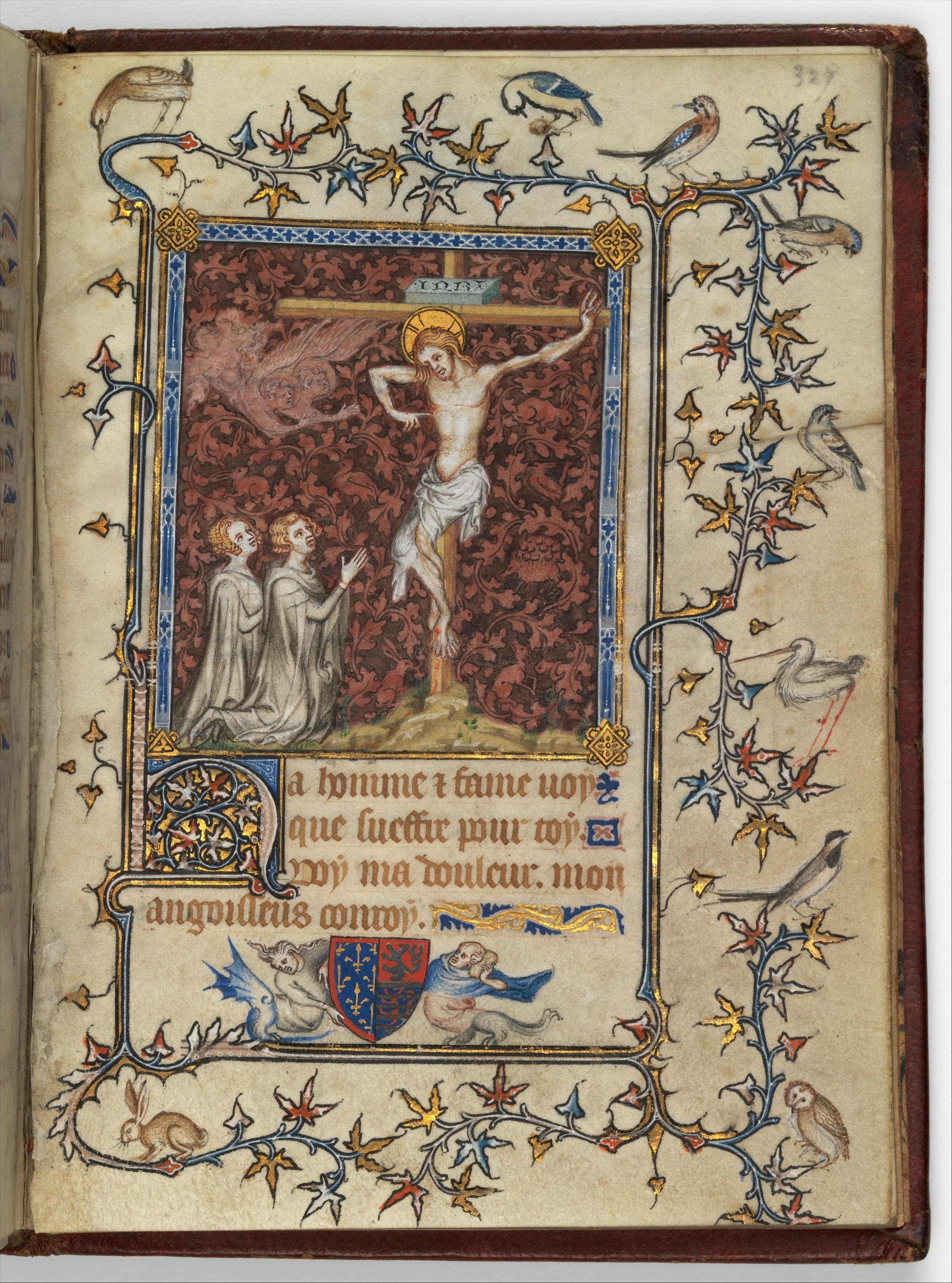
I · THE OBJECT · BRITISH MUSEUM
Psalter of Bonne de Luxembourg
▶ Listen · narrated
A private book of psalms, small enough to hold in one hand, links a named illuminator, a duchess, and a year when plague was already moving through France.
At a glance
- Date
- 1348
- Creator
- Jean Le Noir
- Origin
- France
- Type
- Illuminated manuscript; psalter
- Collection
- Metropolitan Museum of Art
- Inventory
- 69.86
Look closer
A book built for the hand
Each page measures only 126 by 88 millimetres (3.46 in). Across 333 leaves of parchment the scale never becomes monumental. The whole object is sized for private use: held close, carried, opened on a lap rather than a lectern. That physical smallness shapes how the painting works. Gold leaf and fine line have to carry meaning at a distance of inches, not feet, and the illuminations reward looking that is slow and near.
Grisaille, colour, and gold
The decoration is worked in tempera, grisaille, ink and gold leaf on vellum. Grisaille — modelling in greys — gives figures a sculptural weight without filling every surface with colour. Against that restraint, gold catches light and marks the sacred or the hierarchical. The combination is not austerity for its own sake; it is a deliberate register in which line, tone and metal do different jobs on a very small field.
Psalms beside the stars
Among the illustrations are graphic treatments of astrological material associated with the Roman writer Marcus Manilius. A psalter’s core is the biblical psalms, yet this book also makes room for images that organise the heavens. The juxtaposition is visible on the page: devotion and celestial order sharing the same bound object, not filed in separate genres as a modern library might insist.
The story
The Psalter of Bonne de Luxembourg is a small illuminated manuscript made in France in 1348. It is a psalter: a book whose principal text is the Psalms, intended for prayer and private reading rather than for public liturgical display alone. Its 333 parchment leaves, each only 126 by 88 millimetres (3.46 in), place it firmly in the category of personal books. You do not approach it as you would a choir book or an altar panel. You hold it.
The illuminations are attributed to the miniaturist Jean Le Noir. The materials are tempera, grisaille, ink and gold leaf on vellum — a standard high-end toolkit of the period, used here at a scale that leaves little room for loose handling. Grisaille supplies form; gold supplies emphasis; colour, where it appears, is selective. Nothing in the verified record requires us to treat every page as a single continuous programme, but the craft is consistent enough that the book reads as one commission rather than a scrapbook of hands.
The manuscript was probably commissioned for Bonne de Luxembourg, Duchess of Normandy. She was the daughter of John the Blind and the wife of John II of France. The dating clusters around the end of her husband’s life as duke, about 1348–49. She died of plague in 1349. Those two facts sit beside each other without a surviving contract to join them: the book’s year, and the year of her death. Probability, not a signed receipt, is what links her name to the object.
At mid-century, work of this kind could compete with monastic scriptoria and with panel painting as a commercially attractive form of donor and owner portraiture. A psalter was not only a tool for saying the psalms. It was also a place where status, piety and craft met on vellum that a single person could own. Jean Le Noir’s name on the attribution matters because it anchors the book in a professional urban practice of illumination, not only in anonymous workshop production.
The illustrations include graphic representations of astrological predictions drawn from Marcus Manilius. That detail is easy to pass over if one expects a psalter to contain only biblical imagery. It does not. The heavens and the psalms share the same binding. Whether those images were read as science, as omen, or as learned decoration, they show that the book’s intellectual world was wider than a narrow definition of private devotion.
The manuscript is now in the collection of the Metropolitan Museum of Art and is held at The Cloisters in New York, where it is usually on display. Its inventory number is 69.86. How it travelled from fourteenth-century France to that collection is not set out in the facts used here; what is certain is its present institutional home and its identity as a French illuminated psalter of 1348 attributed to Jean Le Noir.
What remains, then, is a small object with a large density of claim: a named artist, a probable royal owner, a precise year, a death by plague in the next, and a mix of psalm and star-lore still legible on the page. The silence around the commission is part of the story. So is the survival of the book past the person for whom it was most likely made.
Why it mattered then
In its own moment the psalter belonged to a culture in which private prayer books were both spiritual instruments and social objects. A duchess’s psalter, if that is what this was, sat at the intersection of piety and rank. Illuminated manuscripts of this quality could stand beside monastic production and panel painting as desirable commissions; they offered a portable surface for skilled painting and for the quiet assertion of ownership. The year 1348 is not neutral. Plague was already moving, and Bonne de Luxembourg died of it in 1349. A book dated to that hinge year was made inside a world about to be thinned by epidemic. Whether the commission was finished in full knowledge of that threat cannot be proved from the surviving facts. What can be said is that the object belongs to the last stretch of her life as duchess, and that the professional illuminator’s art was still being paid for and practised as that crisis arrived. Including Manilius among the images also says something about the moment. Learned antiquity and Christian prayer were not sealed from each other in a high-status French book. Astrology and psalmody could share parchment without the book ceasing to be a psalter. That mixture is a period fact, not a modern novelty.
Why it matters now
The book still matters because it is a complete, datable, attributable object from a year that European memory has loaded with catastrophe, yet the object itself is not a plague tract. It is a psalter. Looking at it forces a correction of scale: history’s large events and a person’s small book existed in the same months. It also matters as evidence of female ownership at the highest level of French society, even when the link must be stated as probable rather than proven. Bonne’s name attaches to the manuscript through scholarship and circumstance, not through an intact commissioning document in every retelling. Holding that hedge in view is part of reading the object honestly. For museum visitors the psalter is a lesson in intimacy. Displayed at The Cloisters as part of the Metropolitan Museum of Art, it asks for the kind of attention its original format demanded: close, unhurried, and willing to notice grisaille beside gold, and stars beside psalms. Jean Le Noir’s attribution keeps a maker’s name in the frame where many medieval books offer only silence. The survival of both name and object is not inevitable; it is contingent, and that contingency is why the book still earns its place in a learning sequence.
The surprising detail
A psalter is expected to hold the Psalms. This one also carries graphic representations of astrological material linked to Marcus Manilius, the Roman writer. Sacred song and a map of celestial influence share the same tiny leaves. The combination is not a modern curatorial mash-up; it is in the book’s own fourteenth-century programme, and it complicates any neat split between devotion and learned cosmology.
What is disputed
The link to Bonne de Luxembourg is probable, not documented beyond dispute in the facts used here. The manuscript is dated 1348 and attributed to Jean Le Noir; the commission is usually placed at the end of her husband’s life as duke, about 1348–49, and she died of plague in 1349. Those alignments are strong but still circumstantial. How the book later entered the Metropolitan Museum of Art is not set out in the sources relied on for this lesson.
Remember this
A palm-sized French psalter of 1348, painted by Jean Le Noir, probably for Bonne de Luxembourg — psalms and stars on the same vellum, made the year before she died of plague.
Test yourself
Why does calling this simply “Bonne de Luxembourg’s prayer book” both help and mislead a first encounter with the object?
It helps because the manuscript is a psalter — a book of psalms for personal use — and scholarship links it, probably, to Bonne as commissioner or owner around 1348–49. It misleads if the name is taken as a proven signature on every page, or if “prayer book” is heard as excluding anything but biblical imagery. The illuminations are attributed to Jean Le Noir, not signed by Bonne, and they include astrological material from Manilius alongside the psalms. The honest description is narrower and stranger: a small French illuminated psalter of 1348, by Jean Le Noir, probably made for her, mixing devotion with celestial imagery, now Metropolitan Museum of Art 69.86.
Go deeper
Image: Jean Le Noir, Public domain. Licence: Public domain. Source.