I · THE OBJECT · BRITISH MUSEUM
studiolo di Guidobaldo da Montefeltro
▶ Listen · narrated
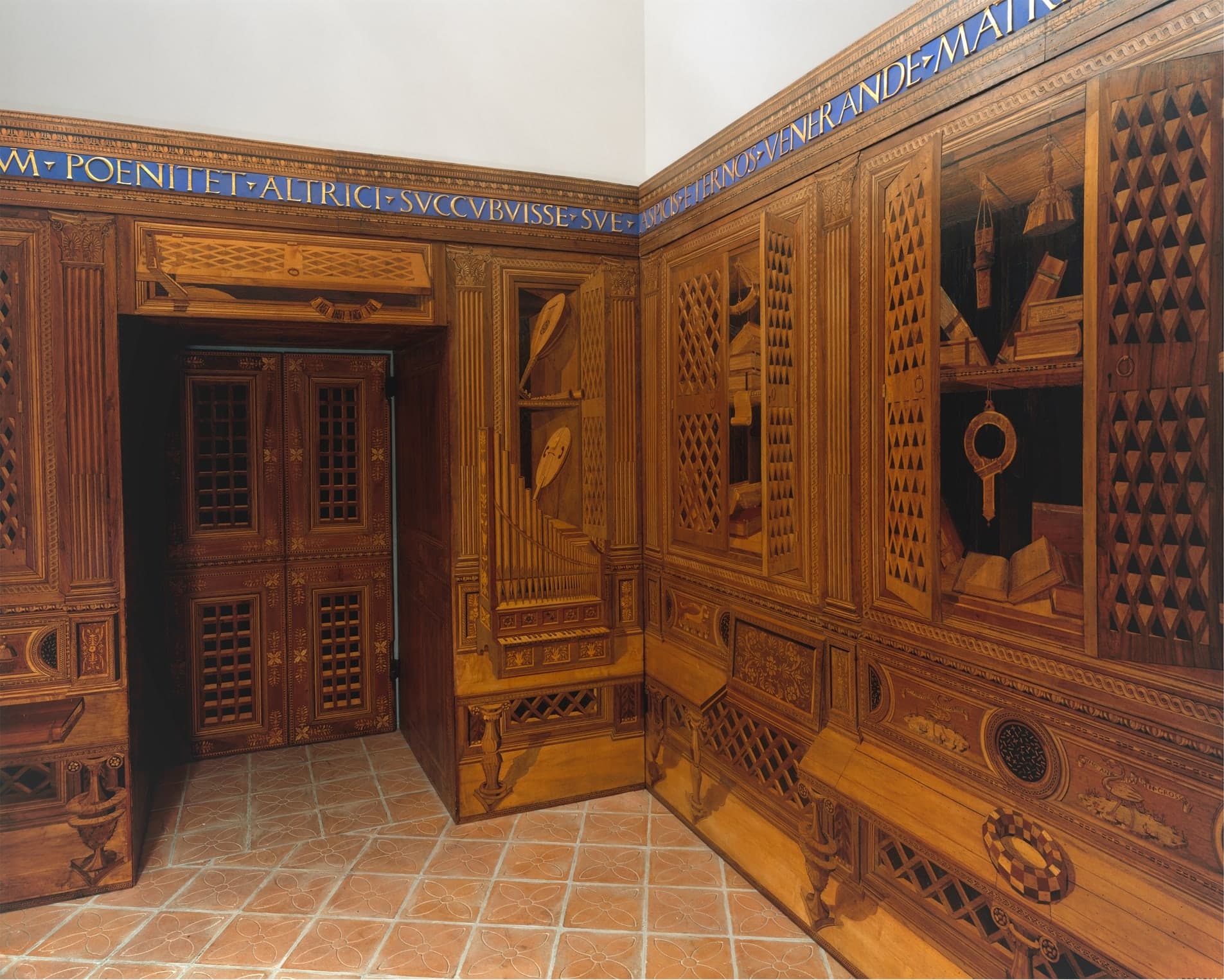
This is not a reconstruction or a replica. It is the actual room, dismantled panel by panel, crated, and reassembled at the Metropolitan Museum of Art.
At a glance
- Date
- 1478
- Material
- Wood
- Creator
- Francesco di Giorgio
- Origin
- Italy
- Museum number
- 39.153
Look closer
No paint, only wood
Every image on these walls is made from pieces of wood veneer cut to shape and fitted together — a technique called intarsia. Different species give different colours: pale woods for highlights, dark ones for shadow. The pictures show books, musical instruments, armour, and architectural elements, all rendered in perspective. The illusion depends on the viewer standing in the centre of the room: move to the side and the geometry flattens.
A room for thinking
A studiolo was a private study, a room for reading, writing, and contemplation. It was small by design, furnished with a desk and perhaps a few shelves, and often decorated to reflect the owner's interests. The intarsia panels here depict objects associated with learning and statecraft: books, scientific instruments, weapons. The room was not for receiving visitors but for withdrawing from them.
Dismantled and moved
The room was taken apart and shipped to the Metropolitan Museum of Art, where it was reassembled. The panels were removed from the palace walls, numbered, packed, and reinstalled in a gallery designed to match the original dimensions. The room you see is not a copy: it is the wood that lined the walls in Italy.
The story
A studiolo was a small, private room for study and reflection, typically located off the main chambers of a palace. This one was commissioned in 1478, and the designer was Francesco di Giorgio, an artist and engineer. The room is now identified with Guidobaldo da Montefeltro.
The walls are lined with intarsia panels — pictures made by cutting thin sheets of wood veneer into shapes and fitting them together like a jigsaw. No paint is used. The colour comes from the wood itself: different species give different tones, from near-white to near-black. The panels depict books, musical instruments, armour, scientific instruments, and architectural elements, all rendered in perspective.
The technique is demanding. Each piece of veneer must be cut precisely and glued to a backing board. The grain of the wood matters: it can suggest texture or direction. The colour matters too, but wood darkens with age, so what you see now is not what was seen in 1478. Some contrasts have faded; others have sharpened.
The perspective in the panels is consistent, designed for a viewer standing in the centre of the room. The images show objects in niches, on shelves, or behind lattice doors, all apparently receding into the wall. Move to the side and the illusion collapses: the geometry no longer resolves.
The room was dismantled and sold. It was acquired by the Metropolitan Museum of Art and reassembled in a gallery. The dimensions of the gallery were made to match the original room, so the panels fit as they did in the palace. The wood, the joinery, and the images are the same. What changed was the building around them.
Why it mattered then
A studiolo was a statement of identity. The objects depicted in the intarsia were not random: they were chosen to reflect the owner's interests and virtues. Books and scientific instruments signalled learning; armour and weapons signalled military command. The room was private, but it was also a carefully constructed image of the self, meant to be understood by those few who were admitted. The intarsia technique itself was a demonstration of skill and expense. It required rare woods, expert craftsmen, and time. The room was a luxury object, but it was also a tool of self-fashioning, embodying the ideal of the scholar-prince, a ruler who was also a man of letters.
Why it matters now
The room raises questions about what it means to preserve a building by moving it. The studiolo is not a replica or a reconstruction: it is the actual wood, the actual panels, reassembled in a different country. But it is no longer in the palace it was made for, no longer adjacent to the rooms it was designed to complement. It sits in a museum gallery, behind a rope, lit by electric lights. Some argue that moving the room saved it from decay or destruction. Others argue that it was removed from its context and that something essential was lost in the transfer. The Metropolitan Museum presents it as a period room, a way of experiencing Renaissance domestic space. But the experience is necessarily partial: the palace, the city, the network of rooms around it are absent. The room also prompts reflection on intarsia as a medium. It is a technique that has largely disappeared, replaced by cheaper methods of decoration. The studiolo is a record of what was possible with wood veneer and patience, and of a moment when such labour was considered worthwhile.
The surprising detail
The room was commissioned in 1478 by Federico da Montefeltro, but it is now identified with his son Guidobaldo. The circumstances of the transfer are not detailed in the surviving records, but the room passed from father to son. The distinction matters less for the object than for the history: the room was made for one prince and came to be associated with another.
How it got here
The studiolo was removed from the Ducal Palace in Gubbio and sold. It was acquired by the Metropolitan Museum of Art and installed there. The removal and sale of architectural elements from Italian palaces was not uncommon during the period when this transfer occurred, when economic pressures and changing attitudes toward historic buildings led to the dispersal of interiors. The legal and ethical standards governing such transfers have since changed, but the studiolo remains at the Metropolitan Museum, where it has been on public display.
Remember this
A Renaissance study, made of wood veneer pictures, dismantled and rebuilt at the Metropolitan Museum — still the same room, but no longer in the same world.
Test yourself
The intarsia panels in the studiolo were designed to be viewed from the centre of the room. What happens to the images when you move to the side, and why does this matter for understanding how the room was used?
The perspective collapses. The images are rendered in linear perspective, with all the sightlines converging on a single viewpoint in the centre of the room. Move to the side and the geometry no longer resolves: shelves that appeared to recede into the wall now look skewed, and the illusion flattens. This matters because it tells you how the room was meant to be inhabited. The studiolo was not a space for pacing or for multiple people. It was designed for one person, standing or sitting in the centre, surrounded by images that only made sense from that position. The perspective was not just a decorative choice: it was a way of structuring the experience of the room, reinforcing its function as a private, contemplative space.
Go deeper
- Studiolo from the Ducal Palace in Gubbio · Wikipedia
- studiolo di Guidobaldo da Montefeltro — Wikidata · Wikidata
Image: Giuliano da Maiano / Francesco di Giorgio, CC0. Licence: CC0. Source.