III · THE WORK · ART HISTORY
The Fortune Teller
▶ Listen · narrated
Two half-length figures, a plain ground, and a ring about to leave a finger: an early Caravaggio built entirely on divided attention.
At a glance
- Artist
- Caravaggio
- Date
- 1594
- Medium
- Oil on canvas
- Dimensions
- 99 × 131 cm (4 ft 4 in)
- Location
- Louvre Museum, Room 712
- Genre
- Genre art
Look closer
Where each person looks
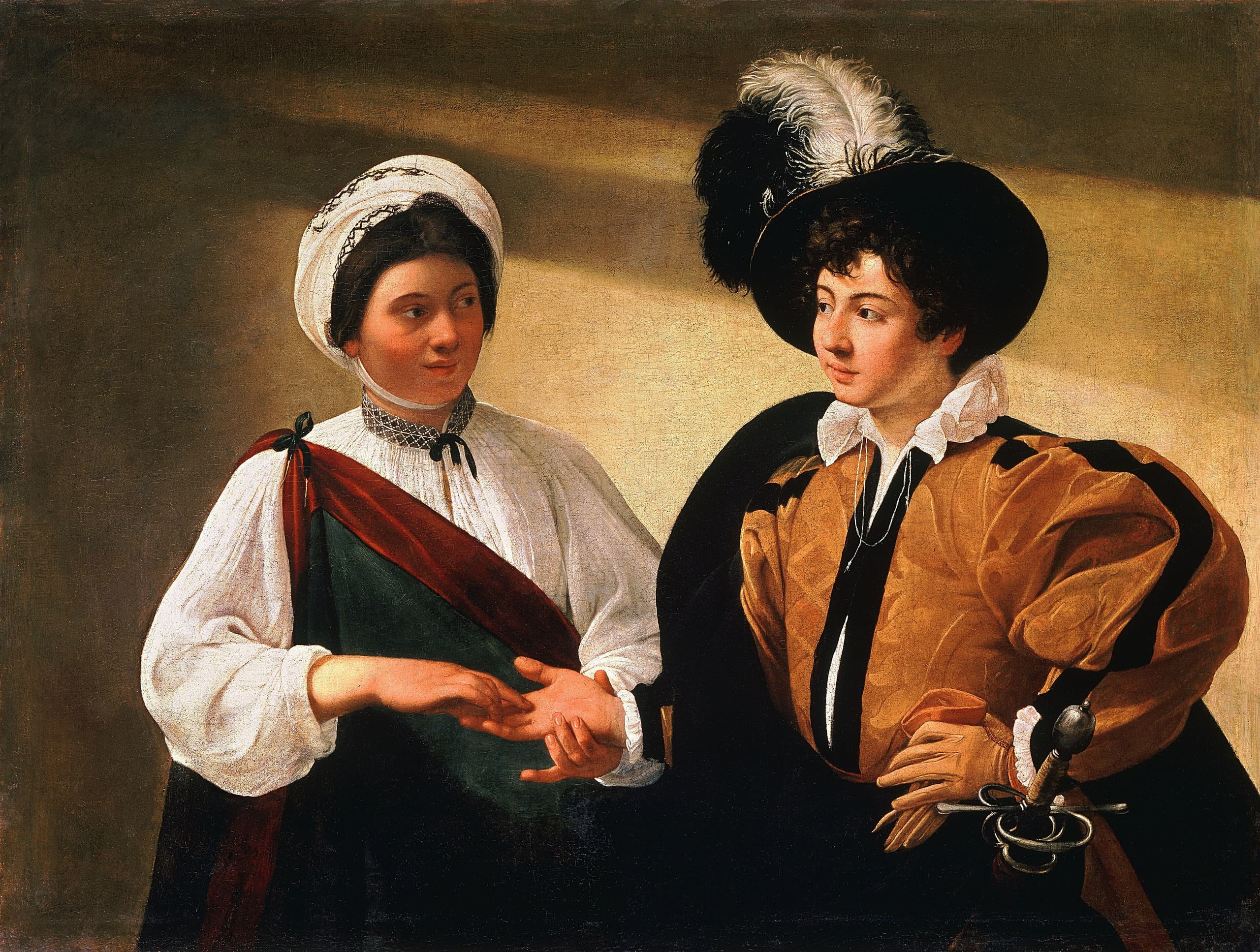
The young man does not watch his own hand. He watches the fortune teller’s face. She, in turn, keeps her eyes on the palm she is reading. The painting is built on that crossed attention: one figure absorbed by expression, the other by the hand. Nothing in the background competes with the exchange. The plain ground throws both heads forward so that the mismatch of gazes is the first structure you read.
The meeting of the hands
The compositional centre is not a face but the knot of hands in the lower middle of the canvas. His right hand is offered open. Her hands close around it in the gesture of palmistry. Look longer and a second action appears inside the first: while one of her hands seems to trace the lines, fingers of the other work at a ring on his finger. The theft is not a side incident. It is folded into the same contact that pretends to tell his future.
Half-length, no room
At ninety-nine centimetres high and one hundred and thirty-one wide, the canvas holds the two figures tightly. There is no deep interior, no street receding behind them, no secondary group at the edge. Costume does the social work instead: his feathered hat, gloves and sword mark a young man of means; she is presented without caricature. Genre art here means ordinary encounter treated at the scale and finish of a serious oil painting, with nowhere for the eye to escape the bargain between them.
The story
The Fortune Teller shows two people at half length against a dark, undescribed ground. A young man in fine clothes holds out his hand. A woman takes it and appears to read the palm. He looks at her; she looks at the hand. That is the whole stage.
What the painting is doing only becomes clear when the hands are read as carefully as the faces. The gesture of fortune-telling and the gesture of theft occupy the same few inches of canvas. As she steadies his hand, she is also easing a ring from his finger. He does not notice because he is busy reading her expression for the future she seems to offer. Caravaggio does not dramatise the crime with a lunge or a glance toward the viewer. He lets it sit inside a civil, almost tender exchange, so that the viewer who misses it at first is put in something like the young man’s position.
The picture is genre art: a scene of contemporary low or street life rather than scripture, myth or court portraiture. In the mid-1590s that choice still carried weight. A large, carefully finished oil on canvas was being asked to hold a subject that older hierarchies would have treated as marginal. Caravaggio answers not by moralising captions or comic distortion but by giving both figures the same light and the same pictorial seriousness. The young man’s dress signals money and a certain vanity; the fortune teller is neither grotesque nor allegorical. They meet as equals inside the frame even as the action quietly disadvantages him.
This is the version in the Louvre, in the Department of Paintings, inventoried as INV 55 and MR 105, and hung in Room 712. It measures ninety-nine centimetres by one hundred and thirty-one. A second version, also by Caravaggio, is in Rome. The Louvre canvas is tied to an inception date of 1594, yet the dating of both pictures has been disputed, and the order in which they were painted is not settled. Wikidata records the work as both a painting and an artwork copy — a useful reminder that a second autograph version is not the same thing as a later imitation by another hand.
Nothing in the surface shouts the later Caravaggio of heavy shadow and violent revelation. The method is already visible, though: figures brought close, narrative carried by hands and glances, empty ground instead of elaborate setting. The painting is less about predicting a fate than about watching someone fail to see what is being done to him.
Why it mattered then
In Rome in the 1590s, oil paintings of serious ambition were still expected to carry sacred, historical or allegorical weight. Genre scenes existed, but to treat a street bargain between a youth and a fortune teller at half-length, with no moral label and no comic frame, was to test what a canvas could be for. Caravaggio’s picture does not tell the viewer what to think of either figure. It stages charm and theft as one continuous action and relies on close looking to finish the meaning. That reliance was itself modern: it assumed an audience willing to read gesture the way it had been trained to read attribute and symbol. The work sits near the start of his public career in Italy, already aligned with Italian Baroque painting’s interest in bodies caught mid-deed, yet still lighter and more open than the tenebrist altarpieces that would follow.
Why it matters now
The Fortune Teller remains legible because its engine is attention, not period costume. One person watches a face; the other watches a hand; the viewer must do both, and often does them in the wrong order. That lag — the moment before the ring is noticed — is still the painting’s real drama. It also offers a clear early statement of habits that later become inseparable from Caravaggio’s name: cropping tight, emptying the background, letting ordinary hands carry the story. For anyone trying to understand how genre art claimed seriousness in European painting, this canvas is a precise, unhurried example rather than a manifesto.
The surprising detail
The image that feels so singular exists twice. Both the Louvre canvas and a version in the Musei Capitolini in Rome are given to Caravaggio himself. The Louvre associates this one with 1594; other accounts shift the pair slightly and disagree on sequence. The same work is catalogued as painting and as artwork copy, which here points less to derivate status than to the unsettled relationship between two autograph versions. The picture of a unique encounter is, in the record, a double.
What is disputed
The dates of both versions of The Fortune Teller are disputed. The Louvre records this canvas with an inception of 1594; other accounts place the Roman version around that year and the Louvre picture slightly later. Which version came first, and how far one revises the other, has not been settled.
Remember this
The fortune is the distraction. The subject is the ring leaving the finger while the young man watches the wrong thing.
Test yourself
Why does it matter that the theft happens inside the palm-reading gesture, rather than as a separate action at the edge of the frame?
Because the painting then turns on simultaneous attention, not sequence. The hands that seem to offer knowledge are the same hands taking property. The young man’s mistake is not simple distraction; he is trusting the very contact that harms him. A viewer who reads the faces first and the ring late is drawn into a related error — which is why the composition centres the hands and keeps the ground empty.
Go deeper
Image: Masur, Public domain. Licence: Public domain. Source.