III · THE WORK · ART HISTORY
Madame X (Virginie Amélie Avegno Gautreau)
▶ Listen · narrated
A woman in profile, pale against darkness, wearing a dress cut to reveal as much as it conceals. The painting was meant to be daring. The question is why it worked too well.
At a glance
- Artist
- John Singer Sargent
- Date
- 1884
- Medium
- Oil on canvas
- Dimensions
- 243.2 × 143.8 cm
- Collection
- Metropolitan Museum of Art
Look closer
The strap that was repainted
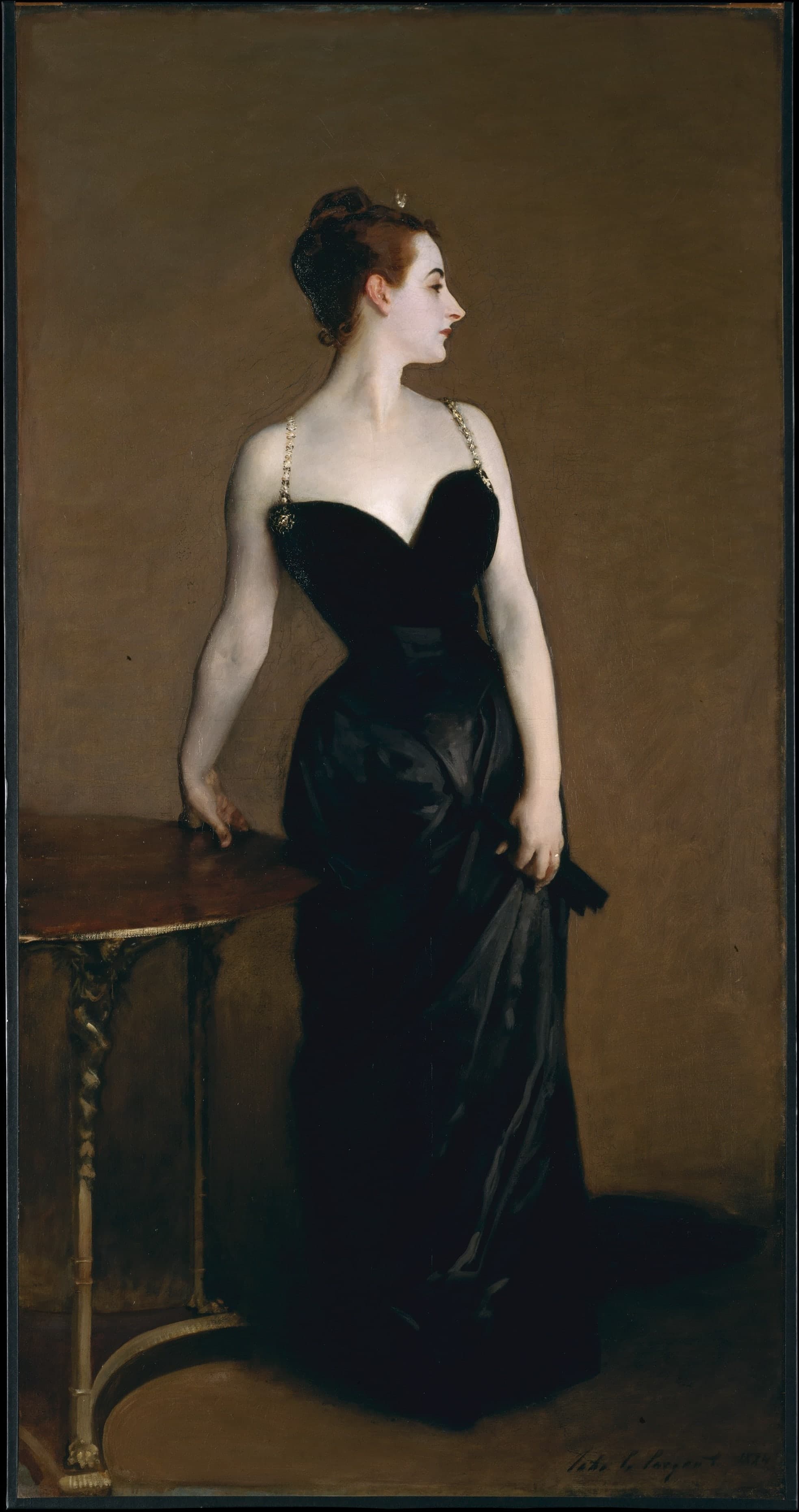
The jewelled strap over her right shoulder now sits securely in place. It was not painted that way. In the version Sargent exhibited at the Paris Salon, the strap had slipped down her arm. After the hostile reception, he repainted it to its current position. The change is small — a few centimetres of fabric — but it was enough that he kept the altered painting in his studio for decades rather than sell it. The dress itself remains cut daringly low at the bodice and back.
The profile and the contrasts
Virginie Gautreau is shown in strict profile, her face turned fully to the right, her body angled away from the viewer. The composition is built on stark contrasts: pale skin against black satin, the figure against a dark background that gives almost no sense of place or depth. Her right arm is bent sharply, hand on hip; her left hangs at her side holding a fan. The pose is rigid, almost sculptural, and the lighting isolates her as if she were an object on display rather than a person in a room.
The absence of a commission
This was not a commissioned portrait. Sargent asked to paint Gautreau, not the other way around. She was known in Paris society for her beauty and her carefully constructed appearance, and Sargent evidently saw her as a subject who could advance his reputation. That reversal of the usual arrangement — the artist pursuing the sitter rather than being hired by her — meant he controlled the composition entirely, and it also meant the financial and reputational risk was his when the painting failed to please.
The story
Virginie Amélie Avegno Gautreau was a socialite, the wife of a French banker, and a figure whose appearance was a deliberate construction. Sargent painted her not because she hired him but because he sought her out. The portrait was made in oil on canvas and completed in 1884. It shows her in profile, standing against a dark background, wearing a long black satin gown with jewelled straps. The dress is cut low across the chest and back. Her skin is rendered in a pale tone that contrasts sharply with the black fabric and the dim surroundings. Her right hand rests on her hip, her left holds a fan, and her posture is stiff, almost frozen.
The painting was shown at the Paris Salon of 1884. The response was hostile. Critics described it as vulgar, over-sexualised, or criticised the extreme contrast between the pale flesh and the dark dress. Part of the scandal centred on a detail: one of the jewelled straps had been painted hanging off her shoulder, not secured in place. That small element — a strap that had slipped — was read as provocative, as though the dress were in the process of being removed or had been carelessly adjusted.
Sargent repainted the strap. He moved it back onto her shoulder, where it now sits in the version held by the Metropolitan Museum of Art. The change did not undo the scandal. The painting had already been seen, and the damage to Sargent's reputation in Paris was done. He did not sell the portrait. He kept it in his studio, and it remained there for decades. It was not until later in his life that he sold it to the Metropolitan Museum, and even then he is recorded as having been reluctant to part with it.
The composition is a study in oppositions. The figure is revealed and concealed at once: the dress exposes the shoulders, arms, chest and back, but the black fabric absorbs light and flattens form. The profile view denies the viewer access to her gaze. The background gives no context, no setting, no sense of a room or a place. She is isolated, lit as if on a stage, and the effect is more like a specimen under examination than a person in a social space. Whether that was Sargent's intention or an unintended consequence of his choices is not recorded.
The painting is now held by the Metropolitan Museum of Art. It has been described as highly regarded within American art collections, though how that regard compares to other works is not specified in the available material. What is clear is that a portrait painted to advance a career instead became a problem, and that the problem was significant enough that Sargent altered the work and kept it out of circulation for years.
Why it mattered then
The scandal surrounding this portrait was not an abstract matter of taste. It was a social event that affected both the sitter and the painter. For Gautreau, the reception was humiliating. She was recognised in the painting despite Sargent having titled it simply as a portrait of Madame X, and the public criticism of the work was understood as criticism of her — of her appearance, her dress, her behaviour. The painting was read as evidence of vanity, impropriety, or both. For Sargent, the response was a professional setback while he was working in France. He had sought out a sitter whose beauty and social position he thought would reflect well on his skill, and instead the work was rejected as tasteless. The decision to repaint the strap suggests he believed the original version had crossed a line, though whether he agreed with that judgment or simply needed to contain the damage is not recorded. The fact that he kept the painting rather than sell it, and that he held onto it for so long, suggests it remained important to him — either as a work he valued despite its reception, or as a reminder of a miscalculation.
Why it matters now
The painting is now regarded differently than it was at the Salon. The scandal that surrounded it has become part of its history, and the repainted strap is treated as evidence of the collision between artistic intention and social expectation. The portrait is studied as an example of how a work can be technically accomplished — the rendering of the satin, the control of the contrasts, the precision of the profile — and still provoke a hostile response because of what it chooses to show or how it chooses to show it. The question it raises is not whether the painting is good, but what it means for a portrait to be too revealing, and who gets to decide. That question has not become irrelevant. The painting also serves as a record of Sargent's early career, before he moved to Britain and America and built the successful practice that followed. It is a work that did not achieve what it was meant to achieve in its own moment, and that fact is now part of what makes it interesting.
The surprising detail
Sargent kept the painting in his studio for decades after repainting the strap. He did not sell it, did not exhibit it again in Paris, and is recorded as having been reluctant to part with it even when he finally sold it to the Metropolitan Museum of Art. That reluctance is striking. The portrait had caused him professional harm, had required him to alter it, and had failed in its purpose of advancing his reputation. Yet he held onto it. Whether that was because he valued the work despite its reception, or because it represented something unresolved, or simply because no one wanted to buy a painting associated with a scandal, is not stated in the available material. What is recorded is that he kept it close for a very long time.
What is disputed
The available material does not specify when Sargent sold the painting to the Metropolitan Museum of Art, only that he kept it in his studio for decades and was reluctant to part with it. The reasons for his reluctance are not documented. The claim that the painting is now regarded as highly significant within American art collections is attributed to the Musée d'Orsay, but the basis for that comparison and whether it reflects a consensus view is not detailed in the sources.
Remember this
A portrait painted to impress became a scandal, was repainted, and then kept by the artist for decades — a success that failed, or a failure he could not let go.
Test yourself
Why might Sargent have repainted the strap but kept the rest of the composition unchanged — the low-cut dress, the stark contrasts, the rigid pose — if he believed the painting had caused offence?
Because the strap was the detail that critics and viewers fixed on as evidence of impropriety — the visible sign that the dress was not secure, that it was slipping, that the scene was somehow in motion toward undress. Repainting it addressed the specific complaint without altering the broader composition, which Sargent may have believed was not the problem. The rest of the painting — the exposed skin, the dramatic contrasts, the stiff, isolated pose — was daring, but it was also controlled and deliberate. The strap, by contrast, introduced an element of accident or carelessness, and that may have been what crossed the line. By securing it, Sargent removed the suggestion of disorder while preserving the composition he had intended. Whether that distinction was meaningful to the critics, or whether the scandal would have occurred regardless, is not recorded. But the fact that he made only that one change suggests he saw it as the element that had misfired, not the painting as a whole.
Go deeper
Image: John Singer Sargent, Public domain. Licence: Public domain. Source.