IV · THE GAME · MAJOR LEAGUE BASEBALL
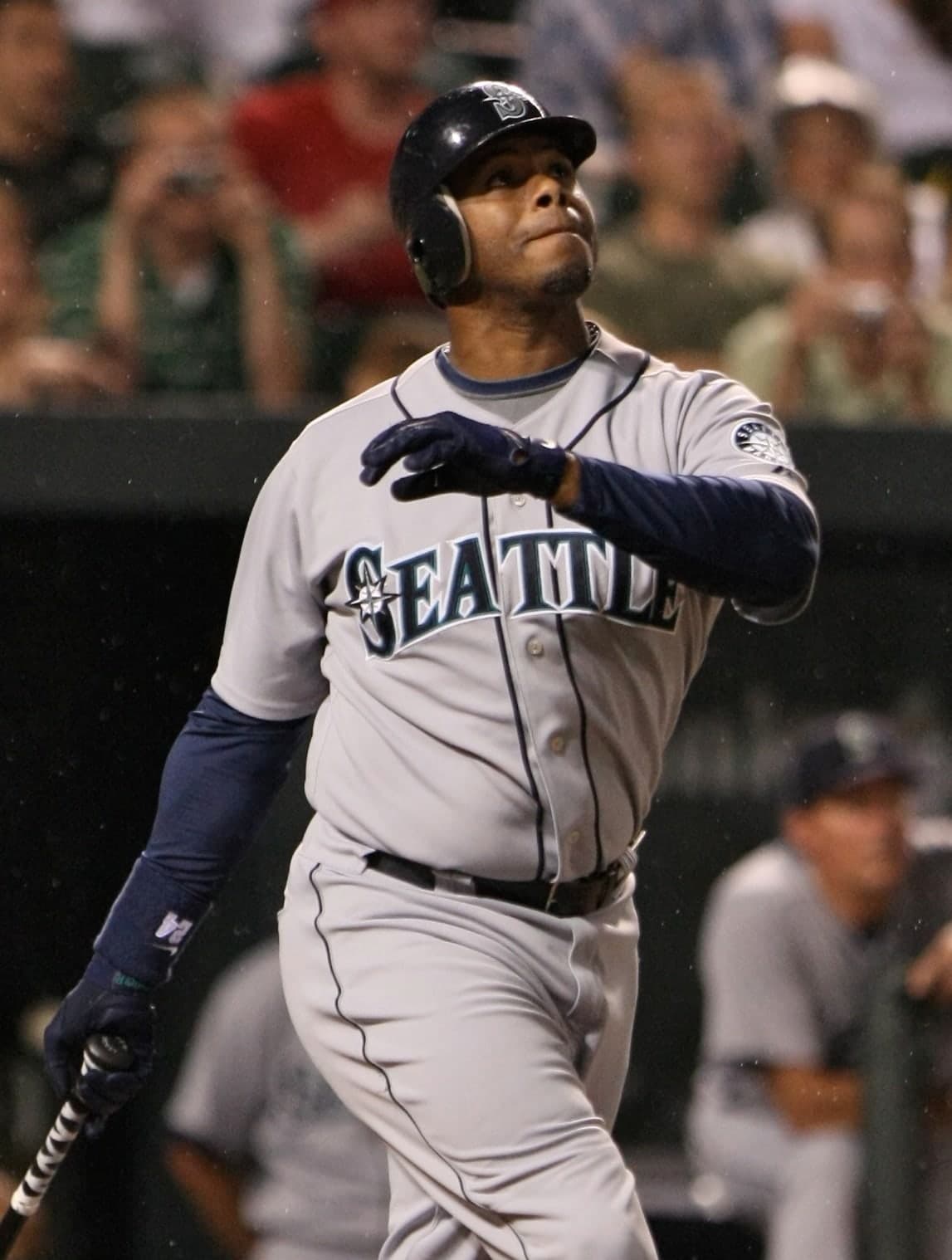
Ken Griffey Jr.
Most careers build slowly. Griffey's moved the other direction: the highest totals came first, and the second half was a series of shortened seasons and smaller numbers.
At a glance
- Career
- 2,671 games · 2,781 hits · 630 home runs · 1,836 runs batted in · .284 average
- Debut
- 3 April 1989, aged 19, at Oakland-Alameda County Coliseum
- Last game
- 31 May 2010, for the Seattle Mariners
- Height and weight
- 6 feet 2 inches · 230 pounds
Look closer
The debut was decided by one run and one inning
On 3 April 1989 Seattle made five hits to Oakland's six, and each side made one error. Oakland scored twice in the third inning and did not score again. Seattle scored once in the fifth and once in the sixth, but never put two runs together in a single inning. The ninth inning shows a dash for Oakland because the home side does not bat when it is already ahead. The game lasted two hours and nineteen minutes in front of 46,163 people.
The highest home-run totals all came in a concentrated span
Between 1993 and 1999 Griffey hit 45, 40, 17, 49, 56, 56 and 48 home runs — every season above forty except the shortened 1995, when he played only 72 games. The 56 in 1997 and the 56 in 1998 are the two highest single-season totals in the table. After 1999 the largest number is 40, in 2000, and most seasons after that are in the twenties or teens. The peak was brief and the descent was long.
Games played fell sharply after the move to Cincinnati
In the Seattle years from 1989 to 1999, Griffey played fewer than 140 games only twice: 127 in his debut year and 72 in 1995. In the Cincinnati years from 2000 to 2008 he played 140 or more only twice: 145 in 2000 and 144 in 2007. The 2001 season was 111 games, 2002 was 70, 2003 was 53. When he returned to Seattle in 2009 he played 117 games, then 33 in 2010 before his last game on 31 May.
The story
On the evening of 3 April 1989 the Seattle Mariners and the Oakland Athletics played in front of 46,163 people at the Oakland-Alameda County Coliseum. Seattle made five hits, Oakland made six, and each side made one error. Oakland scored twice in the third inning and once in the first. Seattle scored once in the fifth and once in the sixth, but never managed two runs in a single inning, and lost 3–2. The game lasted two hours and nineteen minutes. The ninth inning shows a dash for Oakland because the home side does not bat when it is already ahead.
The debut was a loss, but the career that followed was not built on losses. Between 1989 and 1999 Griffey played for Seattle, and in most of those seasons he played more than 140 games. The home-run totals rose quickly: 16 in the debut season, then 22, 22, 27, and then 45 in 1993. The 1994 season was shortened — the whole league stopped in August — but Griffey hit 40 home runs in 111 games. In 1995 he played only 72 games and hit 17. Then came 49 in 1996, 56 in 1997, 56 in 1998, and 48 in 1999. Every season between 1993 and 1999 was above forty home runs except the injury-shortened 1995.
After 1999 the numbers changed shape. In 2000 Griffey moved to the Cincinnati Reds and played 145 games, hitting 40 home runs. That was the last time he hit forty. The 2001 season was 111 games and 22 home runs. The 2002 season was 70 games and 8 home runs. The 2003 season was 53 games and 13 home runs. The games-played column, which had been steady in Seattle, became erratic in Cincinnati. Some seasons were full — 128 games in 2005, 144 in 2007 — but most were not. The home-run totals in Cincinnati ranged from 8 to 35, and the batting average, which had been above .300 in the Seattle years, reached .300 only once more, in 2005.
In 2008 Griffey played 102 games for Cincinnati, then was traded to the Chicago White Sox and played 41 more. In 2009 he returned to Seattle and played 117 games, hitting 19 home runs and batting .214 — the lowest average of any full season in the table. In 2010 he played 33 games, made 18 hits in 98 at-bats, hit no home runs, and played his last game on 31 May. The career lasted twenty-two seasons and covered twenty-two years from debut to last game. The highest totals came early, and the second half was a series of shortened seasons and smaller numbers.
Why it mattered then
A player who hits fifty-six home runs in consecutive seasons is a commercial and sporting presence, and Griffey was both in the late 1990s. The fact that he played in Seattle, a city without a recent winning tradition, made the numbers more visible rather than less: there was no team success to share the attention. The move to Cincinnati in 2000 was news because it was a return — Griffey was born in Pennsylvania but his father had played for Cincinnati, and the son's arrival was framed as a homecoming. The injuries that followed were news for a different reason: they turned a player who had been durable into one who was not, and the question became whether he would play at all, not how well.
Why it matters now
The shape of the career — early peak, long decline — is a useful counterexample to the usual narrative, in which a player improves, sustains, and then falls away. Griffey's highest home-run seasons came before he turned thirty, and the years after that were a negotiation with what remained. The 630 home runs are a large total, but the way they were accumulated — heavily front-loaded, then spread thinly across many partial seasons — makes them harder to compare with careers that followed a different arc. The lesson is that durability and talent are separate things, and a career can contain both a peak and a long aftermath.
The surprising detail
The two fifty-six-home-run seasons, 1997 and 1998, are identical in one other way: Griffey struck out 121 times in each. The home runs per strikeout in those two years are the same to two decimal places. The batting average in 1997 was .304, in 1998 it was .284, so the strikeouts were constant while the hits were not. The 1999 season, with 48 home runs, had 108 strikeouts, a better ratio. The highest strikeout total in the table is not in the fifty-six-home-run years but in 1998, tied with 1997 at 121. After the move to Cincinnati the strikeout totals stayed in the sixties, seventies and eighties, even as the home runs fell.
What is disputed
Every figure here comes from the MLB Stats API. Statistical categories were not all recorded consistently across the twenty-two seasons covered, and the league's published totals are the ones used here rather than anything independently recomputed. The debut game linescore is as the API records it; no box score or play-by-play from that game has been verified against a second source.
Remember this
630 home runs, with the two highest seasons — 56 and 56 — arriving back-to-back before age thirty, and many years of partial seasons after that.
Test yourself
The debut game was decided by a single run. Using only the linescore, what explains why Seattle lost despite making nearly as many hits as Oakland and committing the same number of errors?
Timing. Oakland scored twice in one inning — the third — while Seattle never scored more than once in any inning. Equal hits do not mean equal innings: Oakland's six hits were clustered into three scoring innings (one run in the first, two in the third), while Seattle's five hits produced only two runs across two separate innings (one in the fifth, one in the sixth). A one-run margin is narrow, but Seattle never had the multi-run inning that would have closed it. The errors were equal, so they cancel out as an explanation.
Go deeper
- Ken Griffey Jr. — MLB Stats API player record · MLB Advanced Media
- Ken Griffey Jr. — career hitting totals (MLB Stats API) · MLB Advanced Media
- Debut game linescore — MLB Stats API game 196626 · MLB Advanced Media
- Ken Griffey Jr. — Wikidata · Wikidata
Image: Keith Allison, CC BY-SA 2.0. Licence: CC BY-SA 2.0. Source.