I · THE OBJECT · BRITISH MUSEUM
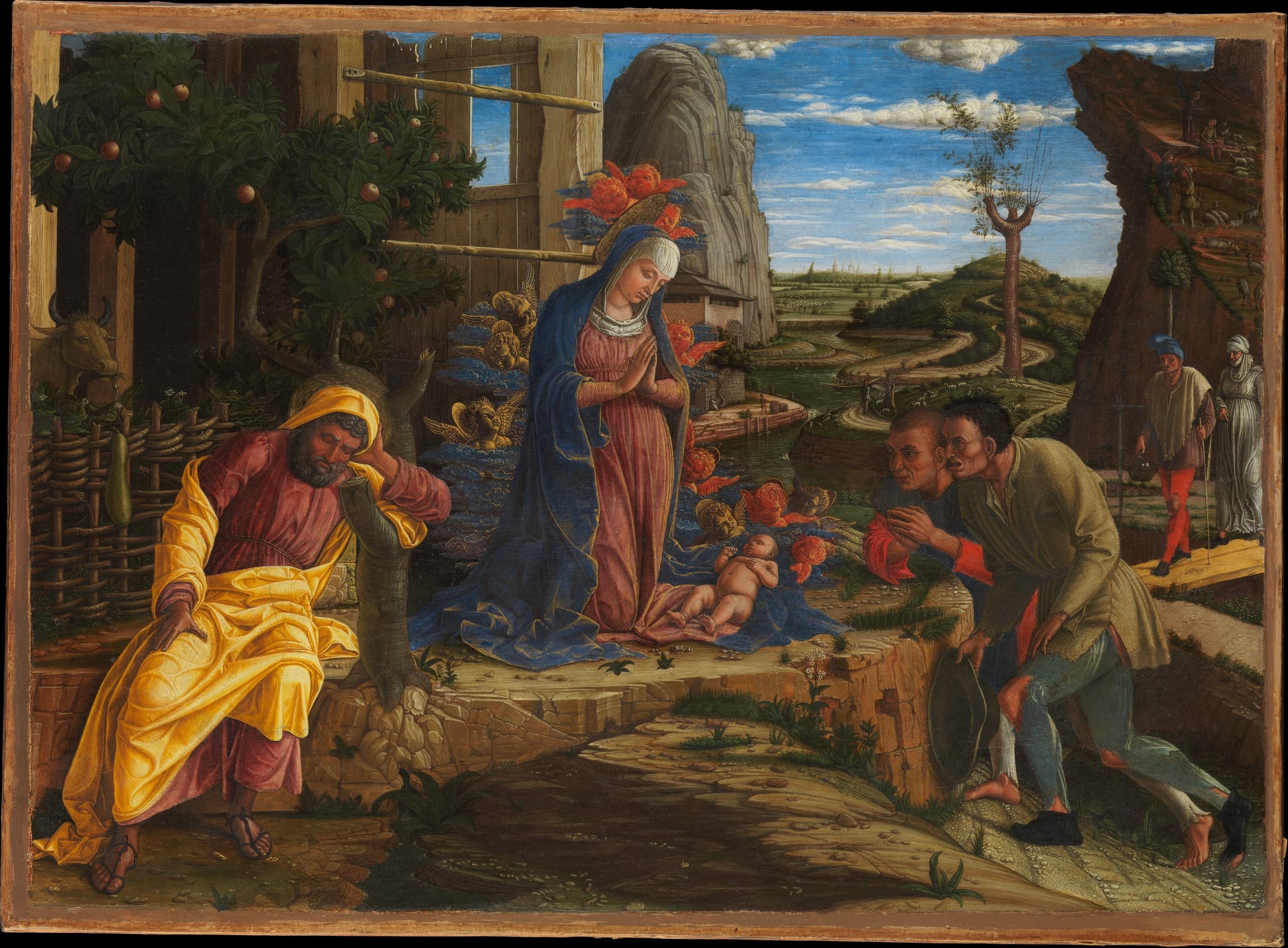
Adoration of the Shepherds
▶ Listen · narrated
At only forty centimetres high, this Adoration by Andrea Mantegna is easy to pass by. Its scale, support and date still repay a slower look.
At a glance
- Date
- 1450
- Artist
- Andrea Mantegna
- Material
- Tempera on canvas
- Dimensions
- 40 × 55.6 cm (1 ft 10 in)
- Inventory
- 32.130.2
- Genre
- Religious art
Look closer
A modest horizontal field
The painting is only forty centimetres high and a little over fifty-five centimetres wide. That landscape proportion suits a crowded sacred scene without giving the figures monumental scale. It is a work meant to be approached closely rather than read from across a chapel.
Tempera on canvas
The support is canvas and the medium tempera. Together they fix the object as a portable painted surface rather than a wall scheme. What survives is the finished image and its physical fact: paint bound in tempera on a woven ground, still legible enough to carry the subject.
A named sacred subject
The title identifies the scene as an Adoration of the Shepherds, a standard theme in religious art. The shepherds arrive to honour the infant Christ. Nothing in the surviving museum record supplied here elaborates the exact grouping, so the subject name, not a free invention of detail, is the sure guide to what the painter was asked to show.
The story
Andrea Mantegna’s Adoration of the Shepherds is a painting dated to 1450 and now in the Metropolitan Museum of Art under the inventory number 32.130.2. It measures forty centimetres in height and 55.6 centimetres (1 ft 10 in) in width. The materials are recorded as tempera on canvas. In genre it belongs to religious art; in subject it treats the Adoration of the Shepherds, the moment when shepherds come to the newborn Christ.
Those plain facts already place the work. It is small enough to hang in a domestic or private devotional setting, or to move between rooms, rather than to dominate a large architectural wall. Canvas, rather than a heavy panel alone, keeps the object comparatively light. Tempera gives a matt, precise surface of a kind widely used in Italian painting of the period. None of this needs a dramatic discovery story to matter: the painting is simply one of the works by which Mantegna’s name is still attached to a specific sacred image.
The museum’s records also list Ferrara among the locations associated with the work, alongside the Metropolitan Museum of Art itself. The supplied facts do not explain that link in detail—whether as a place of making, an early home, or another kind of association—so it is safer to note the connection than to force a narrative onto it. What can be said with confidence is narrower and more useful: a named Renaissance painter; a fixed date of 1450; a religious subject of long Christian currency; and a physical object whose size and materials are fully known.
How the painting was found, in the sense of a single dramatic recovery, is not set out in the facts available here. Its present identity is institutional rather than archaeological. It is catalogued, measured, attributed and kept. That quieter path—from workshop to collection—is still a history. It is how most panel and canvas paintings of the fifteenth century reach a modern public: not by being dug from a wall, but by surviving transfer, sale, gift and cataloguing until a museum number such as 32.130.2 makes them permanently findable.
What the viewer meets, then, is not a lost language waiting for a key, but a compact religious image whose maker, date, medium and dimensions are on record. The interest lies in holding those certainties together: Mantegna’s name, the year 1450, tempera on canvas, the Adoration subject, and a scale that asks for attention at arm’s length.
Why it mattered then
In 1450 an Adoration of the Shepherds was not an obscure choice of subject. It belonged to the established cycle of Christ’s infancy and could serve private devotion as readily as a more public commission. A painting on this scale, in tempera on canvas, fitted a culture in which sacred stories were repeated across many formats—manuscripts, panels, frescoes and smaller portable works—so that the same episode could be owned, given or displayed without the cost of a full chapel scheme. Attaching the work to Andrea Mantegna places it inside a named workshop practice of the Italian Renaissance. The date alone does not prove the original patron or room, and the facts here do not name either. Even so, the combination of a recognised painter, a standard religious genre and a manageable size shows how such images circulated as both piety and craft. They made a biblical moment visible and portable at once.
Why it matters now
The painting still matters because it keeps a specific hand, date and sacred subject tied to a real object rather than to a general idea of “Renaissance art.” Museum visitors encounter Mantegna’s name on labels; this canvas is one of the works that justify that label in physical form. Its inventory number, dimensions and materials allow it to be studied, compared and taught without dissolving into anecdote. It also matters as a reminder of limits. We know the maker, the year, the medium, the size and the genre. We do not, from the facts given here, know the full early provenance or a colourful find story. That restraint is useful. It trains attention on what the object securely is—an Adoration in tempera on canvas, forty by 55.6 centimetres (1 ft 10 in), by Andrea Mantegna, in the Metropolitan Museum of Art—rather than on stories the record has not supplied.
The surprising detail
For an object so firmly catalogued, the trail behind it is thinner than the neat museum label suggests. The facts fix painter, date, medium, measurements and present collection, and they note Ferrara as well as the Metropolitan Museum of Art, yet they do not spell out how the canvas travelled or what the Ferrara link precisely means. The surprise is not a hidden emblem in the paint, but how much of a famous painter’s small religious work can remain administratively clear and biographically incomplete at the same time.
What is disputed
The inception is given as 1450; related accounts sometimes treat the date as approximate (around 1450–1451). Ferrara appears among the listed locations beside the Metropolitan Museum of Art, but the supplied facts do not explain whether that marks origin, early ownership or another association. A detailed find narrative and full provenance are not included in the verified record used here, so they are omitted rather than guessed.
Remember this
A forty-centimetre Adoration in tempera on canvas, dated 1450 and given to Andrea Mantegna—small in scale, clear in subject, and still defined as much by its museum facts as by any lost early story.
Test yourself
The painting’s height, medium and subject are all securely recorded. Why is that combination more useful for understanding the work than a single striking anecdote about its discovery would be?
Because height, medium and subject fix what kind of object it is: a small, portable piece of religious art in tempera on canvas, treating the Adoration of the Shepherds. Those facts constrain how it could have been used and seen, even when the early find-story or full provenance is missing. An anecdote without that physical and subject frame floats free; the frame without the anecdote still lets you place the painting in workshop practice, devotion and museum study. Secure description is not the enemy of interest—it is what keeps interest honest.
Go deeper
Image: Andrea Mantegna, Public domain. Licence: Public domain. Source.