III · THE WORK · ART HISTORY
David with the Head of Goliath
▶ Listen · narrated
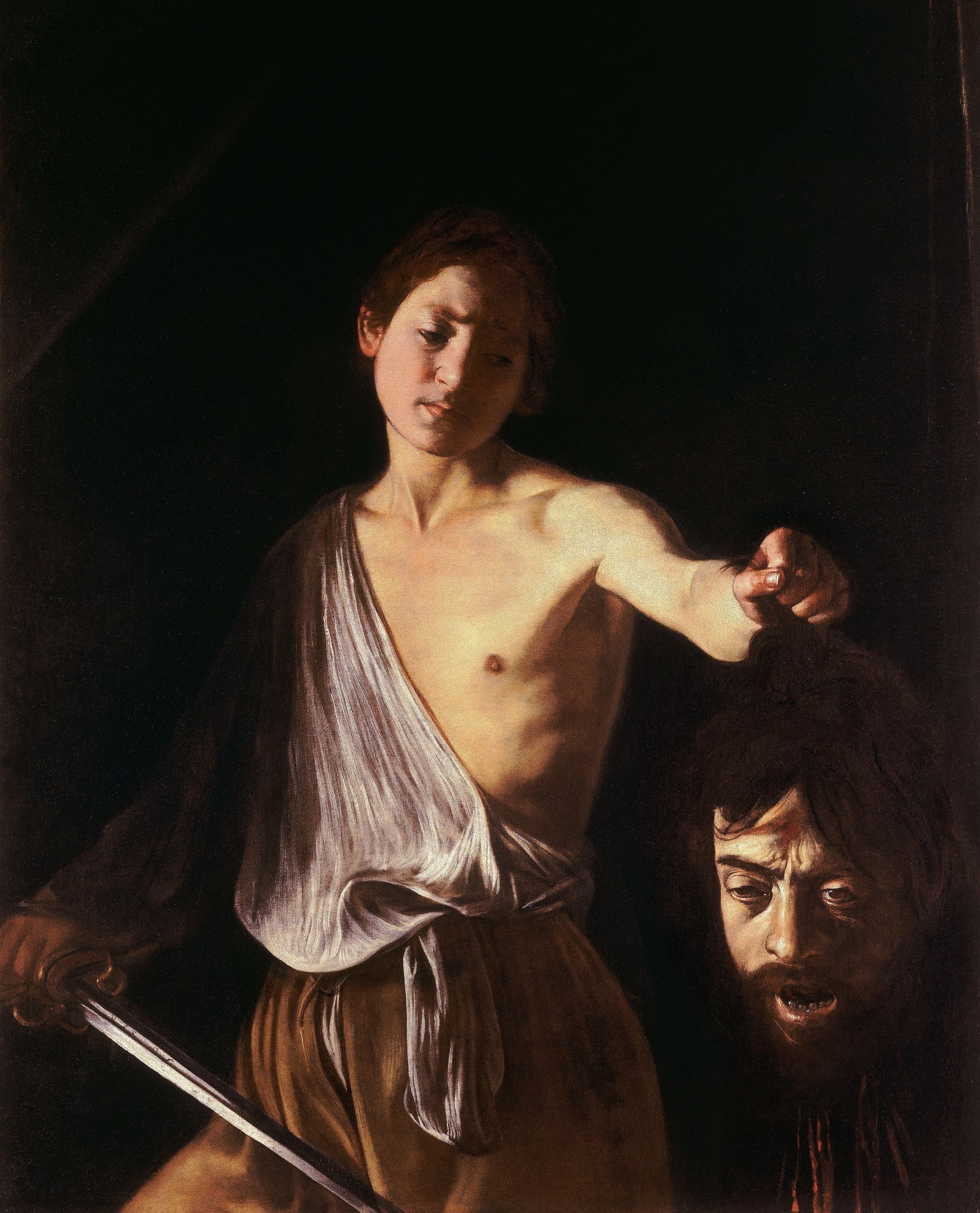
Caravaggio gave Goliath his own features and left David looking stricken rather than jubilant. A familiar conquest becomes an unquiet exchange of glances across the canvas.
At a glance
- Artist
- Caravaggio
- Date
- 1605
- Medium
- Oil on canvas
- Dimensions
- 125 × 101 cm (3 ft 4 in)
- Collection
- Galleria Borghese, Rome
- Inventory
- 455
Look closer
David’s face, not his sword
The youth’s expression is the painting’s true subject. He looks down at the head he holds with a mixture of sadness and compassion rather than pride. The body is turned slightly away; the gaze is not. Caravaggio has made the victor the quieter of the two faces, and the quieter one the harder to read.
The head that looks back
Goliath’s head hangs by the hair from David’s left hand, mouth slack, eyes still half-open. Blood trails from the neck. The features have long been recognised as Caravaggio’s own. The genre listing of the work as a self-portrait rests on this identification: the giant is the painter, and the painter is the dead man.
Letters on the blade
On the sword in David’s right hand runs an abbreviated inscription, H-AS OS. It has been read as a contraction of the Latin humilitas occidit superbiam — humility kills pride. The letters are easy to miss in the dark; once noticed, they fix a moral claim onto a scene that otherwise withholds moral certainty.
The story
The canvas is not large — a little over a metre high — and almost all of it is dark. Out of that darkness come two faces and a length of steel. A young man stands in three-quarter view, bare-shouldered, holding a sword in one hand and, by a fistful of hair, the severed head of Goliath in the other. Light falls hard on the boy’s chest, forearm and brow, and on the slack features of the head. Everything else — the ground, the space behind him, the upper air of the picture — is swallowed in shadow.
What the painting refuses is the usual end of the story. David does not raise the head aloft. He does not look out at us in triumph. His mouth is soft; his eyes are lowered toward the face he has just extinguished. The head, by contrast, still seems almost alive. The eyes are not fully closed. Blood has not finished dripping from the neck. Caravaggio has staged the instant after the act, when victory has already happened and meaning has not yet settled.
The head is his own. That identification is old enough, and widely enough accepted, for the work to be classed not only as religious art but as a self-portrait. Caravaggio has painted himself as the giant brought low. The model for David is less certain. One early phrase, il suo Caravaggino — his own little Caravaggio — has been taken to point toward the studio assistant Cecco del Caravaggio, who worked with him in Rome some years before. No independent portrait of Cecco survives to confirm it. Another reading, drawing on a later portrait of Caravaggio by Ottavio Leoni, treats the pair as a double self-portrait: the younger self holding the ruined head of the older. Both accounts remain speculative. What is not speculative is the effect. The bond between the two faces is intimate and unresolved. David is moved by what he has done; Goliath is the painter. The picture will not let those two facts sit apart.
The sword adds a third voice. Along the blade runs the abbreviated Latin H-AS OS, generally interpreted as humilitas occidit superbiam — humility kills pride. If that reading is right, the inscription supplies the orthodox moral of the David story at the very moment the faces complicate it. Humility may have killed pride, but the boy who did the killing does not look humble so much as stricken, and the prideful head still stares.
The work belongs to the Borghese Collection and hangs in the Galleria Borghese in Rome. It was already recorded there by the mid-seventeenth century. According to the biographer Bellori, Cardinal Scipione Borghese had commissioned a David from Caravaggio; later inventories speak of more than one treatment of the subject in the collection. Whether this canvas was painted as a gift, a plea, or a straightforward commission is a matter of interpretation rather than document. What the surface itself shows is clearer: a religious subject turned into a private reckoning, painted in oil on canvas, 125 centimetres (4 ft 1 in) high and 101 wide, in which the conqueror and the conquered will not release each other.
Why it mattered then
In early seventeenth-century Rome the story of David and Goliath was standard sacred material — good over evil, the humble over the proud, Christ over Satan in the long allegory of the type. Painters were expected to deliver that clarity. Caravaggio’s version keeps the iconography and unsettles the tone. By casting himself as Goliath and giving David an expression of sadness rather than jubilation, he folded personal circumstance into a public subject without abandoning the subject. If the painting was destined for Scipione Borghese, the cardinal who held real power over pardons and preferment, that choice of role would have been legible as more than a clever conceit. Even without that biographical frame, the work sits squarely inside Italian Baroque painting’s appetite for drama held in a single charged instant: not the swing of the sling, but the silence after the head is off.
Why it matters now
The painting still works because it will not resolve the feeling it creates. Viewers come for a Bible story and find two faces locked in an unequal intimacy — one living and sorry, one dead and still almost present. The self-portrait as the vanquished figure continues to unsettle easy talk about artists’ egos; here the painter puts his own likeness on the losing side and leaves it hanging. Debates over who modelled for David, what the sword letters mean, and whether the canvas was a plea for mercy keep the work open without needing to settle it. Close looking remains enough: the lowered eyes, the trailing blood, the dark that eats the rest of the room.
The surprising detail
Caravaggio painted this subject more than once — versions are known in Vienna and Madrid as well as Rome — but only here is the giant so securely read as the painter himself. The Rome canvas is also the one that pairs that self-likeness with a David who looks grieved rather than cold. A near-contemporary parallel, Cristofano Allori’s Judith with the head of Holofernes, shows the painter as the victim too; Allori’s Judith, however, is aloof. Caravaggio’s David is not. The difference is small on the wall and large in effect: one picture flatters the killer, the other binds killer and killed together.
What is disputed
The date is given as 1605 in the museum data, but scholarly opinion has ranged as late as 1609–1610; more recent writers tend toward the earlier year. The model for David is not securely identified: the old phrase il suo Caravaggino may point to Cecco del Caravaggio, or the pair may be a double self-portrait; neither reading can be verified by independent likenesses. The interpretation of the sword inscription as humilitas occidit superbiam is widely accepted but remains an expansion of abbreviated letters. Claims that the painting was a personal plea to Cardinal Scipione Borghese for a pardon are plausible in context and not documented as fact.
Remember this
Caravaggio cast himself as the dead Goliath and gave the living David a face full of regret, so that a story of victory reads as an unsettled bond between two heads.
Test yourself
The painting keeps the traditional David-and-Goliath subject but withholds the usual triumph. Which single choice in the composition does most to create that withholding — and why does it matter more than the blood or the darkness?
David’s expression and downward gaze. Blood and shadow supply drama; they do not supply feeling. By making the victor look sad and compassionate rather than exultant, Caravaggio turns the moral of the story inward. The head may be the painter’s self-portrait, and the sword may preach humility, but it is the boy’s face that stops the scene from becoming a simple win. Without that expression the self-portrait would be a macabre joke; with it, the two faces remain bound to each other.
Go deeper
- David with the Head of Goliath (Caravaggio, Rome) · Wikipedia
- David with the Head of Goliath — Wikidata · Wikidata
Image: Caravaggio, Public domain. Licence: Public domain. Source.