III · THE WORK · ART HISTORY
Portrait of a Young Girl
▶ Listen · narrated
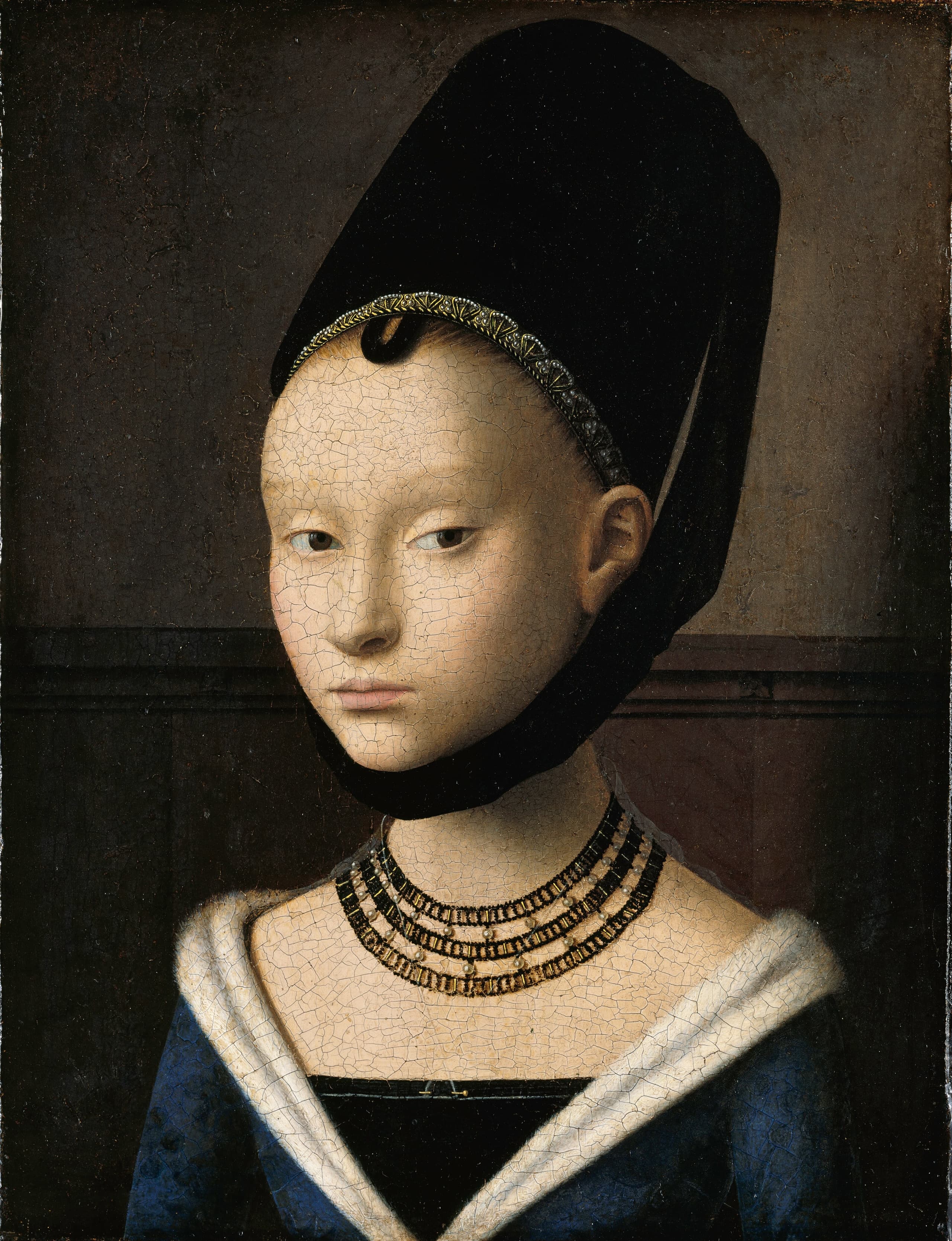
Petrus Christus painted a girl who seems to occupy real air. The panel is tiny, the room is quiet, and the exchange with the viewer does most of the work.
At a glance
- Artist
- Petrus Christus
- Date
- 1470
- Medium
- Oil paint on oak panel
- Dimensions
- 29 × 22.5 cm (9 in)
- Collection
- Gemäldegalerie Berlin
- Movement
- Early Netherlandish painting
Look closer
The returned look
The sitter faces us almost squarely and holds the gaze without softening it into a smile. The expression reads as reserved rather than open, yet the eyes stay active. A slight misalignment between them, and eyebrows that do not sit quite evenly, keep the face from settling into a single mood. The effect is not theatrical. It is the steady attention of someone who has noticed that she is being looked at.
Air around a figure
Instead of a flat or patterned ground, the girl is set in a shallow interior that recedes just far enough to feel continuous. Light and shadow model her head and shoulders as volumes in space. The room does not narrate a story; it simply refuses to collapse into decoration. That small claim — that a portrait sitter can occupy believable air — is one of the panel’s clearest departures from earlier, tighter conventions.
A hand-sized stage
At twenty-nine centimetres high and a little over twenty-two wide, the oak panel is intimate even by portrait standards of its period. Everything in the composition is scaled to close viewing: the modelling of the face, the quiet of the surrounding space, the precision of the oil surface. The painting does not project across a hall. It waits for a viewer who has already come near.
The story
Portrait of a Young Girl is a small oil painting on oak, made by the Early Netherlandish painter Petrus Christus and dated to 1470. It belongs to the Gemäldegalerie in Berlin, where it is recorded under inventory number 532. Nothing in the verified record names the sitter. What the panel offers instead is a face, a shallow room, and a direct exchange of looks.
Christus worked in a tradition already reshaped by Jan van Eyck and Rogier van der Weyden. Oil on panel had become a medium capable of fine tonal transitions and a convincing sense of light falling across skin and cloth. Portraiture in the Low Countries had grown steadily more attentive to likeness and to the social presence of the person shown. This panel takes those habits and presses them a step further. The girl is not pressed against a flat ground or sealed inside a dark niche. She sits in an airy, three-dimensional setting that feels continuous with the space in front of the picture. The room is restrained — no busy furnishings, no emblematic clutter — but it is enough to make her a body in air rather than a head against a screen.
The composition is frontal without being rigid. Shoulders turn just enough to avoid stiffness; the head meets the viewer more squarely. Light models the planes of the face so that cheek, brow and jaw read as rounded forms. The expression is complicated in a quiet way: reserved, intelligent, alert. It does not advertise emotion. It holds still and lets the slight irregularities of the features do the work — eyes that do not align perfectly, eyebrows faintly skewed. Those small asymmetries keep the likeness from hardening into an ideal type. They also make the stare harder to dismiss. She seems to be thinking while she looks.
Scale matters to the whole effect. Twenty-nine by twenty-two and a half centimetres is a format that assumes proximity. The painting was made to be approached, not surveyed from across a room. Up close, the oil surface can carry the soft transitions of flesh and the cooler stillness of the surrounding interior. Distance would flatten both. The panel’s ambition is therefore modest in size and exacting in address: it asks for one viewer at a time and returns that attention with interest.
As a work of the later fifteenth century, the portrait sits near the end of Christus’s known career. It shows how thoroughly the lessons of the earlier Netherlandish masters had been absorbed and how freely they could be rearranged. The advance here is less a new trick of perspective than a change in the contract between sitter and spectator. The girl occupies a believable pocket of space, and she treats the person standing before the panel as someone present in it. That is a compositional decision with social weight. A portrait that acknowledges the viewer this directly makes looking feel less like inspection and more like an encounter.
Why it mattered then
In the decades around 1470, Early Netherlandish painters were refining what a portrait could do. Oil on oak allowed slow building of tone and a persuasive sense of light. Christus’s panel belongs to that technical world, but its importance in its own moment lay in how it staged the sitter. Setting a young woman in an open, airy interior rather than against a closed ground changed the terms of likeness. She became a figure in space, not only a face for identification. The painting also shows the continuing pressure of van Eyck and van der Weyden on later workshops: their interest in volume, in quiet detail, and in the dignity of ordinary presence is here carried forward without simple imitation. For patrons and painters alike, such a work demonstrated that a small private portrait could hold psychological charge and spatial conviction at once. It was influential in the years after it was made because it offered a usable model — frontal, alert, spatially believable — for what a modern likeness might look like.
Why it matters now
The panel still works by the same mechanism that made it striking in the fifteenth century: it meets the viewer halfway. In a museum gallery crowded with larger histories, its size forces a change of pace. You have to come close, and once you do, the returned gaze does not let the encounter stay purely art-historical. The slight misalignment of the eyes and the reserved intelligence of the expression remain readable without specialised knowledge. That durability is part of why close looking still matters here. The painting is not a puzzle to decode so much as a carefully built relation between a face, a shallow room, and the person standing in front of the glass. It reminds contemporary viewers that portraiture’s oldest technical problems — how to place a body in air, how to hold attention without theatrics — are also human ones.
The surprising detail
The entire drama fits on a panel smaller than many book pages. At twenty-nine centimetres high, the painting concentrates face, space and returned gaze into a format that can be covered by two hands. The ambition is not miniature decoration; it is full portrait presence at a scale that refuses spectacle. That mismatch between physical modesty and compositional confidence is easy to miss in reproduction, where the image can be enlarged until it feels monumental. In the gallery, the oak support keeps the encounter intimate and slightly asymmetrical: the sitter seems prepared for company, and the room around her is only just large enough to admit it.
What is disputed
Wikidata gives the inception date as 1470; other accounts place the panel more broadly toward the end of Christus’s life, between the mid-1460s and 1470. The sitter is not identified in the verified record. Claims about precise influence on later painters should be treated as art-historical judgement rather than documented fact.
Remember this
A hand-sized oak panel in which Petrus Christus gives a young sitter real air and a look that does not look away.
Test yourself
The sitter’s expression is often described as reserved yet alert. How do the small irregularities of the face — rather than any broad gesture — help produce that effect?
Because the eyes are slightly misaligned and the eyebrows sit a little unevenly, the face never settles into a single, idealised calm. Those minor asymmetries keep the features active. Combined with a frontal pose and a steady gaze, they read as attention rather than blank composure. The reserve comes from the absence of a smile or narrative gesture; the alertness comes from the fact that the face will not quite resolve into perfect symmetry. The viewer is left with the sense of a mind present behind the likeness.
Go deeper
Image: Petrus Christus, Public domain. Licence: Public domain. Source.