III · THE WORK · ART HISTORY
The Second of May 1808
▶ Listen · narrated
Goya witnessed the French occupation of Spain and the popular rebellion it provoked. This painting, made after the war ended, is his record of the day the violence began.
At a glance
- Artist
- Francisco Goya
- Date
- 1814
- Medium
- Oil on canvas
- Dimensions
- 268.5 × 347.5 cm
- Collection
- Museo del Prado
Look closer
The man in white
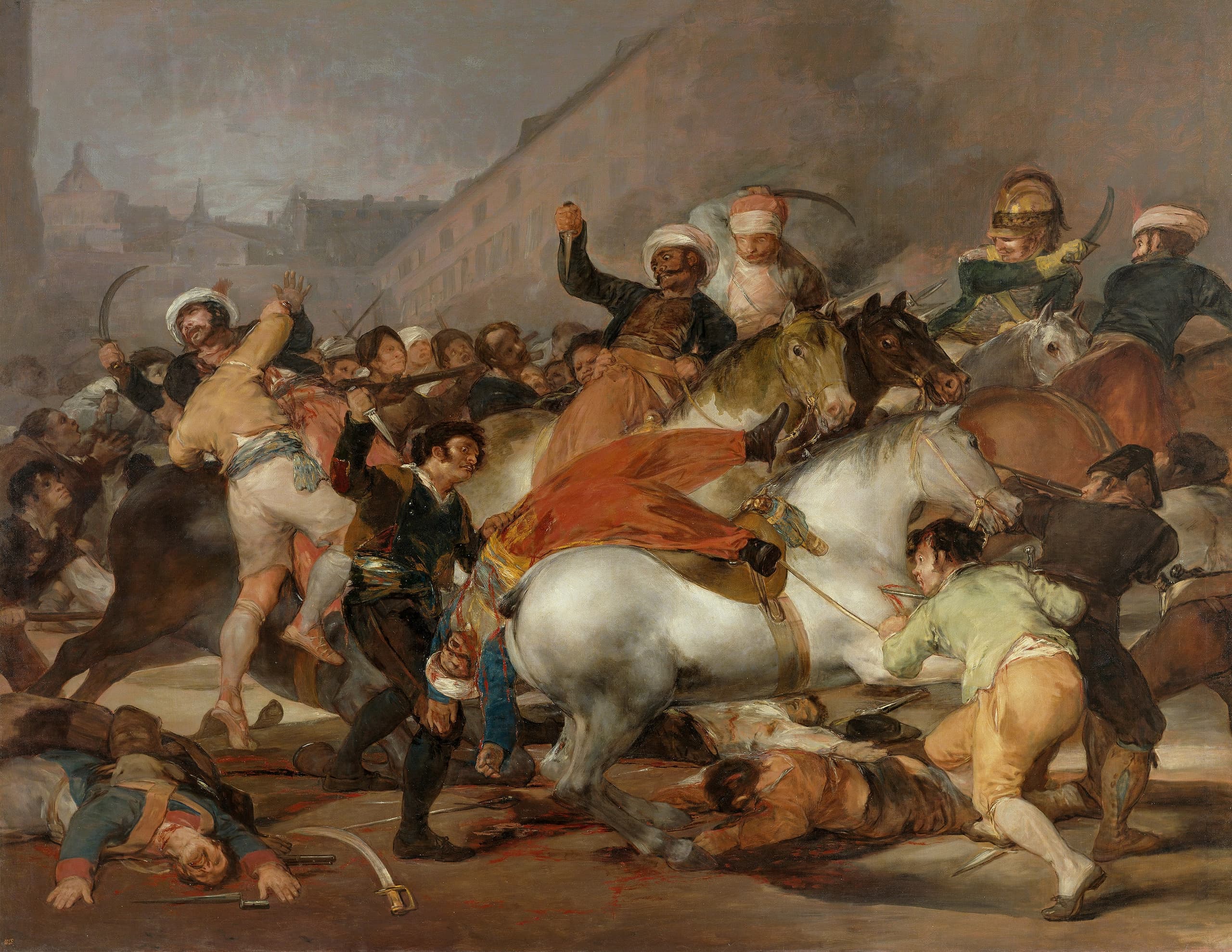
A figure in a white shirt lunges forward at the centre, arms raised, holding a weapon. His posture is diagonal and urgent, his body caught mid-motion. Around him the crowd presses in from all sides, but he is the only figure whose entire upper body is lit and unobstructed. Goya has given him the physical space and the tonal contrast that make him the compositional anchor, though there is no record of who he was or whether he represents a specific person.
The horses' heads
The mounted soldiers ride horses whose heads are turned sharply, mouths open, eyes wide. The animals rear and twist, their necks bent at angles that convey panic rather than control. Goya has painted them as frightened as the people attacking them, which changes what kind of violence the picture describes. The chaos is shared, not directed from above.
The ground plane
Bodies and figures occupy the lower third of the canvas in a compressed, tangled mass. There is no clear ground line and no spatial interval between the figures — they overlap and merge, making it difficult to count them or parse their positions. This crowding is a compositional choice: Goya has collapsed the depth of the street into a shallow, packed zone where the violence has no room to unfold in an orderly way.
The story
Goya painted this in 1814, six years after the event it depicts. The date matters because by then the French occupation had ended, the war was over, and what had seemed like a futile street fight in 1808 could be reframed as the beginning of a national resistance. The painting is not reportage. It is a retrospective claim about what the uprising meant.
The scene is set in a Madrid street. A crowd of civilians attacks mounted soldiers. The soldiers are identified in the painting's alternate title as Mamelukes — cavalry units originally recruited from Egypt who served in the French imperial army. The crowd is armed with knives, sticks, and whatever else was to hand. The composition is a tangle: no clear front or back, no hierarchy of action, no moment of heroism isolated for emphasis. Instead, Goya has painted a dense, compressed scrum in which it is hard to tell who is winning or what will happen next.
The painting was made as a pair with another work, The Third of May 1808, which shows the executions that followed the uprising. The two were completed within a two-month period. Both are now in the Museo del Prado. The pairing is deliberate: the riot and the reprisal, the chaotic violence of the crowd and the organised violence of the state.
Goya witnessed the French occupation. Napoleon had used the pretext of reinforcing his army in Portugal to seize the Spanish throne, placing his brother Joseph in power. Attempts to remove members of the Spanish royal family from Madrid provoked the popular rebellion that occurred between the second and third of May 1808. The uprising was suppressed by forces under Maréchal Joachim Murat.
The painting does not celebrate the uprising in a straightforward way. The violence is mutual and ugly. The horses are as panicked as the people. There is no clear victor in the frame, and no figure stands apart as a leader or a martyr. What Goya has painted is not a heroic tableau but a historical claim: that this day, however chaotic and however brutally it ended, was the start of something that mattered.
Why it mattered then
The painting was made after the war, not during it. That timing is important. In 1808, the uprising was a failure: it was suppressed within a day, and the executions that followed were meant to demonstrate the cost of resistance. By 1814, the French had been driven out, and the question was how to remember what had happened. Goya's painting reframes the street fight as the beginning of the war that eventually succeeded. It makes a claim about causation: that the popular rebellion, however disorganised, was the spark. The pairing with The Third of May 1808 reinforces this. The two paintings together say that the violence of the second and the executions of the third were not separate events but a sequence, and that the meaning of the sequence was not futility but resistance. This was a political argument in 1814, when Spain was negotiating what kind of state it would become after the occupation.
Why it matters now
The painting is studied now as an early example of a history painting that refuses the conventions of the genre. There is no clear hero, no legible moral, no moment of triumph isolated for the viewer to admire. Instead, Goya has painted a kind of violence that is chaotic, mutual, and unresolved within the frame. The picture does not tell you what to feel about it. This approach — painting a historical event as a problem rather than a conclusion — has been influential. The composition's refusal to organise the violence into a hierarchy, and its insistence on showing the horses' panic as well as the crowd's rage, make it a different kind of war painting. It describes the event without tidying it into a narrative that would make it easier to consume.
The surprising detail
The painting's companion, The Third of May 1808, is far better known. The Second of May is less reproduced, less cited, and less often treated as a turning point in the history of painting. Yet Goya made them as a pair, completed them in the same two-month period, and hung them together. The fame of one and the relative obscurity of the other is a curatorial outcome, not an authorial one. What Goya painted was a sequence: riot, then execution. The sequence is the point, and half of it is usually missing from the story.
What is disputed
The painting's alternate title identifies the mounted soldiers as Mamelukes, but the historical record of which units were present in that street on that day is thin. The identification comes from later tradition rather than from a contemporary source that Goya is known to have used. The man in white at the centre is sometimes described as a specific historical figure, but there is no evidence that Goya intended him as a portrait rather than as a compositional anchor.
Remember this
Goya painted this six years after the event, when the war was over and the question was what the uprising had meant, not what it had looked like.
Test yourself
Why does it matter that Goya painted this in 1814 rather than in 1808, and what does the six-year gap change about what the painting is doing?
Because in 1808 the uprising was a failure — it was suppressed in a day, and the French remained in power. By 1814 the French had been driven out and the war was over. The six-year gap means the painting is not a record of an event whose outcome was unknown, but a retrospective claim about what the event meant. Goya is arguing that the chaotic street fight was the beginning of the resistance that eventually succeeded. The painting is not reportage; it is an interpretation made with hindsight, and that changes its function. It is a work of history painting in the sense that it constructs a narrative about causation and consequence, not in the sense that it documents what happened.
Go deeper
Image: Francisco Goya, Public domain. Licence: Public domain. Source.