I · THE OBJECT · BRITISH MUSEUM
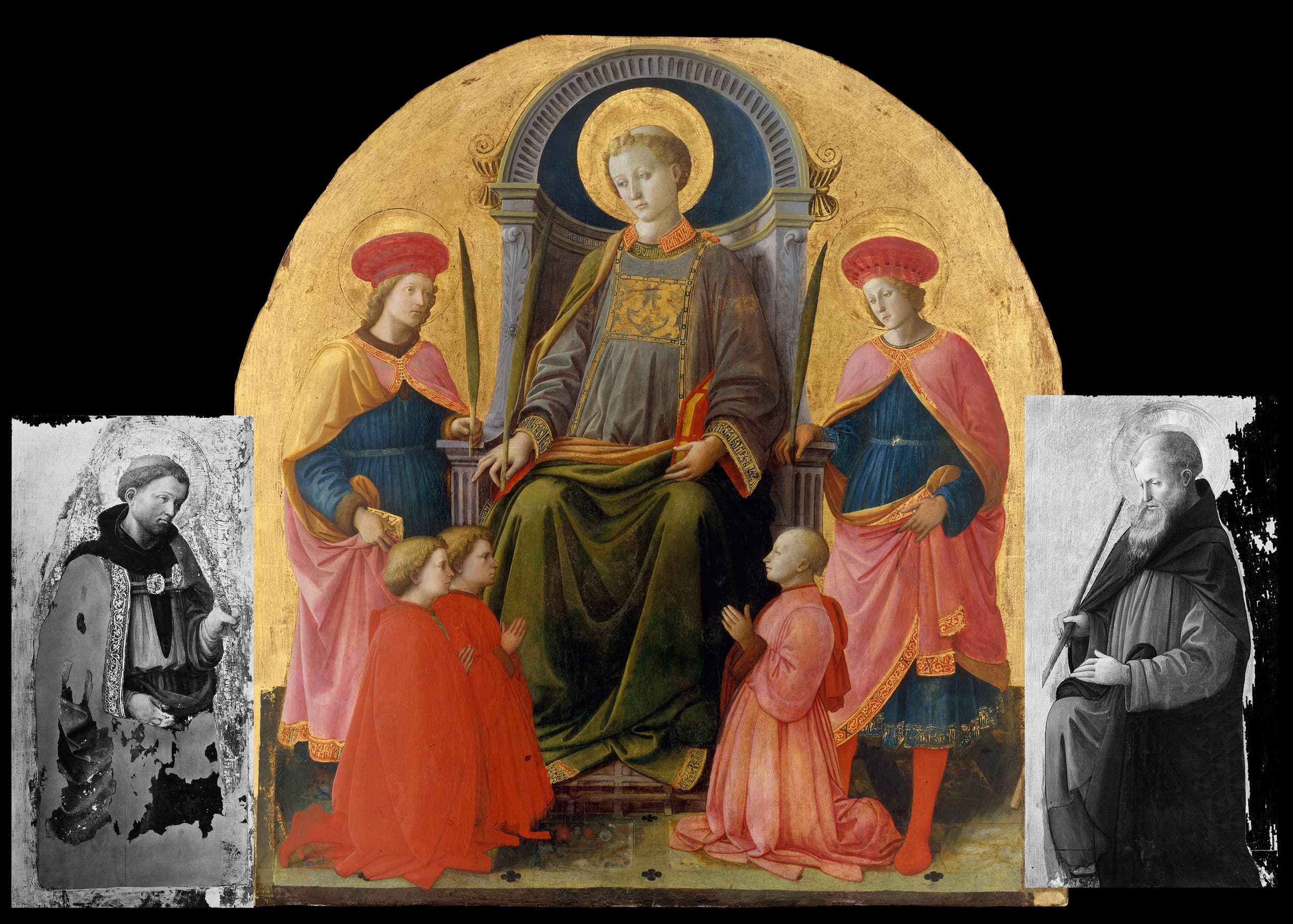
Saint Lawrence Enthroned with Saints and Donors
▶ Listen · narrated
This work rewards slow looking because its title already describes an arrangement of authority, sanctity and human presence, all held within a single painted panel.
At a glance
- Maker
- Filippo Lippi
- Date
- 1453
- Medium
- Tempera on panel
- Size
- 121 × 116 cm (3 ft 10 in)
- Museum
- Metropolitan Museum of Art
Look closer
The enthroned saint
Saint Lawrence occupies the position announced in the title: he is enthroned. A throne is a visible device for ordering the scene. It establishes a centre and asks the viewer to understand the other figures in relation to the seated saint.
Saints beside donors
The title brings saints and donors into the same image. The pairing makes a distinction visible within the gathering: sacred figures occupy the devotional scene, while donors are human participants represented within it.
One object, three parts
The museum inventory number ends in “a–c”, identifying three parts. That detail changes how the panel may be read: the painting is not only an image of a group, but an object whose present physical arrangement is part of its history.
The story
Saint Lawrence Enthroned with Saints and Donors is a religious painting by Filippo Lippi, made in 1453. Tempera was applied to a panel measuring 121 centimetres (4 ft) high and 116 centimetres (3 ft 10 in) wide. It is held by the Metropolitan Museum of Art, where its inventory number is 35.31.1a–c.
Its title offers a useful first map. Saint Lawrence is enthroned, so the composition has a declared focal point. Saints appear with him, and donors also appear in the painting. The image therefore does not present a single holy figure in isolation. It gathers different kinds of presence around an established centre: the saint on the throne, other sacred figures, and the donors named in the title.
That arrangement matters because a religious panel can do several things at once. It can organise devotion around a saint; it can set figures into a hierarchy of position; and it can include the people identified as donors within the image’s sacred setting. Even without treating every detail as a solved historical document, the title makes clear that the painting asks viewers to notice relationships between its figures.
The object is also a panel, rather than merely a scene preserved in reproduction. Its inventory designation records three components, 35.31.1a–c. This is a modest but important reminder that works of art have material histories as well as pictured subjects. The panel’s present form, its medium, and its museum record belong to the way it is encountered now.
The supplied information does not describe the circumstances in which the painting was found, nor does it provide a full account of how it entered the Metropolitan Museum of Art. Those absences are worth keeping in view. A museum location identifies where an object is held; it does not by itself explain every earlier stage of its history.
Why it mattered then
In its own moment, the panel’s stated subject joined devotion with representation. Saint Lawrence’s throne made him the compositional centre, while the accompanying saints and donors placed several kinds of figures within one religious image. That structure could make the image a setting for attention: viewers were directed towards the enthroned saint, yet donors remained visibly present within the sacred assembly. The work’s tempera-on-panel format gave that arrangement a durable physical form.
Why it matters now
The painting still matters because it resists a narrow reading of religious art as an image of saints alone. Its title names donors alongside Saint Lawrence and the other saints, making the human participants part of the work’s subject. It also encourages attention to the artwork as an object. The designation 35.31.1a–c, the panel support, and its present museum location remind us that an image reaches us through a material and institutional history, not outside one.
The surprising detail
The inventory number is not simply a catalogue label. The ending “a–c” identifies the work in three parts. A viewer may first meet a unified devotional scene, while the museum record quietly preserves a more complicated fact about the object’s physical form.
What is disputed
The supplied background describes uncertainty around the dating, although the verified record gives 1453. It also does not provide enough information to establish where the panel was found or reconstruct its full early history.
How it got here
The supplied facts place the painting in the Metropolitan Museum of Art and list Vincigliata as a location. They do not explain how or when it reached the museum, and no ownership dispute or repatriation claim is provided.
Remember this
An enthroned saint gives the panel its centre; saints and donors make that centre a shared, ordered gathering.
Test yourself
Why does the presence of donors change how we might read a painting centred on an enthroned saint?
Because the title identifies donors as part of the pictured gathering, not as people outside it. Their presence means the panel joins sacred figures with human participants. The saint remains the centre, but the image also records a relationship between devotion and those represented within the devotional setting.