III · THE WORK · ART HISTORY
Yazılıkaya
▶ Listen · narrated
Yazılıkaya was carved, not built. The images and the place are the same object, fixed in stone that cannot be moved without destroying them.
At a glance
- Culture
- Hatti
- Date
- 14th century BC
- Method
- Rock relief
- Classification
- Archaeological site; sculpture
Look closer
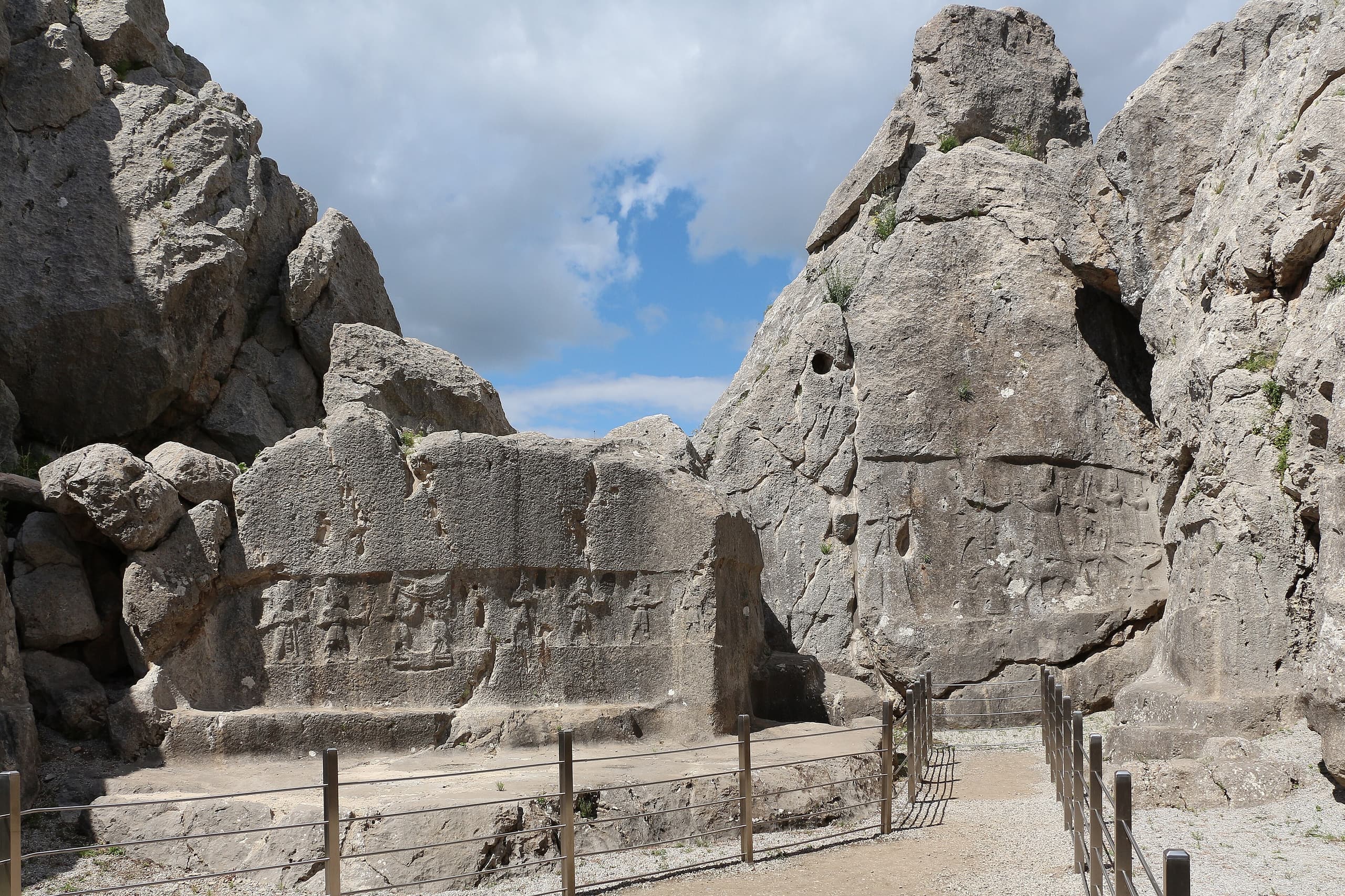
Living rock, not a block
These forms were not cut from quarried stone and set in place. Rock relief means the carvers worked the face of the outcrop itself, lowering backgrounds and leaving figures standing proud of, or flush with, a wall that was already there. The support is geological. Every contour you follow is both a carved decision and a negotiation with cracks, slope and grain that predated the chisel.
Two kinds of object at once
Yazılıkaya is classed as sculpture and as an archaeological site. That is not a soft label but a structural fact of the work. You cannot separate the images from the enclosure that holds them. Composition here includes the ground underfoot and the height of the rock face; the ‘picture plane’ is a place you can still enter.
Registers forced by the wall
The carving is ordered in horizontal zones that climb the stone. An upper register is not only higher in a design; it is physically higher on the cliff. Lower detail sits nearer the floor of the space, where weather and passage have had longer to blunt the cut edges. Hierarchy is built into elevation as much as into scale or pose.
The story
Yazılıkaya does not behave like a panel painting or a freestanding statue. It is rock relief from the fourteenth century BC, made within Hatti culture, and recorded as both sculpture and archaeological site. Those classifications pull in the same direction. The work was subtractive: carvers opened the surface of living stone and left figures and groups fixed in the outcrop that supplied them. Nothing was assembled on a prepared support. The wall was given; the images had to find their order inside it.
That constraint shapes everything available to close looking. Composition is not free arrangement on a blank field. It is a set of decisions about grouping, scale and height made against a rock face whose fractures, recesses and slope already existed. An upper zone of carving is literally higher on the cliff. A focal figure holds not only the centre of a design but a position in a space you can still stand inside. Lower passages of relief sit nearer the floor of the enclosure, where water, abrasion and touch have had longer to work on the cut edges. The hierarchy you read in the image is also a hierarchy of place.
The method matters as much as the arrangement. Rock relief binds image to location with a finality that freestanding stone or painted plaster does not. Once the silhouettes are established in the face of the outcrop, the work cannot travel. To move it would be to destroy the rock that is its body. Yazılıkaya is therefore less an object placed in a landscape than a landscape persuaded into imagery. Looking closely means attending to chisel work and to geology at the same time: to the crispness or wear of a contour, and to the way that contour follows or resists the natural plane.
What the figures represent, and how the enclosure was used, is not settled on the sparse verified record alone. Names, rites and the full cast of the scenes belong to interpretation rather than to the secure facts of date, culture and technique. The making, though, is firm enough. Someone chose to cut into bedrock rather than to build a wall and decorate it. The composition we inherit is inseparable from that choice. The focal figure, the stacked registers and the worn lower detail are not ornaments applied to a sanctuary; they are the sanctuary’s surface, opened and ordered in the fourteenth century BC and left where the stone still stands.
Why it mattered then
In its own moment Yazılıkaya fixed images in a permanent public surface. Rock relief made the carvings part of the place rather than furnishings within it. For a Hatti audience of the fourteenth century BC, that would have meant that whatever hierarchy the registers and the focal figure established was not portable symbolism but a durable feature of the site itself. The work did not illustrate a location; it helped to constitute one. Meaning attached to standing in front of particular stone, at a particular height, before figures that could not be rearranged.
Why it matters now
Yazılıkaya still matters because it refuses the usual separation between artwork and site. Museums can reframe portable sculpture; they cannot reframe this without remainder. The double identity as sculpture and archaeological site is not a cataloguing curiosity but a limit on how the work can be known. Close looking today is still close looking at a rock face: at registers tied to elevation, at a focal figure held by geology as much as by design, at lower detail altered by weather. It is a reminder that some ancient images were never meant to be mobile, and that their composition includes the ground on which the viewer stands.
The surprising detail
The same work is formally both a sculpture and an archaeological site. That is unusual even among rock reliefs, and it follows from the method. Because the images were cut into living stone and left there, the object of study is inseparable from the place. You do not visit a setting that happens to contain carvings; the carvings are a modified outcrop. Classification doubles because the thing itself doubles.
What is disputed
Whom the carved figures represent, and how the enclosure was used, is not settled on the verified facts given here. Date, Hatti culture, rock-relief method and the double classification as sculpture and archaeological site are secure; names, rites and a full iconographic reading are not, and should not be stated as certain.
Remember this
Yazılıkaya is rock relief: fourteenth-century BC Hatti carving in which sculpture and site are the same irreversible object.
Test yourself
Yazılıkaya is classed as both sculpture and archaeological site. Setting aside later interpretation of the figures, what does the rock-relief method itself force on any reading of the composition?
It forces composition and place to be read together. Because the figures were cut into living stone rather than made as movable blocks, height on the wall is real elevation on a cliff, not only a pictorial device; the focal figure occupies a position in an enclosure you can enter; and lower detail sits where weather and passage reach first. The arrangement cannot be fully understood as a design transferable to another support. Any account of hierarchy, grouping or emphasis has to include the geology that still holds the cuts.
Go deeper
Image: Bernard Gagnon, CC BY-SA 3.0. Licence: CC BY-SA 3.0. Source.