I · THE OBJECT · BRITISH MUSEUM
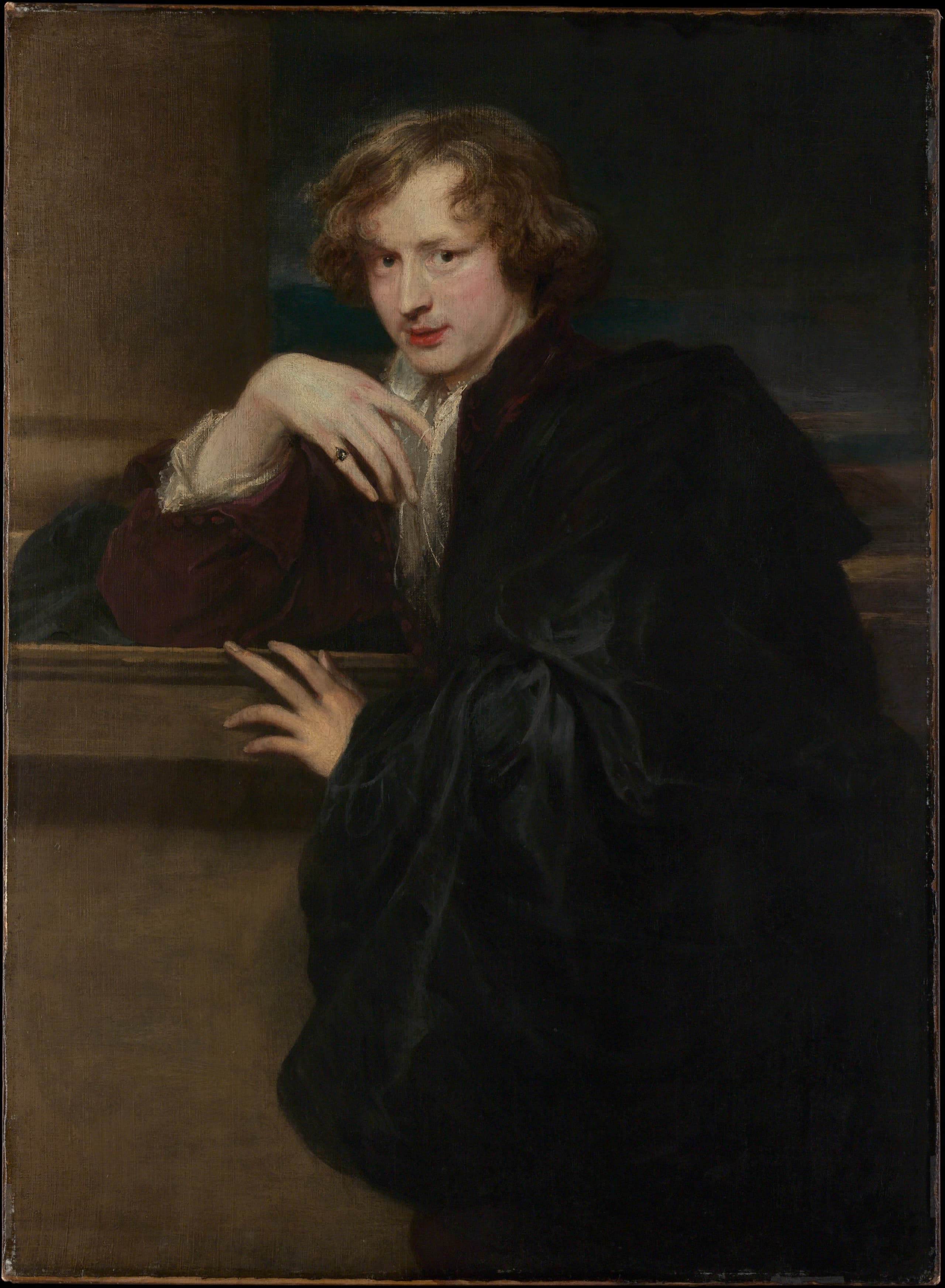
Self-Portrait
▶ Listen · narrated
Self-portraiture is never neutral. In 1620 Anthony van Dyck painted himself in oil on canvas; the work held by the Metropolitan Museum of Art shows why the genre mattered to Baroque painters.
At a glance
- Date
- 1620
- Artist
- Anthony van Dyck
- Material
- Oil paint on canvas
- Dimensions
- 119.7 × 87.9 cm (2 ft 11 in)
- Inventory
- 49.7.25
- Genre
- Self-portrait
Look closer
Self-portrait as the subject
The work is catalogued as a self-portrait: the sitter and the painter are the same person. That choice is not a minor detail of genre. It means the face, the pose, and the finish were decided by the person who had most to gain or lose from how they were read. Nothing in the surviving facts tells us the exact costume or gesture; what they do fix is the claim. Van Dyck presented himself, in oil, as worth looking at on those terms.
Oil on canvas, at a set scale
The support is canvas; the medium is oil paint. The painted surface stands 119.7 centimetres (3 ft 11 in) high and 87.9 centimetres (2 ft 11 in) wide — large enough for a half-length figure to hold a room, small enough to travel and to hang in a private collection. Scale is part of the argument a portrait makes. These measurements place the work between the intimacy of a cabinet picture and the public address of a full-length state likeness.
Filed under Baroque
The painting is classed within the Baroque movement. That label does not, on its own, dictate a single style of brushwork or lighting; it situates the canvas in a period when painters across Europe were testing how far oil paint could carry presence, status, and emotion. A self-portrait from 1620 sits inside that experiment: the artist as both maker and evidence of what the medium could do.
The story
This is a painting: oil on canvas, begun or completed in 1620, by Anthony van Dyck. It is a self-portrait. It belongs to the Metropolitan Museum of Art, where it is held under the inventory number 49.7.25, and its dimensions are recorded as 119.7 centimetres (3 ft 11 in) in height and 87.9 centimetres (2 ft 11 in) in width.
Those facts are spare, and they should stay spare. They already mark out a clear object. A young painter — the reference tradition places him in his early twenties at the date of the work — turned the tools of portraiture on himself rather than on a patron. The result is not a document of a commission in the ordinary sense. It is a claim staked in paint: that the artist’s own likeness was a fit subject for oil, for canvas, and for sustained attention.
Self-portraiture in this period was never only private practice. To paint oneself was to enter a conversation about skill, status, and how far a painter might stand beside the nobles and scholars who usually filled the frame. Van Dyck’s name is attached to the Baroque; the movement label groups him with artists who pushed oil paint toward vivid presence. A self-portrait is one of the sharpest tests of that ambition, because there is no external sitter to share the credit or absorb the failure.
The canvas has more than one place attached to it in the record. Alongside the Metropolitan Museum of Art, Euston Hall appears as a location. That double listing is a reminder that pictures move. They hang in houses, change hands, cross collections, and only later settle into the numbered calm of a museum inventory. The facts supplied here do not narrate each transfer; they do fix where the work is understood to sit now, and under what number.
What remains on the wall is still the same kind of object it was in 1620: a self-likeness in oil, sized for a room, made by the person it shows. The silence around gesture and costume in the bare catalogue is useful. It keeps the attention on what can be stated without invention — who made it, when, in what medium, at what scale, and in which genre — and on why those choices still repay a slow look.
Why it mattered then
In 1620 a self-portrait was a practical and social act as much as a private one. Painters built reputations on likeness; to turn that skill inward was to show, without a named patron in the frame, what the hand could do. Oil on canvas was the standard vehicle for serious portraiture in much of Europe. Working at roughly 120 by 88 centimetres (2 ft 11 in) gave the image enough presence to function as a statement piece while remaining movable. Within the Baroque moment, when artists were pressing paint toward stronger effects of presence and rank, a self-portrait let the maker stand as both proof and author of that skill. The genre also circulated among artists and collectors as evidence of invention, not only of hired labour. Van Dyck’s canvas belongs to that economy of attention.
Why it matters now
The painting still matters because self-portraiture has not become a settled problem. Every generation reopens the question of how much control a maker has over their own image, and how far a likeness can carry authority without a commission behind it. Museum visitors meet this canvas as a finished, numbered object — 49.7.25 — yet it began as a living artist’s decision about face, scale, and medium. That gap between workshop choice and institutional label is part of what keeps early modern self-portraits useful. They show the long history of artists managing their own visibility, in materials that still hang in public rooms and still ask to be read as both person and performance.
The surprising detail
The same object is tied, in the record, to two places at once: the Metropolitan Museum of Art and Euston Hall. Museum and country house sit side by side in the location field, without a full itinerary attached in the facts given here. The inventory number 49.7.25 anchors the canvas at the Met; Euston Hall remains a second fixed point, a reminder that ownership and hanging place are part of a painting’s life, not footnotes to it.
What is disputed
The recorded locations include both the Metropolitan Museum of Art and Euston Hall. The facts supplied here do not explain the sequence or terms of that double association, so any full ownership path would be guesswork and is omitted.
How it got here
The painting is in the collection of the Metropolitan Museum of Art under inventory number 49.7.25. Euston Hall is also listed as a location. No further transfer history is stated in the verified facts, and none is invented here.
Remember this
A 1620 oil self-portrait by Anthony van Dyck: the painter as sitter, canvas as claim, now numbered 49.7.25 at the Metropolitan Museum of Art.
Test yourself
Why is calling this work a self-portrait more than a filing label — what does the genre itself change about how we read the canvas?
Because the sitter and the maker are the same person, every decision about likeness, finish, and scale is also a decision about self-presentation. There is no separate patron in the frame to absorb the meaning. The painting has to carry both the craft of portraiture and the artist’s claim to be a fit subject for that craft. Genre, here, is part of the argument, not only the category on the label.
Go deeper
Image: Anthony van Dyck, Public domain. Licence: Public domain. Source.