III · THE WORK · ART HISTORY
Colonne Vendôme
▶ Listen · narrated
A single column of bronze stands at the heart of Place Vendôme. Built to mark a victory, it has spent as much of its life being argued over as being looked at.
At a glance
- Inception
- 1800
- Material
- Bronze
- Height
- 44.3 metres (145 ft 4 in)
- Type
- Victory column; sculpture
- Genre
- Public art
Look closer
Height as an argument
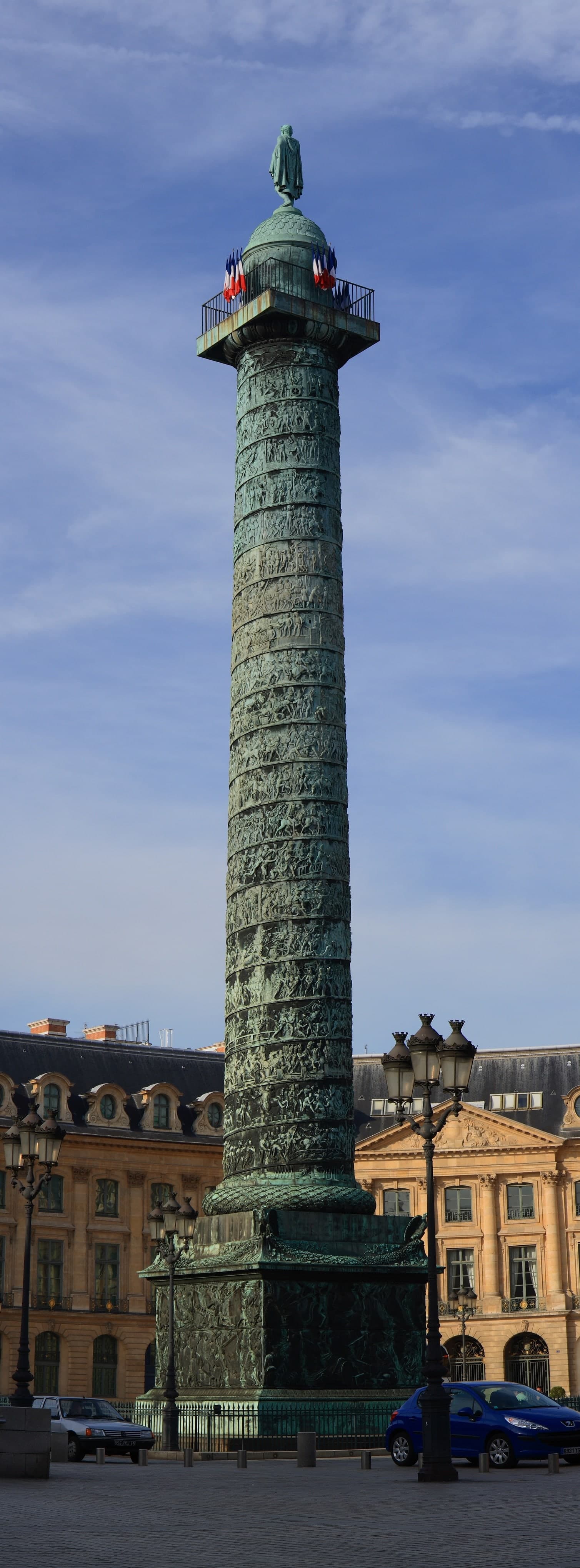
At 44.3 metres (145 ft 4 in) the column clears the continuous façades of Place Vendôme. A victory column works partly by outranking everything around it: the bronze shaft is not only a sculpture but a vertical claim on the skyline of the square, visible from every entrance before any detail of its surface can be read.
Bronze, not stone
The material is bronze for the full height that matters. That choice is heavier, costlier and more deliberate than a stone shaft painted or clad to resemble metal. Public sculpture in bronze announces permanence; later events would test how permanent the claim really was.
The square as a frame
Place Vendôme was laid out so that regular architecture and pedimented screens at the corners give a rectangular plan the aspect of an octagon. The column occupies the centre of that controlled room. Composition here is urban before it is sculptural: one freestanding vertical set inside a measured enclosure of façades.
The story
The Colonne Vendôme is a bronze victory column standing in the middle of Place Vendôme, in the 1st arrondissement of Paris. It is public art in the strict sense: a sculpture made to be approached from all sides, fixed in a square already designed for display, and intended to hold a political meaning in open air rather than in a gallery.
Its inception is recorded as 1800. The height is 44.3 metres (145 ft 4 in). Those two figures alone set the terms of looking. Whatever else the column carries in the way of imagery or inscription, the first fact a walker meets is scale — a single metal shaft rising clear of the surrounding roofs — and the second is that someone paid for bronze at that height in order to make a victory permanent.
The square that holds it has its own history of names and purposes. It was originally the Place Louis-le-Grand, later called the Place Internationale, and is known now as Place Vendôme. Its regular architecture, by Jules Hardouin-Mansart, uses pedimented screens canted across the corners so that a rectangular plan reads almost as an octagon. Into that disciplined enclosure the column was set as the only freestanding vertical accent. The composition of the monument is therefore inseparable from the composition of the square: remove the column and the space changes character; keep the column and every vista is organised around it.
As a type, the victory column borrows an ancient form — the commemorative shaft standing free in a public place — and puts it to modern use. This one was erected by Napoleon I to commemorate the Battle of Austerlitz. The genre is not neutral. A victory column does not ask to be admired as pure form; it asks to be read as evidence that a regime won, and that the win deserved metal and height at the centre of a capital.
Making follows from that ambition. Bronze at 44.3 metres (145 ft 4 in) is a material and logistical decision as much as an aesthetic one. The finished object is both sculpture and urban furniture: heavy, fixed, and impossible to treat as portable decoration. Viewers walk around it. The square’s paving becomes its extended base. Looking closer means noticing how little the shaft explains on its own and how much of its force comes from where it stands and what has been done to it.
On 16 May 1871, by decree of the Paris Commune, the column was torn down. The act was deliberate. The Commune treated the monument as a symbol worth destroying, not as an inert leftover. It was subsequently re-erected and remains a prominent feature on the square. The bronze that occupies the centre today therefore carries at least two public decisions in sequence: the original decision to raise a victory column, and the later decision to put one back after a political demolition. Neither cancels the other in the historical record.
Close looking, in this case, is less about isolating a single carved episode on the surface than about holding form, material, site and afterlife in the same view. The column is still what the facts say it is — bronze, 44.3 metres (145 ft 4 in), a victory column and a work of public sculpture. It is also a object that a city once refused and then restored. That double life is part of what the eye meets when it meets the shaft in Place Vendôme.
Why it mattered then
In its own moment the column was a clear instrument of state memory. Napoleon I needed a durable, highly visible sign of the Battle of Austerlitz, placed in a square already associated with royal and imperial display. A victory column supplied a classical language of triumph; bronze at great height supplied cost, difficulty and the appearance of permanence. The surrounding architecture framed the shaft so that no approach to the square could avoid it. Public art here was not an ornament added after the fact. It was the vertical centre of a carefully composed urban room, meant to fix a military claim in daily sightlines.
Why it matters now
The column still stands on the same spot, and that continuity is why it remains useful to think with. Cities inherit monuments whose original meanings no longer command agreement; the Colonne Vendôme makes the habit visible. It has been raised, attacked, felled and restored. A viewer standing before it now is looking not only at bronze and height but at a sequence of decisions about what may occupy a public square. Arguments elsewhere about the removal or retention of statues often treat such conflicts as new. This column’s nineteenth-century demolition and later return show that the argument is older, and that re-erection itself is a political act rather than a neutral reset.
The surprising detail
The column did not simply weather in place. On 16 May 1871 the Paris Commune ordered it torn down, treating a victory monument as an emblem of the order it opposed. It was later re-erected and still occupies the centre of the square. Few works of public sculpture have a biography that includes official creation, official destruction and official return within a single century. The bronze shaft is therefore as much a record of disagreement as of triumph.
What is disputed
The verified facts fix the work as bronze, 44.3 metres (145 ft 4 in) high, a victory column and public sculpture with an inception of 1800. The demolition of 1871 and later re-erection belong to the documented history of Place Vendôme. Finer points — the exact subject-matter of any reliefs, the original casting process, and how much of the present bronze belongs to the first making — are not established in the material used here and should not be stated as certain.
Remember this
A 44.3-metre bronze victory column, once torn down by the Commune and later re-erected, still holds the centre of Place Vendôme.
Test yourself
The Colonne Vendôme was torn down in 1871 and later put back on the same spot. What does that sequence reveal about public monuments that an undisturbed life on the plinth would not?
That a monument’s meaning is not sealed at the moment of making. Demolition and re-erection are both deliberate public acts. Leaving the column down would have left Place Vendôme as a different kind of political space; putting it back restored the form while adding the memory of its fall. What stands today is therefore not only a victory column from 1800 but evidence that the city once refused that claim and then chose to reinstate the bronze anyway.
Go deeper
Image: Benh LIEU SONG, CC BY-SA 3.0. Licence: CC BY-SA 3.0. Source.