I · THE OBJECT · BRITISH MUSEUM
Esther before Ahasuerus
▶ Listen · narrated
A woman faints before a throne, her life and her people's survival hanging on a king's reaction. Artemisia Gentileschi made that instant monumental.
At a glance
- Artist
- Artemisia Gentileschi
- Date
- 1629
- Material
- Oil paint on canvas
- Dimensions
- 208.3 × 273.7 cm
- Museum number
- 69.281
Look closer
The moment of collapse
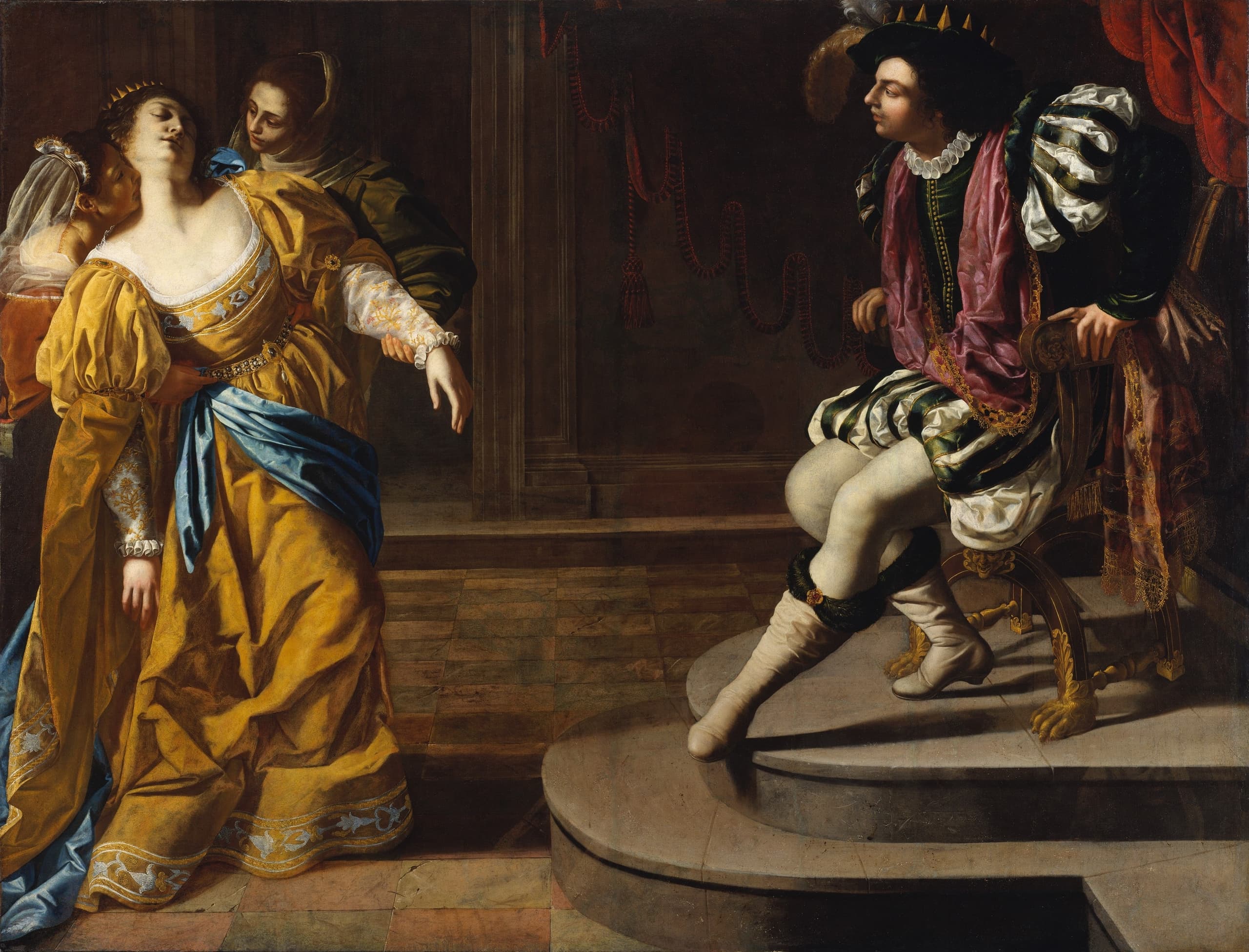
Esther does not stand upright before the king. Her body buckles, supported by two attendants who catch her weight as she faints. One attendant braces her from behind while another reaches across to steady her. The painting captures the instant described in the biblical account when the queen, uninvited and therefore risking execution, enters the king's presence and is overcome. Her physical collapse is the hinge of the scene: the king rises from his throne in response, extending his sceptre — the gesture that spares her life.
Light as structure
The light falls from the left, illuminating Esther's pale dress and the king's robes while leaving much of the background in shadow. This is not even illumination across the canvas. The lit areas guide the eye to the two main figures and create a diagonal movement from Esther's fainting body up toward the king's extended sceptre. The attendants and courtiers occupy darker zones, framing the central action without competing for attention. The contrast organises the narrative: what matters most is brightest.
Scale and ambition
The canvas measures over two metres high and nearly three metres wide. Paintings of this size required substantial commissions and were made for specific settings — a palace room, a chapel, a civic building. The figures are close to life-size, and the composition accommodates multiple characters across a wide format. Who commissioned this work is not recorded, but the scale itself indicates that Gentileschi was working for a patron with space and resources to display a painting of these dimensions.
The story
The painting shows a scene from the biblical story of Esther. Esther, a Jewish woman, has become queen of Persia by marrying the king. When the king's advisor persuades him to issue a decree ordering the killing of all Jews in the kingdom, Esther faces a dilemma. She can intercede, but approaching the king without being summoned is punishable by death unless he extends his sceptre to spare the petitioner. Esther fasts for three days, then enters the throne room uninvited. The text records that she faints in the king's presence. The king rises and extends his sceptre, granting her safety and an audience. She uses that audience to expose the advisor's plot and save her people.
Gentileschi painted the moment of Esther's faint. The queen, dressed in pale fabric that catches the light, collapses into the arms of two attendants. Her body tilts backward, her weight supported. The king, seated on a throne at the right, leans forward and reaches out with his sceptre. His gesture is the fulcrum of the scene: it converts Esther's risk into survival. Courtiers and attendants fill the background, witnesses to the crisis.
The painting is dated 1629. Who commissioned it is not recorded, and where it was originally displayed is unknown. It entered the collection of the Metropolitan Museum of Art in 1969, donated by Elinor Dorrance Ingersoll. Gentileschi made other paintings of Esther, but this is the largest treatment of the subject that survives from her work.
The composition is theatrical. The figures are grouped like actors on a stage, with the fainting queen and the responding king as the two poles of the action. The attendants and courtiers create depth and context but do not distract from the central exchange. The lighting reinforces this focus, concentrating brightness on Esther and the king while letting the surrounding figures recede into shadow. The result is a painting that directs attention as deliberately as a spotlight.
Why it mattered then
Esther was a popular subject in seventeenth-century European painting because her story offered both drama and a model of courage. A woman who used intelligence and timing to save her people appealed to patrons who valued narratives of virtuous intervention. For a painter, the story provided opportunities to show emotion, movement, and a climactic moment — the faint, the extended sceptre, the reversal of danger into safety. For Gentileschi, painting Esther may also have carried personal resonance. She worked in a profession dominated by men and built a career that required navigating patronage, reputation, and the practical difficulties of securing large commissions. Esther's combination of vulnerability and effectiveness — fainting, but achieving her aim — offered a narrative of power exercised through apparent weakness. Whether Gentileschi consciously identified with Esther is not recorded, but the subject recurs in her work, and this version, with its monumental scale and theatrical staging, suggests sustained engagement with the story's possibilities.
Why it matters now
The painting is part of the recovery of Gentileschi's work and reputation. For centuries, her paintings were attributed to her father or to other male contemporaries, or they were known but not studied seriously. That changed in the late twentieth century, as scholars reassessed her output and recognised both the range of her subjects and the ambition of her compositions. Esther Before Ahasuerus is not as widely reproduced as her paintings of Judith beheading Holofernes, but it demonstrates the same command of scale, light, and narrative structure. The painting also raises questions about how we read images of women made by women. It is tempting to interpret every female protagonist in Gentileschi's work as a self-portrait or a statement about gender. Sometimes that interpretive impulse clarifies; sometimes it reduces a painting to biography. Esther Before Ahasuerus rewards attention as a composition — as a solution to the problem of staging a moment of physical collapse and royal response across a canvas nearly three metres wide — whether or not we read it as coded autobiography. The painting matters because it was made with skill and ambition, and because it survives as evidence of work that might easily have been lost or misattributed.
The surprising detail
The painting was donated to the Metropolitan Museum of Art in 1969, but its history before that donation is not fully documented. Where it hung between 1629 and the twentieth century, and through whose hands it passed, remains unclear. This is not unusual for seventeenth-century paintings, but it means that much of the painting's life is unrecorded. The gap between making and museum is often longer than the documented life on the wall.
How it got here
The painting was donated to the Metropolitan Museum of Art in 1969 by Elinor Dorrance Ingersoll. Its location and ownership between 1629 and the twentieth century are not documented in the available records.
Remember this
A monumental canvas of a fainting queen and a king's sceptre — the instant when risk converts to survival, painted at theatrical scale.
Test yourself
Why does the painting show Esther fainting rather than standing upright before the king?
Because the biblical account describes her fainting in the king's presence, and that moment is the narrative hinge. Esther's collapse is not a failure; it is the event that prompts the king to respond. The faint makes visible the danger she has placed herself in — approaching the king uninvited was a capital offence — and it triggers his extension of the sceptre, the gesture that spares her and grants her an audience. By choosing to paint the faint rather than a later moment, Gentileschi captures the instant of maximum risk and the beginning of its resolution. The painting is not about Esther's strength in the sense of standing firm; it is about the effectiveness of her calculated vulnerability.
Go deeper
- Esther Before Ahasuerus (Artemisia Gentileschi) · Wikipedia
- Esther before Ahasuerus — Wikidata · Wikidata
Image: Artemisia Gentileschi, Public domain. Licence: Public domain. Source.