I · THE OBJECT · BRITISH MUSEUM
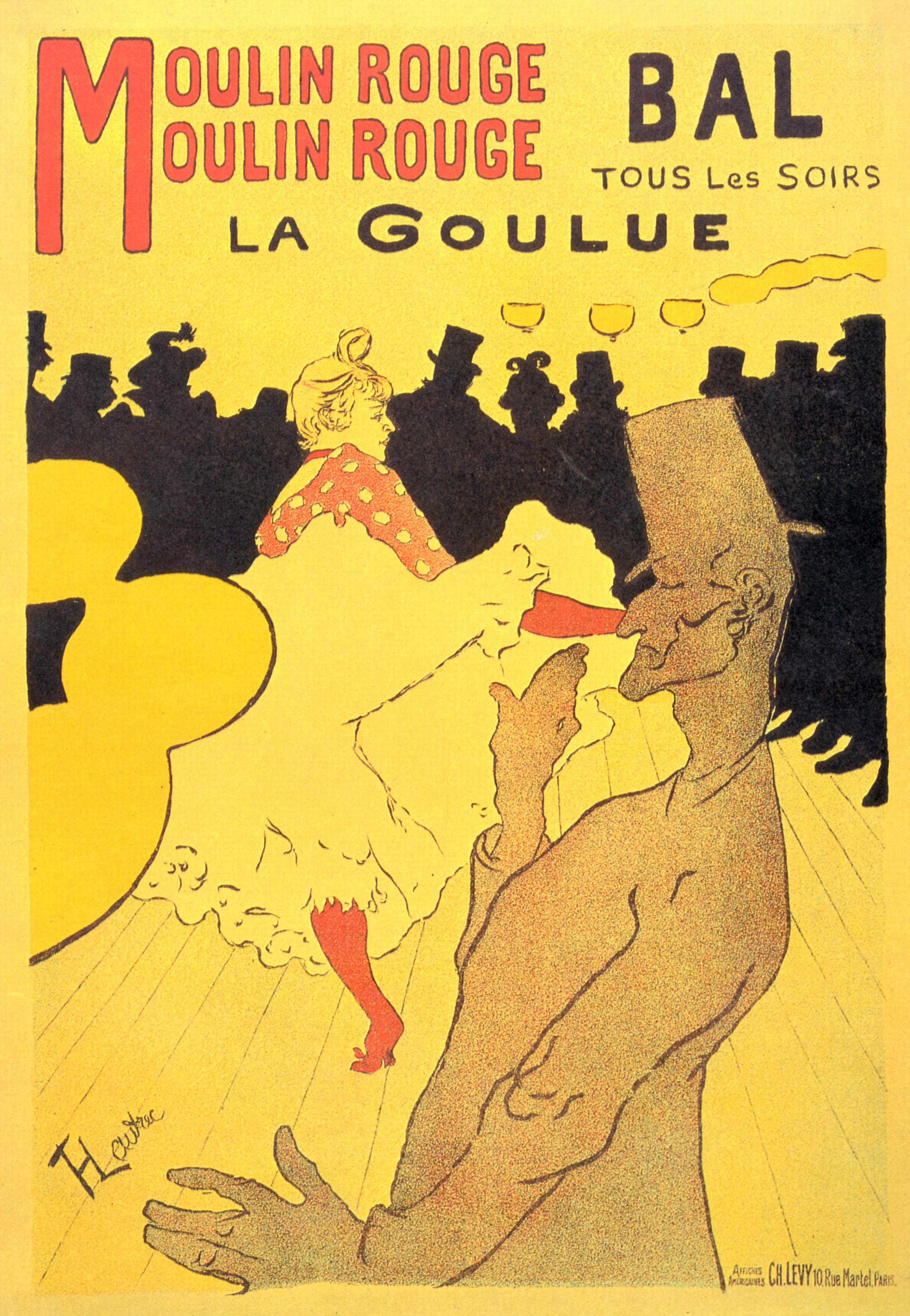
Moulin Rouge: La Goulue
▶ Listen · narrated
A poster was meant to last days on a Paris wall. This lithograph outlived that job, and still names a dance hall and the dancer it was made to sell.
At a glance
- Date
- 1891
- Creator
- Henri de Toulouse-Lautrec
- Medium
- Lithograph print; poster
- Dimensions
- 191 × 117 cm (3 ft 10 in)
- Collection
- Metropolitan Museum of Art
- Inventory
- 32.88.12
Look closer
A sheet built for the street
At 191 centimetres (6 ft 3 in) high and 117 wide, the sheet is almost the height of a person. That scale was not a gallery luxury. It was practical for a wall or a hoarding, where the design had to stop a passer-by at a distance before any small lettering could be read. The object in the museum is the same kind of sheet that once competed with other bills in public space.
Lithograph, not a unique drawing
This is a colour lithograph — a print, not a one-off painting. The point of the medium was repetition: the same design could be pulled many times and posted across the city. What hangs in a collection is therefore one survivor from a commercial run, not a solitary studio work. That fact shapes how the image should be read: as advertising first, preserved art second.
Art Nouveau on a jobbing brief
The work is placed in the Art Nouveau movement, yet its brief was ordinary publicity for a Paris dance hall. The tension is useful. Decorative modern style here is not detached ornament; it is pressed into service to name a venue and sell an evening out. The poster sits at the join between fine-art reputation and the hired work of the street.
The story
Moulin Rouge: La Goulue is a poster by the French artist Henri de Toulouse-Lautrec, made in 1891. It is a colour lithograph, tall and relatively narrow, and it belongs to the Metropolitan Museum of Art under the inventory number 32.88.12. In origin it is French; in classification it is both a lithograph print and a poster, and it is associated with the Art Nouveau movement.
Its job was straightforward. It advertised the Paris dance hall Moulin Rouge and the dancers known as La Goulue and “No-Bones” Valentin. The design had to work as public speech: large enough to catch the eye, clear enough to fix names and a place in the mind of someone walking past. Toulouse-Lautrec was not inventing a private allegory. He was fulfilling a commercial commission in a city thick with printed bills.
Lithography suited that task. A design could be printed in colour in multiple impressions and pasted up wherever the management wanted attention. Reference accounts suggest a run on the order of about three thousand copies, though that figure is given as probable rather than certain. What is clearer is the fate of most impressions. They were used as advertising and lost to weather, overpasting, and ordinary discard. Survival was the exception. Examples that remain are now held by the Metropolitan Museum of Art, the Indianapolis Museum of Art, and many other institutions.
That path from wall to museum is part of what the object is. Nothing in the verified record describes a dramatic excavation or a single rediscovery moment. The poster did not need to be dug from the ground; it needed not to be destroyed in the course of doing its work. Each surviving sheet is a remnant of a much larger printed population, cut off from the street context that once justified its size and boldness.
The dimensions still read as street furniture. Nearly two metres high, the sheet was scaled for distance viewing. In a gallery that same scale becomes imposing in another way: visitors stand before an advertisement that has outlasted the season it was meant to sell. The names it carries — Moulin Rouge, La Goulue — are no longer only local publicity. They have become, through repetition and preservation, part of how later audiences picture late nineteenth-century Paris nightlife.
Toulouse-Lautrec’s authorship matters here without needing myth. A painter known to art history took on a poster brief and produced an image that institutions later collected as art. The categories were already porous. Art Nouveau style, commercial lithography, and entertainment publicity met on one sheet. The museum object is that meeting, fixed in ink on paper and kept long after the paste dried.
Why it mattered then
In 1891 the Moulin Rouge was a going concern that needed crowds. A poster was a tool for that need: cheap to multiply, quick to distribute, and legible in the open air. Toulouse-Lautrec’s sheet named the venue and its featured dancers so that a Paris public would know where to go and whom they might see. Colour lithography made it possible to flood the city with the same design rather than rely on a single painted sign. Most impressions were expected to disappear in use. Their value was immediate attention, not permanence. Within that moment the work belonged to advertising practice as much as to any artistic movement later attached to it.
Why it matters now
The sheet still matters because it shows how an image made for a short commercial life can become a long historical document. What was once paste-and-paper publicity is now a measured object in a major collection, cited as Art Nouveau and filed under a permanent inventory number. It preserves the linkage between a named artist, a named venue, and named performers without pretending the original brief was scholarly. For anyone interested in how modern visual culture blurs art and promotion, the poster is concrete evidence: style, celebrity, and salesmanship on one large lithographic page. Its survival also asks a quiet question about taste — why this bill, among thousands, was kept when so many others were not.
The surprising detail
The print run is usually put at about three thousand copies, yet only a scattered minority survive in museums. The rest were used as intended — stuck to walls and lost. The object’s rarity today is the direct result of its original success as disposable advertising, not of a small exclusive edition.
What is disputed
The often-repeated figure of about three thousand impressions is presented as probable, not as a firmly documented total. The exact size of the run, and the paths by which individual sheets moved from bill-posting stock into museum collections, are not fully settled in the sources used here.
Remember this
A large colour lithograph made to sell nights at the Moulin Rouge; most copies vanished on the walls, and the few that remain are how a poster became a museum object.
Test yourself
Why does treating Moulin Rouge: La Goulue only as a unique work of fine art miss something essential about what it is?
Because it was conceived as a colour lithograph poster — a design for multiplication and public pasting, not as a single studio picture. Its height and width served distant street viewing; its medium existed to produce many impressions; and most of those impressions were meant to be used up. The museum sheet is a survivor of a commercial run. Reading it only as solitary art erases the advertising job that determined its form, and the loss of the other copies that makes each survivor meaningful.
Go deeper
Image: Henri de Toulouse-Lautrec, Public domain. Licence: Public domain. Source.