I · THE OBJECT · BRITISH MUSEUM
Madonna and Child
▶ Listen · narrated
This painting arrived in the record only in the early twentieth century. What it still offers is a clear view of how one Renaissance painter made a sacred subject feel spare and inevitable.
At a glance
- Date
- 1508
- Artist
- Bramantino
- Material
- Tempera on panel
- Dimensions
- 34.3 × 27.6 cm (11 in)
- Inventory
- 12.178.2
Look closer
A courtyard, not a throne room
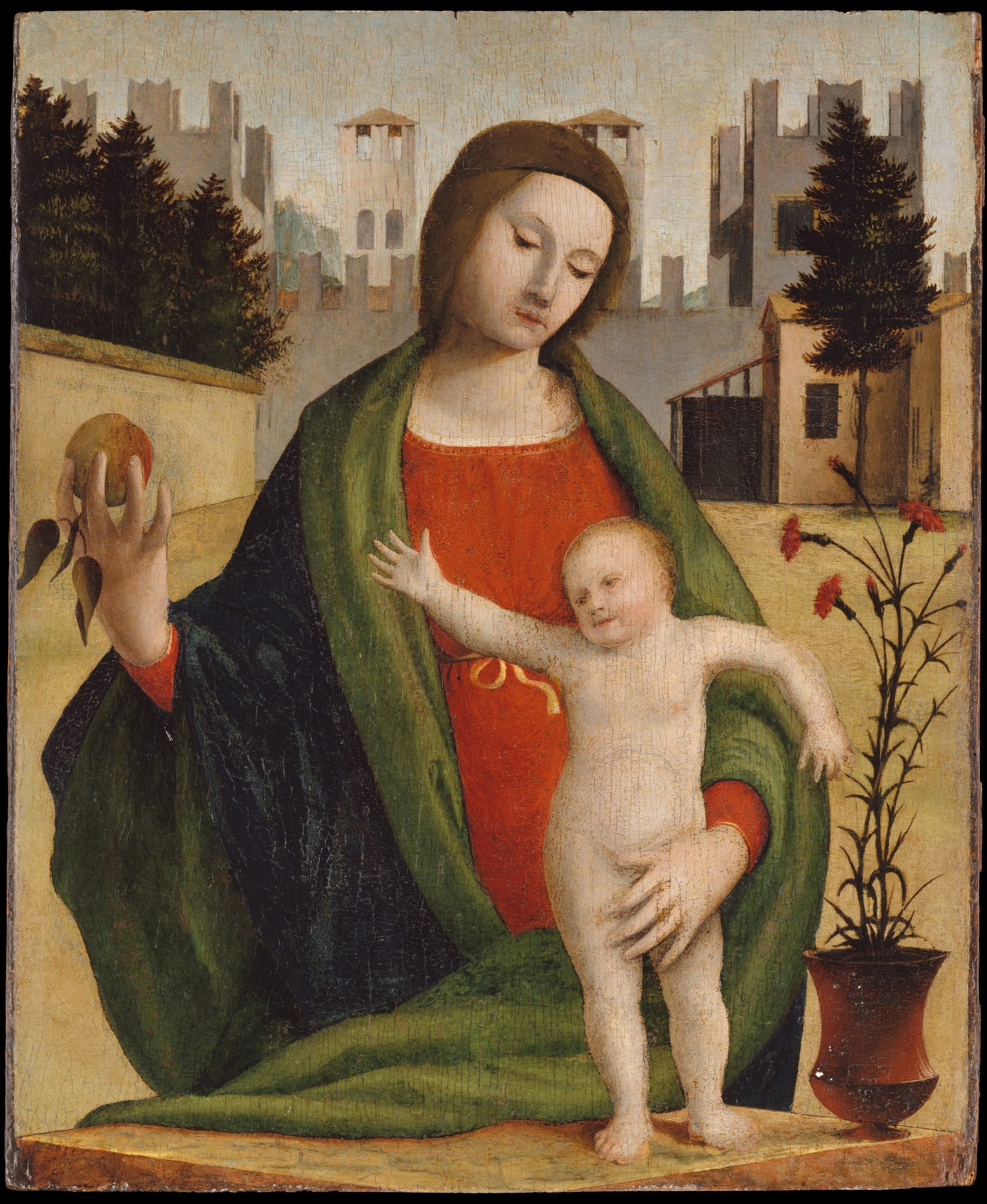
The scene is set outdoors in a courtyard, closed by a crenellated wall with towers. The architecture is plain and blocky rather than ornate. Bramantino’s habit of simplifying volumes and shapes is visible here: walls read as flat planes, towers as solid upright masses, and the whole setting feels measured rather than sumptuous. The sacred pair occupy ordinary masonry, not a golden niche.
The child on the yellow cube
The naked Child stands on a yellow granite cube. He leans toward an apple held by his mother. In the conventional reading of the motif, the apple stands for the fruit of original sin; by reaching for it, the Child accepts the destiny of redeemer. The geometry of the cube keeps the moment still and deliberate rather than anecdotal.
Carnations in a vase
A vase of red carnations sits in the scene as a second symbol. The red is understood to recall the blood of the Passion; the flowers are also read as a sign of the mystical marriage between mother and son — that is, between Christ and the Church. Like the apple, the bouquet turns a domestic detail into theology without needing an inscription.
The story
This is a small religious painting in tempera on panel, made by the Italian Renaissance painter Bramantino and dated to 1508. It measures only 34.3 by 27.6 centimetres (11 in) — a private scale, not a church altarpiece. The Metropolitan Museum of Art holds it under the inventory number 12.178.2; it is sometimes called the Kleinberger Madonna after the dealer through whom it entered the collection.
What we see is the Madonna and Child in a courtyard. Behind them rises a crenellated wall with towers. The Child, naked, stands on a yellow granite cube and leans toward an apple in his mother’s hand. Nearby is a vase of red carnations. The volumes are pared down: faces, limbs, and masonry are simplified rather than richly modelled. That spareness is characteristic of Bramantino’s way of building a picture.
The symbols are conventional for the period, and they do quiet work. The apple points to original sin and to the Child’s acceptance of the role of redeemer. The red carnations recall the blood of the Passion and the mystical marriage of Christ and the Church. Nothing in the panel shouts these meanings; they sit in the open for a viewer who already knows the language.
The panel’s earlier life is largely blank. Its history is unknown before the early twentieth century, when it was recorded in the Paris collection of Count Victor Goloubew and attributed, wrongly, to Francesco Francia. In 1912 Goloubew sold it to the art dealer Kleinberger, who later that year sold it to the Metropolitan Museum of Art. The painting is in a poor state of conservation, and the Madonna’s face has been partially repainted. What survives is still legible as Bramantino’s: a compressed sacred drama staged against plain architecture, with objects that carry doctrine as calmly as furniture.
The work matters less as a sensational rediscovery than as evidence of how a Renaissance painter could treat a familiar subject without spectacle. The courtyard, the cube, the apple, and the carnations form a closed system of meaning on a panel small enough to hang in a room. That combination of reduced form and dense symbolism is the picture’s real argument.
Why it mattered then
In its own moment a Madonna and Child was among the most repeated subjects in Italian religious art. Patrons and painters relied on a shared set of signs — the apple, the red flower, the vulnerable naked Child — so that a small domestic panel could carry the same theology as a large altarpiece. Bramantino’s contribution was not a new story but a particular handling of volume and space: simplified shapes, a courtyard closed by military-looking walls, a Child posed on a stone cube as if on a plinth. The painting offered devotion in a measured architectural frame, suited to private looking rather than public ceremony. Attribution to a named master such as Bramantino also placed the work inside the competitive market for refined small panels, even if that name was later lost and replaced for a time by Francesco Francia’s.
Why it matters now
The panel still matters because it shows how much meaning a Renaissance picture can hold without grandeur of size or surface. At roughly the dimensions of a large book, it concentrates courtyard, wall, Child, apple, and carnations into a single readable field. It also illustrates the fragility of both paint and reputation: the Madonna’s face is partly repainted, the early history is missing, and the work spent time under the wrong artist’s name before reaching the Metropolitan Museum of Art in 1912. Looking at it now is an exercise in attending to convention and condition at once — to symbols that once spoke fluently, and to a surface that has not travelled unchanged. For a modern audience the picture is a compact lesson in how sacred imagery was built from ordinary objects and plain architecture, and how museum collections often preserve works whose biographies begin only when they enter the market.
The surprising detail
For a painting now firmly given to Bramantino, its modern life began under another name. When it was still in Count Victor Goloubew’s Paris collection it was misattributed to Francesco Francia. Only in 1912, moving through the dealer Kleinberger to the Metropolitan Museum of Art, did it settle into the identity under which it is known today. The panel is also in poor condition, with the Madonna’s face partially repainted — so the image visitors meet is partly a later surface over an earlier one.
What is disputed
The date is given as 1508 in the museum’s linked data, while other accounts place the work before 1508. The painting’s history before the early twentieth century is unknown, so neither its original patron nor its first setting can be stated. The Madonna’s face has been partially repainted, which limits how securely one can read the original handling of that passage.
How it got here
The work’s whereabouts are unrecorded until the early twentieth century, when it appeared in the Paris collection of Count Victor Goloubew under a misattribution to Francesco Francia. In 1912 Goloubew sold it to the dealer Kleinberger, who sold it later that year to the Metropolitan Museum of Art, where it remains (inventory number 12.178.2). No contested-ownership claim is recorded in the sources used here.
Remember this
A small Bramantino panel: courtyard, Child on a yellow cube, apple and red carnations carrying the theology, history blank until 1912.
Test yourself
Why do the apple and the vase of red carnations matter as much as the figures in this panel?
Because they turn a quiet courtyard scene into a statement about salvation without needing text. The apple is read as the fruit of original sin, and the Child’s reach toward it as acceptance of his role as redeemer. The red carnations recall the blood of the Passion and the mystical marriage of Christ and the Church. Bramantino’s simplified setting leaves these objects fully visible; they are not decoration but the doctrinal machinery of the picture.
Go deeper
Image: Bramantino, Public domain. Licence: Public domain. Source.