III · THE WORK · ART HISTORY
Music in the Tuileries
▶ Listen · narrated
Manet painted the Tuileries concerts without a single instrument. What he put on the canvas instead was the social fabric of Second Empire Paris — friends, critics, and himself among them.
At a glance
- Artist
- Édouard Manet
- Date
- 1862
- Medium
- Oil paint on canvas
- Dimensions
- 76.2 × 118.1 cm (3 ft 10 in)
- Collections
- National Gallery; Hugh Lane Gallery
- Genre
- Genre art
Look closer
The music you cannot see
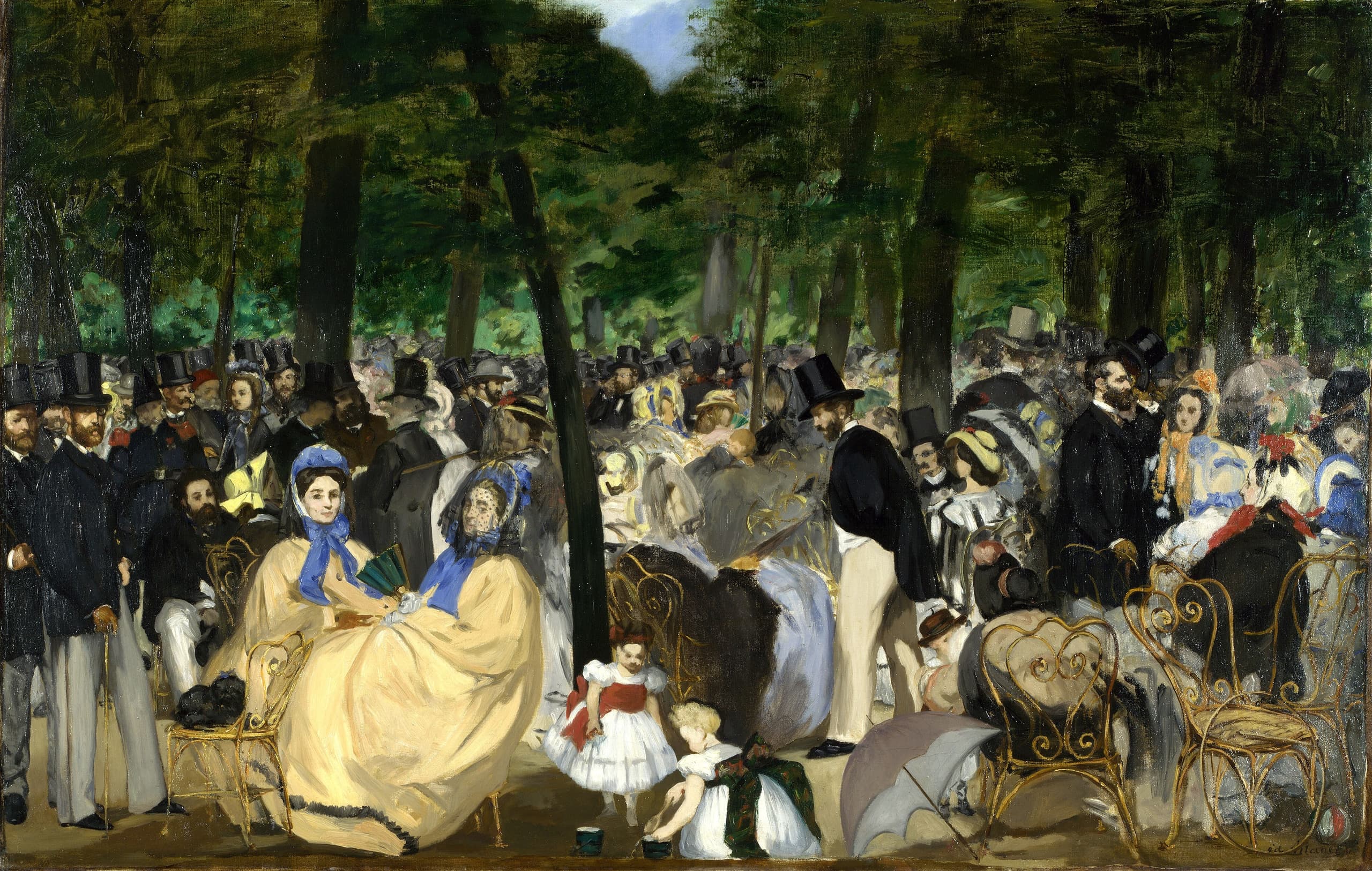
The title promises a concert in the Tuileries gardens, yet no band, instrument or conductor appears. What fills the canvas is the audience: a dense fringe of top hats, bonnets, dark coats and pale dresses under the trees. The sense of occasion is carried entirely by posture and proximity — people turned toward one another, chairs drawn close, a child held in the light. The music is an atmosphere the viewer is left to supply.
Friends named in paint
This is not an anonymous crowd. Manet places himself at the far left, beside the painter Albert de Balleroy. Seated nearby is the sculptor and critic Zacharie Astruc. Further in are the critic Théophile Gautier, the poet Charles Baudelaire, the painter Henri Fantin-Latour looking out, the composer Jacques Offenbach against a tree, and Manet’s brother Eugène in white trousers. The fair-haired child near the centre is Léon Leenhoff. The picture is a map of a circle as much as a record of a place.
The new iron chairs
In the foreground sit the garden’s newly installed iron chairs, which in 1862 had only just replaced the older wooden ones. Manet gives them clear, hard edges and a slight gleam — ordinary street furniture treated with the same attention as the faces above them. They anchor the scene in a specific season of civic refurbishment and keep the lower edge of the painting firmly in the present tense of that year.
The story
Music in the Tuileries shows the weekly outdoor concerts that drew fashionable Paris to the gardens beside the Louvre. Manet does not paint the performers. He paints the throng: men in dark coats and tall hats, women in pale crinolines, children, and a scatter of recognisable acquaintances under a canopy of trees. The format is modest — just over a metre wide — yet the surface is packed almost to the edges, with little open sky and almost no clear path through the crowd.
The handling is deliberately loose. Faces and costumes are blocked in with broad, uneven strokes rather than polished modelling. Contemporaries who preferred a finished academic surface found the effect incomplete; others read the broken paint as a way of catching the flicker of a public afternoon. The picture has long been linked to Manet’s admiration for Frans Hals and Diego Velázquez, painters who could set a figure down with economy and still keep it alive. Here that economy is applied to a modern leisure subject rather than a court or a tavern.
Several of the sitters can be named with some confidence. Manet stands at the extreme left; beside him is Albert de Balleroy. Zacharie Astruc is seated. Eugène Manet appears in the foreground, right of centre, in white trousers. Jacques Offenbach, glasses and moustache, sits against a tree toward the right. Théophile Gautier leans against a tree in a brown suit and full beard; Charles Baudelaire is placed to Gautier’s left. Henri Fantin-Latour, bearded, looks toward the viewer. The fair-haired child in the centre is Léon Leenhoff. The gathering is therefore both a genre scene and a group portrait of Manet’s own circle of artists, writers and musicians.
The painting was first shown in 1863. Two decades later, in January 1883, shortly before his death, Manet sold it to the opera singer and collector Jean-Baptiste Faure. It passed to the dealer Paul Durand-Ruel in 1898 and to Sir Hugh Lane in 1903. After Lane died in the sinking of the Lusitania in 1915, an unwitnessed codicil appeared to leave the work to what is now the Hugh Lane Gallery in Dublin; a court in 1917 held that codicil invalid and awarded the painting, under an earlier will, to the National Gallery in London. A compromise reached in 1959, later adjusted in 1993, means the two institutions share the Lane Bequest pictures. Music in the Tuileries remains part of that shared arrangement, listed today with both collections and ordinarily located at the National Gallery.
Why it mattered then
In 1862 the Tuileries concerts were a known fixture of Parisian leisure, and Manet chose to record not the programme but the audience. That choice mattered. Large group scenes of contemporary life were still relatively uncommon as serious exhibition pictures; by filling a canvas with friends, critics and passers-by under the trees, Manet treated everyday sociability as a subject worth the same attention once reserved for history or allegory. The open brushwork and the refusal to tidy the surface into academic finish also announced a painterly manner that some viewers found unfinished and others found newly truthful to outdoor light and movement. Younger painters — among them Monet, Renoir and Bazille — took note of the idea of assembling modern crowds on a single canvas. The picture stands early in Manet’s long interest in how people spend free time in public, and it fixed a particular Second Empire garden, complete with its newly installed iron chairs, at a precise moment of fashion and acquaintance.
Why it matters now
The painting still works as a study in what a crowd looks like when no single hero dominates the frame. Faces half-turn, hats overlap, and the eye has to pick its way without a clear narrative path. That evenness of attention — friend and stranger given much the same weight — remains useful for anyone thinking about how public space is pictured. The work also carries a later history of ownership and dispute that keeps it current: shared between London and Dublin under the Lane Bequest arrangements, it is a reminder that paintings move through wills, courts and national negotiations as well as through studios. Looking at it now means looking both at Manet’s garden and at the institutional life that has kept the canvas visible in two cities rather than one.
The surprising detail
The music of the title is entirely offstage — no musicians are shown — and it has been noted that several of the identifiable figures were prominent French Wagnerians. Some writers have therefore speculated that the unheard programme might be Wagner’s. The suggestion is intriguing and unprovable; nothing in the painting confirms what was being played. The title names an occasion; the canvas declines to illustrate it.
What is disputed
The idea that the unheard music might be by Wagner rests on the presence of known French Wagnerians among the sitters and remains speculation, not documented fact. Contemporary complaints that the picture looked unfinished reflect taste, not a single settled judgement. The Lane Bequest ownership dispute is a matter of legal record; the 1959 and 1993 sharing arrangements are the practical resolution, not a simple transfer of title.
Remember this
Manet gives the Tuileries concert its crowd, its chairs and its named friends — and withholds the musicians entirely, leaving the music to the title and the viewer’s inference.
Test yourself
Why does the absence of any visible musicians change how the painting asks to be read, compared with a more conventional concert scene?
A conventional concert picture would organise the composition around performers and an audience facing them. Manet removes that centre. Without instruments or a stage, the canvas becomes a study of social presence itself — who stands near whom, how fashion and acquaintance fill a public garden — and the music remains an atmosphere rather than a depicted event. The title still claims a concert; the paint records only the gathering that made the concert a social fact.
Go deeper
Image: Édouard Manet, Public domain. Licence: Public domain. Source.