II · THE DISCOVERY · HISTORY OF SCIENCE
Special relativity
Two assumptions about how the universe behaves led to conclusions that contradicted everyday intuition: that time passes differently for observers in motion, and that nothing can travel faster than light.
At a glance
- Published
- 1905
- Credited to
- Albert Einstein
- Type
- Scientific theory; physical law
Look closer
Two postulates, not a list of conclusions
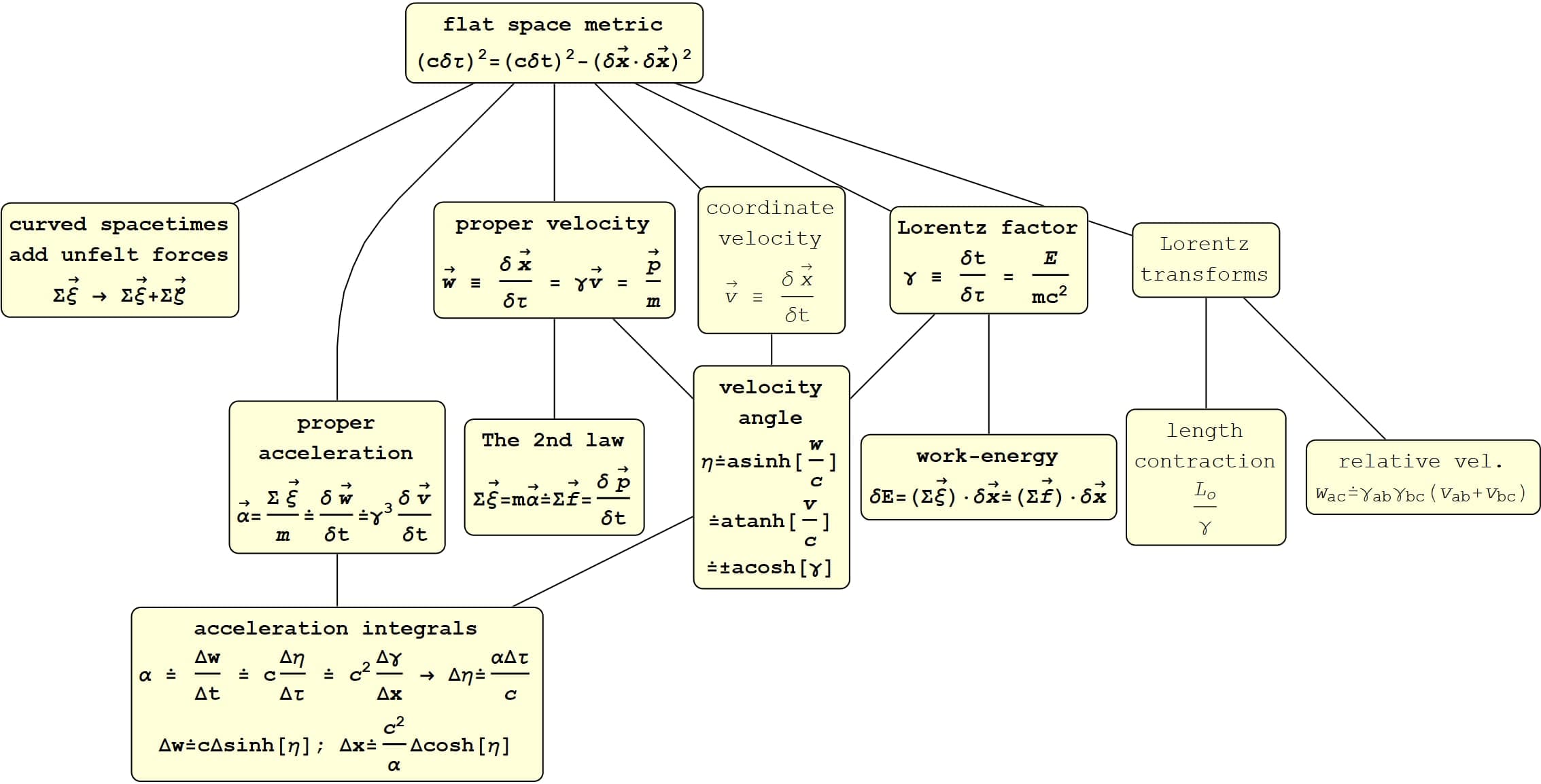
Einstein's 1905 paper presented the theory as resting on two starting assumptions. One: the laws of physics are the same in all frames of reference that move at constant speed — what is called an inertial frame. The other: the speed of light in vacuum is the same for all observers, no matter how the light source or the observer is moving. Everything else in the theory follows from those two statements.
One postulate was already Galileo's
The postulate that the laws of physics do not change if you are moving at constant speed was not new in 1905. Galileo had formulated it centuries earlier, and it is known as Galilean invariance. What Einstein did was combine that older principle with the constancy of light speed, and show that the two together required time and space to behave differently than anyone had thought.
The name distinguishes it from general relativity
The theory is called special relativity to distinguish it from Einstein's later general theory of relativity, published in 1915. Special relativity applies to observers moving at constant speeds; general relativity extends the framework to include acceleration and gravity. The word 'special' marks the narrower scope, not a claim about importance.
The story
In 1905, Albert Einstein published a paper titled 'On the Electrodynamics of Moving Bodies'. The paper proposed a new way of understanding space and time, built on two postulates.
One postulate was that the laws of physics are identical in all inertial frames of reference — that is, in any situation where an observer is moving at constant speed, or not moving at all. An observer sitting still and an observer moving past at constant velocity should both see the same physical laws at work. This principle was not new; Galileo Galilei had formulated it, and it is called Galilean invariance.
The other postulate was that the speed of light in vacuum is the same for all observers, regardless of how the light source or the observer is moving. If you are standing still and measure the speed of a beam of light, and someone else measures the same beam while moving toward it at high speed, both of you will record the same number. This constancy of light speed was the novel claim.
Taken together, these two postulates led to conclusions that contradicted everyday experience. If the speed of light is always the same, then time cannot be absolute. Two observers moving relative to each other will measure time passing at different rates. Space is not absolute either: lengths contract along the direction of motion. What one observer measures as simultaneous, another will not.
The mathematics of the theory shows that nothing with mass can be accelerated to the speed of light, because doing so would require infinite energy. The speed of light becomes a universal limit.
Einstein's paper did not present experimental proof in the usual sense. It was a theoretical argument: if these two postulates are true, then space and time must behave in these specific ways. The experimental evidence that supported the postulates, and the predictions that followed from them, accumulated over the decades that followed.
Why it mattered then
Before 1905, physicists treated space and time as separate and absolute: a second was a second for everyone, a metre was a metre everywhere, and events that were simultaneous for one observer were simultaneous for all. Einstein's theory required abandoning those assumptions. Time could pass at different rates depending on motion. Lengths could contract. Simultaneity was relative, not universal. The theory resolved puzzles that had troubled physicists studying electromagnetism and light. It showed why certain experiments measuring the motion of the Earth through space had failed to detect the expected effects. The framework it provided became essential for understanding how charged particles behave at high speeds, which mattered for the development of particle physics in the decades that followed.
Why it matters now
Special relativity is the foundation for much of modern physics. Particle accelerators, which smash particles together at speeds close to the speed of light, rely on the theory's predictions about mass, energy and time dilation to function. Satellite navigation systems adjust for relativistic effects: satellites in orbit experience time differently than receivers on the ground, and the system must account for that difference to give accurate locations. The theory established that mass and energy are equivalent, related by the equation that expresses energy as mass times the speed of light squared. That equivalence underpins nuclear physics and explains how stars generate energy. Special relativity remains the framework within which physicists describe motion and energy when gravity is weak enough to ignore.
The surprising detail
The theory was published in 1905, but the verified facts record both its inception and discovery date as that year, with no finer detail. The reference text describes it as a paper published in 1905, but does not give a month or day. That a theory this consequential has its discovery recorded only to the year, not to a specific date, is unusual compared to other discoveries in the dataset, which sometimes carry precision down to the day.
What is disputed
The verified facts give 1905 as both the inception and discovery date, with no month or day recorded. The reference text confirms the paper was published in 1905 but provides no finer dating. This precision to the year only, rather than to a specific date, is what the record supports.
Remember this
Two postulates about motion and light led to conclusions about time and space that contradicted intuition but matched what experiments measured.
Test yourself
Einstein's postulate about inertial frames was not new in 1905 — Galileo had stated it centuries earlier. What did Einstein add that made the theory revolutionary?
Einstein combined Galileo's principle — that the laws of physics are the same in all inertial frames — with the postulate that the speed of light is constant for all observers. That second claim was the novel one, and when paired with Galileo's principle, it forced a rethinking of space and time themselves. If light speed is always the same, then time and space cannot be absolute; they must adjust depending on the observer's motion. The revolutionary part was not Galileo's principle but the combination, and the willingness to accept what followed from it.
Go deeper
Image: P. Fraundorf, CC BY-SA 4.0. Licence: CC BY-SA 4.0. Source.