III · THE WORK · ART HISTORY
Ship of Fools
▶ Listen · narrated
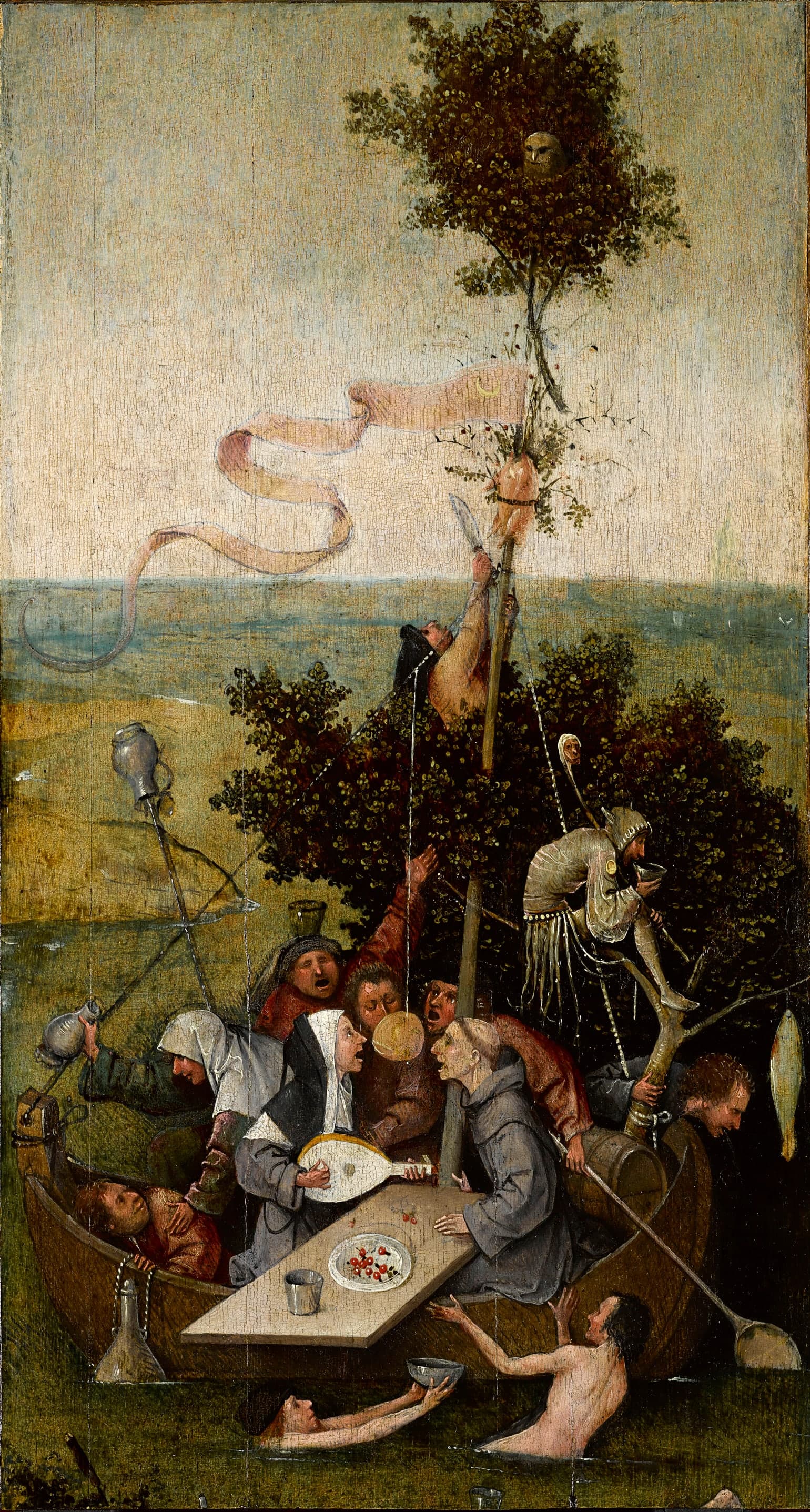
Bosch cast gluttony as a boat that goes nowhere. The panel itself was later sawn apart, so the allegory of waste now lives split between two museums.
At a glance
- Artist
- Hieronymus Bosch
- Date
- 1500
- Medium
- Oil on panel
- Dimensions
- 58 × 32.5 cm (1 ft 1 in)
- Collection
- Louvre, Room 815 (RF 2218)
- Genre
- Allegory
Look closer
A wing, not a whole
The Louvre panel is only about two-thirds of its original height. It once formed part of a triptych wing that was later cut into separate pieces. The missing lower third survives independently at Yale University Art Gallery under the title Allegory of Gluttony. What you see in Paris is therefore not a complete composition but a truncated one: the narrative continues below a cut edge that is easy to forget once the frame is on.
The tall, narrow field
At 58 centimetres (1 ft 11 in) high and only 32.5 wide, the surviving surface is a slender upright. That proportion suits a wing rather than a central panel. Crowding figures into such a tight vertical strip forces the eye up the mast of the little vessel and through a stack of bodies, food and foolish business. The format is part of the satire: there is nowhere for anyone to go except further into the press of the boat.
Gluttony without a sermon board
The painting belongs to the Early Netherlandish tradition and is classed as an allegory. It has long been read as a treatment of gluttony within a larger meditation on the deadly sins. Nothing on the panel labels the vice in words. The argument is made by behaviour — eating, drinking, idling on a ship that is no serious craft — so the moral charge sits in what the figures are doing, not in a caption.
The story
Hieronymus Bosch’s Ship of Fools is a small oil painting on panel, dated to 1500, now in the Department of Paintings of the Louvre. It hangs in Room 815 under the inventory number RF 2218. At 58 by 32.5 centimetres (1 ft 1 in) it is modest in scale, yet it is one fragment of something that was once larger and more elaborate.
The surviving picture is not a freestanding invention that simply happens to be narrow. It is what remains of a wing from a triptych that was later cut into several parts. This section, roughly the upper two-thirds of its original length, stayed together as the Louvre’s Ship of Fools. The bottom third was separated and is now at Yale University Art Gallery, where it is shown as Allegory of Gluttony. Taken together, those two pieces restore the full height of one wing. The other wing of the same ensemble, which has kept more or less its full length, is Death and the Miser in the National Gallery of Art, Washington, D.C. On the reverse of that wing Bosch painted The Wayfarer, now in Rotterdam. The central panel, if there was one, is unknown.
Read as a pair, the Paris–Yale wing and the Washington wing appear to have staged opposite failures of appetite and thrift: prodigality on one side, miserliness on the other. Both are caricatural. Neither offers a model of temperate life. The Louvre fragment concentrates the charge of gluttony and wasted revelry. Its literary cousin is the older allegory of the ship of fools — a vessel whose crew cannot steer, already present in classical writing and given fresh currency when Sebastian Brant published Das Narrenschiff in 1493. Bosch’s panel does not illustrate Brant line by line; it belongs to the same climate of satire, in which folly is collective, mobile and oddly cheerful.
The physical history of the object matters as much as the iconography. Camille Benoit gave the painting to the Louvre in 1918. In 2015 the museum restored it. Between those dates, and long before the gift, the panel had already suffered the more drastic intervention of being sawn from its lower third and separated from its companion wing. Looking at Ship of Fools in Room 815 is therefore an act of partial seeing. The composition still reads as a crowded boat of debauched revelers, but the full vertical argument of the wing only returns if the mind supplies the Yale fragment below and, more tentatively, the Washington wing beside it.
What remains visible in Paris is the heart of the joke and the warning: a craft that is really a floating tavern, occupied by people busy with appetite and song, going nowhere that a sober pilot would choose. The allegory does not need a storm. Drift and self-absorption are enough.
Why it mattered then
Around 1500, in the culture of Early Netherlandish painting, moral allegory was a serious public language. Viewers were accustomed to images that organised human failure into readable types — the miser, the glutton, the fool — and to altarpiece wings that could carry such types into the space of devotion or private instruction. The ship-of-fools idea, newly sharpened by Brant’s 1493 satire, offered a ready vessel for collective vice: not one sinner in isolation but a whole company agreeing to be lost. Bosch’s panel fits that appetite for pointed comedy with a sting. By pairing prodigality with miserliness across the two wings, the original triptych could condemn opposite errors without praising a soft middle in paint; the sober path was implied by the absence of sense on both sides. A fragment about gluttony alone already spoke clearly in a world that ranked the deadly sins and expected pictures to help people recognise them in behaviour, not only in Latin lists.
Why it matters now
The painting still works as a study in how an image can moralise without a caption, but it also works as a lesson in how museum objects are seldom whole. What the Louvre holds is brilliant and incomplete at once. To understand it is to hold several institutions in mind at the same time — Paris, Yale, Washington, Rotterdam — and to accept that the central panel may never reappear. That condition feels contemporary. Many famous works are survivors of dismemberment, sale and national collecting. Ship of Fools makes the point unusually neat: the allegory of people stuck together on a foolish course is itself scattered across collections, and the viewer who wants the full argument must travel or reconstruct. The satire of drift survives; the furniture of the original altarpiece does not.
The surprising detail
The bottom of this very panel is not lost to fire or time in some vague sense. It is a separate, catalogued painting in another country. Yale’s Allegory of Gluttony is the missing lower third of the same wing, cut away so cleanly that the Louvre object is simply shorter than Bosch left it. The other wing stayed nearer its full length and went to Washington; its reverse, The Wayfarer, is in Rotterdam. A single triptych’s parts now ask four cities to complete one thought. The centre, if it existed, has not been identified.
What is disputed
The central panel of the original triptych, if one existed, is unknown. The grouping of the Louvre fragment with Yale’s Allegory of Gluttony, Washington’s Death and the Miser and Rotterdam’s Wayfarer is the prevailing reconstruction, but it rests on technical and thematic alignment rather than a surviving intact altarpiece. Direct dependence on Sebastian Brant’s 1493 Das Narrenschiff is possible on timing and subject yet not proven as a one-to-one illustration.
Remember this
The Louvre’s Ship of Fools is a cut fragment of a wing: gluttony afloat, with its lower third in Yale and its companion wing in Washington.
Test yourself
Why does treating the Louvre panel as a complete, self-contained picture weaken what Bosch appears to have designed?
Because the panel is only about two-thirds of its original wing. The lower third survives at Yale as Allegory of Gluttony, and the other wing — Death and the Miser, with The Wayfarer on its reverse — belongs to the same ensemble. The full height of the gluttony wing, and the pairing of prodigality against miserliness, are part of the meaning. Seen alone, the Paris fragment still reads as a satire of debauched revelers, but the larger argument of matched extremes, and the physical scale Bosch composed, only return when the scattered parts are held in mind together.
Go deeper
Image: Hieronymus Bosch, Public domain. Licence: Public domain. Source.