III · THE WORK · ART HISTORY
La velata
▶ Listen · narrated
Among Raphael’s portraits this one holds the eye on fabric as much as on flesh. Who she was is still argued; what he painted is not.
At a glance
- Artist
- Raphael
- Date
- 1513
- Medium
- Oil on canvas
- Dimensions
- 82 × 61 cm (2 ft)
- Collection
- Galleria Palatina
- Location
- Hall of Jupiter
Look closer
The veil that names the picture
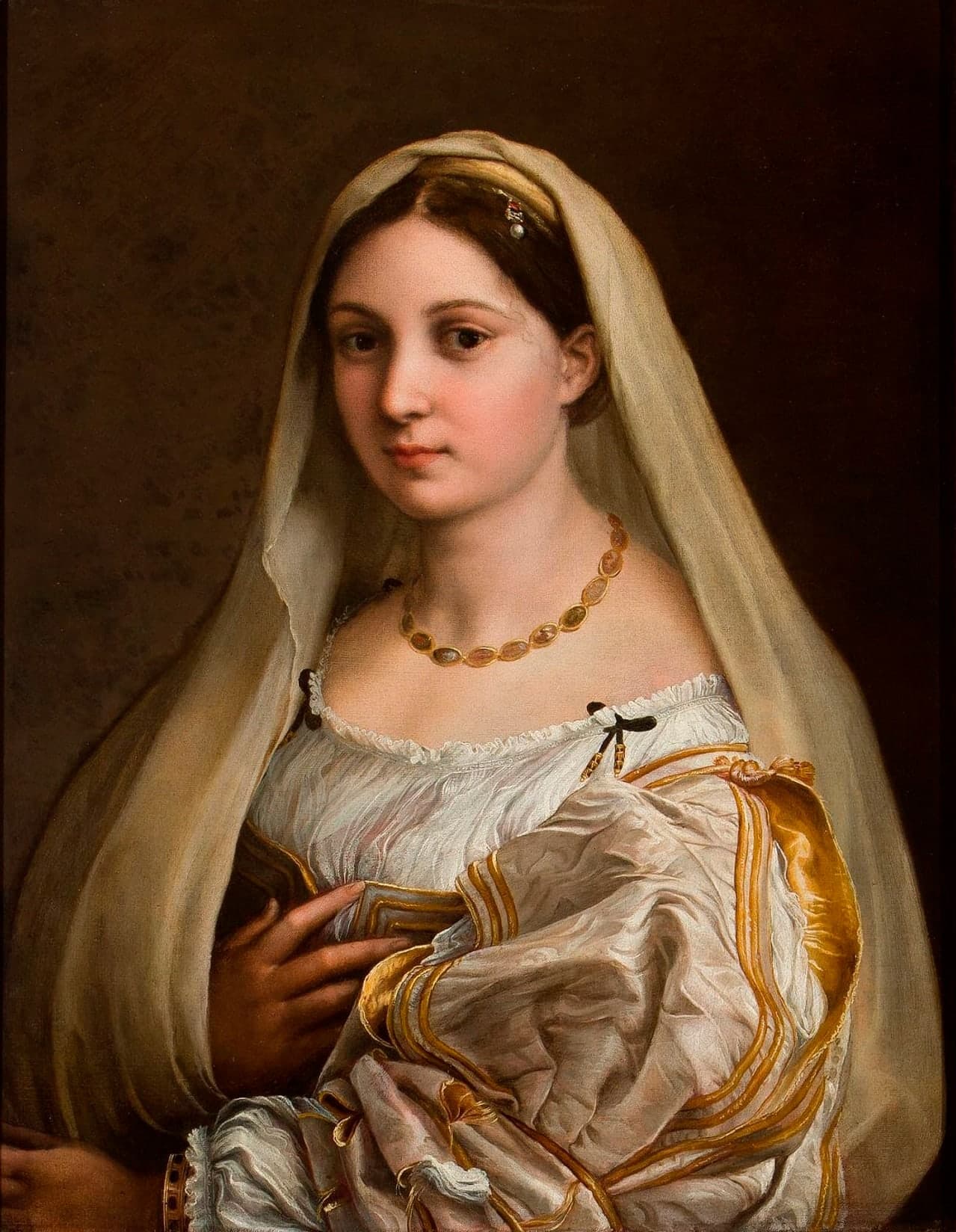
The painting is known as La velata, or La donna velata — the woman with the veil. That single piece of cloth does more than cover the head. It frames the face, softens the outline of the hair and sets a quiet boundary between the sitter and the space around her. The title points us first to this covering, not to a documented name.
Dress given equal weight
As is usual with Raphael, the clothing is chosen and painted with close attention. Here it is strikingly opulent. A large share of the canvas is given over to costume rather than to features alone, so that the eye moves between the calm of the face and the mass of fabric below. The portrait treats dress as a subject in its own right, not as background fill.
A modest scale, a full presence
At eighty-two centimetres high and sixty-one wide, the work is a compact portrait on canvas, not a grand full-length display. Within that rectangle the figure still occupies the field with authority: head, veil and opulent dress are locked into a single vertical arrangement. The size keeps the encounter intimate; the composition keeps it formal.
The story
La velata is an oil painting on canvas by Raphael, dated 1513. It stands eighty-two centimetres high and sixty-one centimetres wide. It belongs to the Galleria Palatina, where it is shown in the Hall of Jupiter, and carries the inventory number 245. In genre it is a portrait; in movement it belongs to the High Renaissance. Its other Italian title, La donna velata, simply restates what the eye meets first: a woman with a veil.
What can be said with certainty is limited and physical. The maker, the date, the medium, the dimensions and the present home are secure. Beyond that, the painting asks to be read through what it shows rather than through a fixed biography of the sitter. A face is held toward us, moderated by the veil. Below and around that face, clothing of conspicuous richness takes up a generous portion of the surface. Raphael’s attention does not thin out once it leaves the features; it stays exact on folds, weight and sheen.
The sitter is traditionally identified as Margherita Luti, a bakeress and Raphael’s Roman mistress, and the same woman is said to appear in another of his portraits, La Fornarina. That identification is long-standing. It is not, on the evidence available here, a documented fact. The honest account keeps the tradition visible and keeps it labelled as tradition. The painting does not name her. The title names the veil.
Compositionally the work is straightforward and unhurried. The figure fills the field without narrative props or a busy setting competing for notice. The drama, such as it is, lies in the balance between person and costume: how much canvas a sleeve or bodice may claim beside a cheek or an eye, and how a veil can both conceal and present. Nothing in the verified record forces a single story onto that balance. The picture remains a High Renaissance portrait in which likeness and display are held in the same careful register.
To look closely, then, is to accept two kinds of knowledge at once. One is material and dated: oil, canvas, 1513, Raphael, a measured rectangle now in the Hall of Jupiter. The other is social and incomplete: a woman whose face has invited names, and whose dress has always been part of the point. Between those two kinds of knowledge the painting sits without impatience.
Why it mattered then
In 1513, within the High Renaissance, a portrait in oil on canvas was a principal way to fix presence, status and beauty in a durable object. Clothing was not a minor accessory in that language. Opulent dress signalled wealth, taste and social position as clearly as a face signalled identity. A veil could serve modesty, fashion or simple formal framing of the head. Whether or not the traditional link to Raphael’s private life is accepted, the public work fits its moment: a compact portrait that treats costume with the same seriousness as likeness, and that trusts oil paint to carry both flesh and fabric without reducing either to a sketch.
Why it matters now
The painting still rewards attention because it will not let the viewer rank face above dress, or legend above surface. Many come to it for the romance of a named mistress and find, instead, a composition that spends long labour on cloth. That redistribution of care remains useful. So does the open identity. The traditional name has not hardened into proof, and keeping that uncertainty in view is part of looking honestly. La velata continues to matter as a case where close looking — at veil, at costume, at the limits of what we can state — is more faithful than a tidy story.
The surprising detail
The woman in La velata is traditionally held to be the same sitter who appears in Raphael’s La Fornarina, and is often named as the bakeress Margherita Luti, described as his Roman mistress. The claim is repeated and familiar, yet it rests on tradition rather than on a settled contemporary identification in the record used here. The portrait that feels most personal is also one of the least securely named.
What is disputed
The identification of the sitter as Margherita Luti, and the claim that she is the same woman shown in La Fornarina, is traditional. It should not be stated as documented fact on the evidence supplied here.
Remember this
La velata gives equal gravity to a veiled face and to opulent dress, and leaves the sitter’s name a tradition rather than a fact.
Test yourself
The painting’s common titles point to a veil, not to a personal name. What does that choice of emphasis suggest about how the work asks to be read?
It directs attention first to what is painted and visible — the veil as a framing device, and by extension the carefully studied clothing — rather than to a biography that remains traditional rather than proven. The titles keep the encounter with the surface primary. Identity may be discussed; it is not what the naming of the picture claims to settle.
Go deeper
Image: Raphael, Public domain. Licence: Public domain. Source.