II · THE DISCOVERY · HISTORY OF SCIENCE
Diode
Electric current usually flows wherever voltage pushes it. A diode breaks that symmetry: it conducts one way and resists the other, which turns out to be exactly what you need to convert AC to DC.
At a glance
- Discovered
- 1901 (Wikidata P575)
- Discoverer
- Jagadish Chandra Bose
- Type
- Two-terminal electronic component with asymmetric conductance
- Common modern form
- Semiconductor diode, typically made of silicon
Look closer
Two terminals, two behaviours
A diode has two electrical terminals. Connect a voltage one way and current flows through it easily — the component has low resistance. Reverse the voltage and current barely flows at all — the resistance is high. That directional behaviour is called asymmetric conductance, and it is the defining property of the component. The direction that conducts is called forward; the direction that blocks is called reverse.
The semiconductor version
Most diodes today are semiconductor diodes: a piece of crystalline semiconductor material, typically silicon, with a structure called a p–n junction connecting the two terminals. The junction is where two regions of the semiconductor meet, one doped to carry positive charge carriers and one doped to carry negative ones. The current–voltage relationship is exponential: small changes in voltage produce large changes in current when the diode is conducting forward.
An earlier form: the vacuum tube
Before semiconductor diodes became standard, thermionic diodes were used. These were vacuum tubes containing two electrodes: a heated cathode that emitted electrons and a plate that collected them. Electrons could flow from cathode to plate but not the reverse, giving the same one-way behaviour. These are now obsolete, replaced by the smaller, cooler-running semiconductor version.
The story
A diode is a component with two terminals that conducts electric current in one direction and resists it in the other. That asymmetry is the point: where most components treat current the same way regardless of which direction it flows, a diode discriminates.
The discovery of this asymmetric conduction is credited to Jagadish Chandra Bose in 1901. An earlier observation was made by Ferdinand Braun in 1874, who noticed asymmetric electrical conduction across the contact between a crystalline mineral and a metal, but the 1901 date is what the record carries for the diode as a component.
The behaviour itself is straightforward to describe. Apply a voltage across the diode in the forward direction — the direction it is designed to conduct — and current flows with low resistance. Reverse the voltage and the current drops sharply; the component now has high resistance. Ideally, the forward resistance would be zero and the reverse resistance infinite, though real diodes approximate this rather than achieving it exactly.
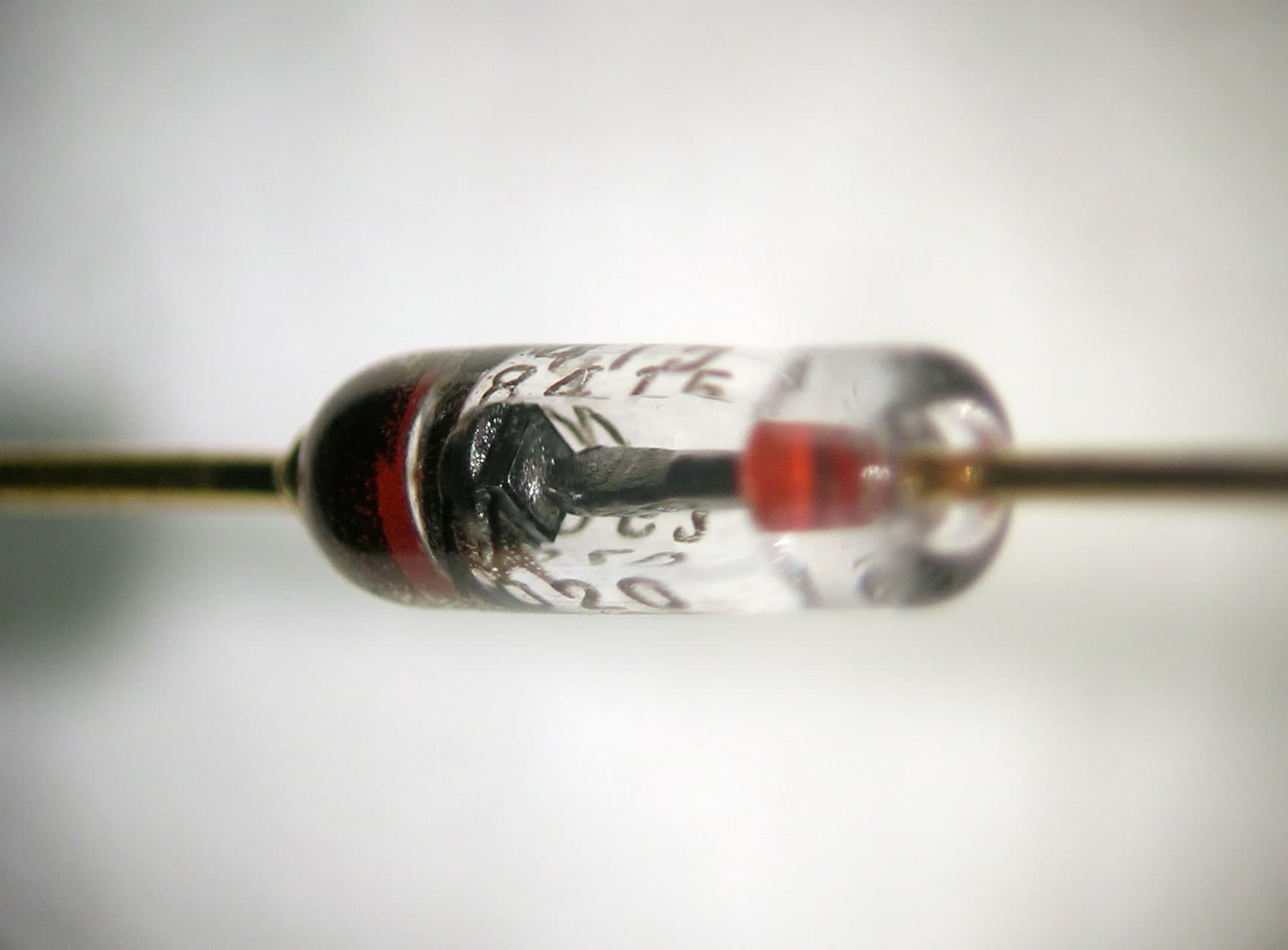
The most common form today is the semiconductor diode. This is a piece of crystalline semiconductor material, usually silicon, with a structure called a p–n junction. The junction is where two regions of the material meet: one region is doped with impurities that create positive charge carriers, the other with impurities that create negative charge carriers. When voltage is applied in the forward direction, current flows across the junction easily. In reverse, the junction resists. The current–voltage relationship is exponential: in the forward direction, small increases in voltage produce large increases in current.
Semiconductor diodes were the earliest semiconductor electronic devices. Silicon is the usual material now, though other semiconductors such as gallium arsenide and germanium are also used.
An older form, now obsolete, was the thermionic diode: a vacuum tube with two electrodes inside. One electrode, the cathode, was heated so that it emitted electrons. The other, the plate, collected them. Electrons could flow from cathode to plate but not in reverse, giving the same one-way behaviour. These have been replaced by semiconductor diodes, which are smaller, use less power, and do not require heating.
Diodes are used wherever that directional behaviour is needed. One common use is in rectifiers, which convert alternating current — current that reverses direction many times per second — into direct current, which flows in one direction only. The diode blocks the reverse half of the AC cycle, leaving only the forward half. Another use is demodulation in radio receivers, where the diode extracts the audio signal from a modulated radio wave. Diodes can also be used in logic circuits and as temperature sensors, since their electrical properties change with temperature.
A widely used variant is the light-emitting diode, which emits light when current flows through it in the forward direction. These are used for electric lighting and as status indicators on electronic devices.
Why it mattered then
Before the diode, there was no simple way to make electric current flow in only one direction. Alternating current, which reverses direction many times per second, could not easily be converted to direct current, which many devices required. The diode made that conversion straightforward: connect it in a circuit and it blocks half the AC cycle, leaving a pulsing DC output that can be smoothed with other components. That function, called rectification, became essential as electrical systems grew. The discovery also mattered for radio. Early radio receivers needed a way to extract the audio signal from the modulated radio wave they picked up. A diode could do this, acting as a detector that responded to the shape of the wave rather than its rapid oscillations. The component made radio receivers simpler and more reliable. The semiconductor form, which came later, mattered because it did the same job as the vacuum tube version but without needing a heated cathode, without the bulk of a glass envelope, and without the power consumption. Semiconductor diodes were smaller, more robust, and could be manufactured in quantity, which made them practical for a much wider range of circuits.
Why it matters now
Diodes are in nearly every piece of electronic equipment. Any device that plugs into mains AC power and runs on DC internally — which is most of them — has a rectifier circuit with diodes converting the AC to DC. Phone chargers, laptop power supplies, and the power circuits inside televisions and computers all rely on this. Radio receivers still use diodes for demodulation, though the circuits are more complex now and often integrated into larger semiconductor chips. The same directional property is used in logic circuits, where diodes can perform simple gating functions, and in protection circuits, where they prevent current from flowing in a direction that would damage other components. The light-emitting variant has become the standard for many lighting applications. LEDs are more efficient than incandescent bulbs and last longer, which is why they have replaced older lighting in torches, traffic signals, vehicle lights, and increasingly in domestic and commercial lighting. The status lights on nearly every electronic device — the small coloured indicators showing power, activity, or charging — are LEDs. The basic asymmetric behaviour discovered in 1901 remains the foundation. The materials and manufacturing have changed, the scale has shrunk, and the variants have multiplied, but the core function is the same: a component that conducts one way and blocks the other.
The surprising detail
The p–n junction at the heart of a semiconductor diode is a boundary between two regions of the same material, not a join between two different materials. Both regions are silicon, or both are germanium, or both are gallium arsenide. What makes them different is the doping: tiny controlled amounts of impurity atoms added to each region. One region gets atoms with an extra electron to donate, the other gets atoms with a missing electron — a hole that can accept one. The junction is where these two doped regions meet, and the asymmetric conduction happens there, at a boundary inside a single crystal. The diode's behaviour comes from rearranging the electrons within one material, not from stacking two different substances.
What is disputed
The discovery date is given as 1901, credited to Jagadish Chandra Bose. An earlier observation of asymmetric conduction across a crystal-metal contact was made by Ferdinand Braun in 1874, but the record as it stands attributes the diode discovery to Bose in 1901. The relationship between Braun's 1874 observation and Bose's 1901 work is not detailed in the verified facts.
Remember this
A diode conducts current in one direction and resists it in the other. That directional behaviour is what converts AC to DC and makes radio demodulation work.
Test yourself
A diode has low resistance in one direction and high resistance in the other. How does that directional property convert alternating current, which reverses direction many times per second, into direct current?
When alternating current flows through a diode, the diode conducts during the half of the cycle when the current is in the forward direction and blocks during the half when the current tries to reverse. This removes half the AC waveform, leaving only the forward-flowing pulses. The output is not smooth DC yet — it is a series of pulses all flowing the same way — but other components such as capacitors can smooth those pulses into steady direct current. The diode's job is to enforce the direction, which is the step AC-powered devices need before they can run on DC internally.
Go deeper
Image: John Maushammer; The original uploader was Morcheeba at English Wikipedia ., CC BY-SA 2.5. Licence: CC BY-SA 2.5. Source.