IV · THE GAME · MAJOR LEAGUE BASEBALL
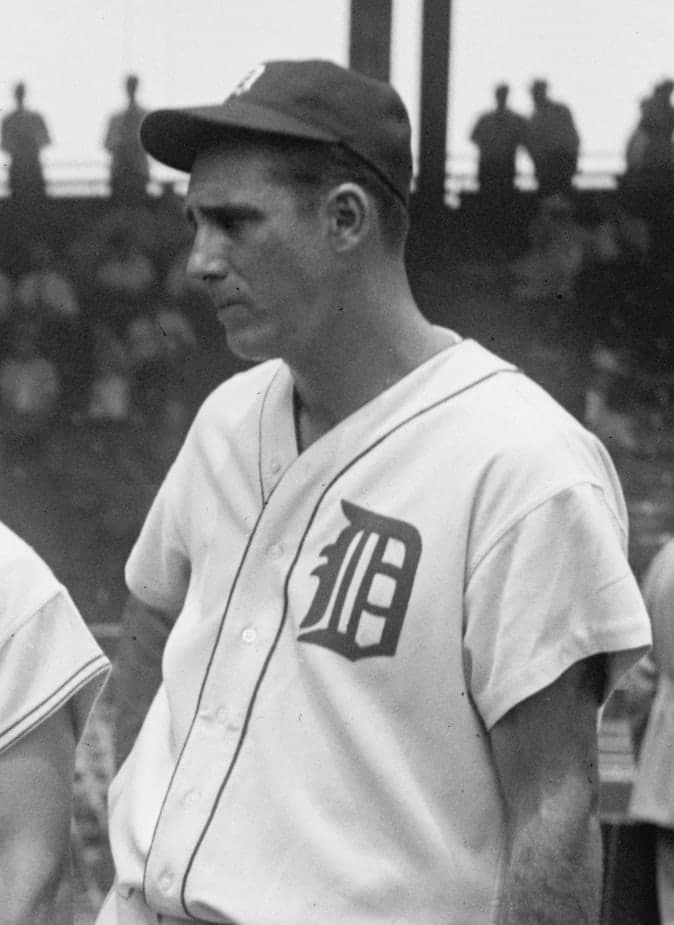
Hank Greenberg
Between 1930 and 1947 Greenberg played thirteen seasons. The other years are not in the table, and the longest gap is not the one you expect.
At a glance
- Career
- 1,394 games · 1,628 hits · 331 home runs · 1,276 runs batted in · .313 average
- Debut
- 14 September 1930, aged 19, at Navin Field, Detroit
- Last game
- 18 September 1947, for the Pittsburgh Pirates
- Height and weight
- 6' 4" · 210 lb
Look closer
The debut was one at-bat in a lost game
On 14 September 1930 the New York Yankees made fifteen hits to Detroit's seven and won 10–3 in front of 15,000 people at Navin Field. New York scored four runs in the second inning and never trailed. Detroit scored once in the sixth and twice in the ninth, both times too late to matter. Greenberg had one at-bat and did not reach base. The line for 1930 is one game, one at-bat, and zeroes in every other column.
The season table has gaps where years are missing
The debut was in 1930. The last game was in 1947. That span is eighteen years, but the table records only thirteen seasons. There is no line for the two years immediately after 1930. There is no line for the years immediately after 1941 — a gap that runs through to 1945. A gap at the start of a career is the shape a minor-league apprenticeship makes. A gap in the middle, beginning when a player is already established, is something else.
Fifty-eight home runs in one season, then a twelve-game year
In 1938 Greenberg played 155 games, made 175 hits, and hit 58 home runs. The following season, 1939, he played 138 games and hit 33 home runs. Then in 1940 he played 148 games and hit 41. In 1941 the line collapses: 19 games, 67 at-bats, 2 home runs. The 1941 season began in mid-April and ended in late September, so nineteen games is not a full season. Something stopped the year early.
The story
On 14 September 1930 the Detroit Tigers played the New York Yankees at Navin Field. New York made fifteen hits to Detroit's seven, scored four runs in the second inning and won 10–3. Greenberg had one at-bat and did not reach base. The line for 1930 is one game, one at-bat, and zeroes in every other column. There is no line for the two years that follow. The table resumes in 1933, when Greenberg was twenty-two years old.
That 1933 season was 117 games, 449 at-bats, and a .301 average. The following year, 1934, he played 153 games, made 201 hits, and hit 26 home runs. In 1935 he hit 36 home runs and drove in 170 runs. In 1936 the line collapses to twelve games and 46 at-bats. In 1937 it returns to 154 games, 200 hits, and 40 home runs. The 1938 season is 155 games and 58 home runs. The 1939 and 1940 seasons are both full: 138 games and 148 games, 33 home runs and 41 home runs.
In 1941 the line is nineteen games, 67 at-bats, and two home runs. A major-league season runs from mid-April to late September, so nineteen games is not a full season. Something stopped the year early. There is no line for the years that follow — the table skips forward to 1945. That 1945 season is 78 games, 270 at-bats, 13 home runs. The 1946 season is full again — 142 games, 44 home runs — and the 1947 season is 125 games for the Pittsburgh Pirates. The last game was on 18 September 1947.
The debut was in 1930. The last game was in 1947. That span is eighteen years, but the table records only thirteen seasons. The missing years sit in two distinct gaps: two years at the start, and a longer gap that begins after 1941. The gap at the start is the shape a minor-league apprenticeship makes. The gap in the middle begins when Greenberg had already played through the 1930s. A gap that long, beginning when a player is already established, is not the shape an injury makes.
The career totals are 1,394 games, 1,628 hits, 331 home runs, 1,276 runs batted in, and a .313 batting average across thirteen seasons. The on-base percentage — the rate at which a batter reaches base by any means — is .412. The slugging percentage — total bases divided by at-bats, a measure that weights extra-base hits more heavily than singles — is .605. The two figures added together give an OPS (on-base plus slugging) of 1.017. Those are the totals the league publishes today.
Why it mattered then
The 1930s and 1940s were the decades in which baseball became a dominant professional sport, and the major leagues were its highest level. A player who hit 331 home runs across thirteen seasons, with multiple seasons reaching or exceeding 40 home runs, was producing offensive output that shaped pennant races and drew crowds. The 58 home runs in 1938 came in a single season. The 183 runs batted in during 1937 came in a single season. Those are the figures the record shows. The gap from the end of 1941 through to 1945 was not unusual among major-league players of that generation. Hundreds of professional athletes were conscripted or enlisted during the war years, and the rosters of every club were depleted. Greenberg's return in 1945, mid-season, and his full season in 1946 were part of a broader return of pre-war players to the sport. The fact that he played 142 games in 1946 and hit 44 home runs, after the gap the table shows, made him visible proof that the major leagues were returning to their pre-war level of play.
Why it matters now
The career is a case study in what a long absence does to the shape of a statistical record. Greenberg played thirteen seasons across eighteen years, and the missing years sit in two distinct gaps: two at the start, and a longer one in the middle. The gap at the start is the time spent in the minor leagues before a player reaches the majors. The gap in the middle is the reason the career totals are lower than they might have been. If the missing seasons had been played, and if Greenberg had produced at the rate he showed in 1940 and 1946, the career home-run total would be considerably higher than 331. That is not a small difference. The season-by-season table is also a record of how baseball counted its statistics in the 1930s and 1940s. The categories recorded — at-bats, runs, hits, doubles, triples, home runs, runs batted in, stolen bases, walks, strikeouts, batting average, on-base percentage, slugging percentage — are the ones that were tracked consistently across that era. Other statistics that are now standard, such as plate appearances or on-base plus slugging, were not calculated at the time and have been computed retrospectively from the available data. The totals here are the ones the league publishes today, not necessarily the ones that were published in 1947.
The surprising detail
The highest single-season home-run total in the table is 58, in 1938. The next-highest is 44, in 1946. Between those two seasons are eight years, and the table has entries for 1939, 1940, 1941 and 1945 — four seasons, not eight. The 1946 season came after the gap the table shows, and Greenberg was thirty-five years old. The fact that he hit 44 home runs that year suggests either that the 1946 season was an outlier or that the absence did less damage to his ability than might be expected. The on-base percentage for 1946 is .373. The on-base percentages for the full seasons in the 1930s range from .367 in 1933 to .438 in 1938, which suggests that pitchers were working around him more carefully in 1946 than they had earlier in his career. The home runs came despite that caution, not because of easier at-bats.
What is disputed
Every figure here comes from the MLB Stats API. Statistical categories were not all recorded consistently across the thirteen seasons covered, and some figures — particularly on-base percentage and slugging percentage — were computed retrospectively from contemporary box scores rather than published at the time. The totals are the ones the league publishes today, not independently recomputed here. The reasons for the gaps in the season table are not recorded in the API data itself.
Remember this
Thirteen seasons across eighteen years: the gaps in the table are as much a part of the story as the totals are.
Test yourself
The 1938 season is the one in which Greenberg hit 58 home runs, and the 1946 season is the one in which he hit 44. What happened between those two seasons, and how does the table show it?
Between 1938 and 1946 there are eight years, but the season table has entries for 1939, 1940, 1941 and 1945 — four seasons, not eight. The years in between are missing entirely, which is the shape a wartime absence makes. The 1941 entry is only nineteen games, which means that season was cut short. The gap that follows runs through to 1945. The 1946 season, then, is Greenberg's return to a full season after the gap, which makes the 44 home runs that year notable: they came at age thirty-five, after the absence the table records.
Go deeper
- Hank Greenberg — MLB Stats API player record · MLB Advanced Media
- Hank Greenberg — career hitting totals (MLB Stats API) · MLB Advanced Media
- Debut game linescore — MLB Stats API game 106697 · MLB Advanced Media
- Hank Greenberg — Wikidata · Wikidata
Image: Harris & Ewing, Public domain. Licence: Public domain. Source.