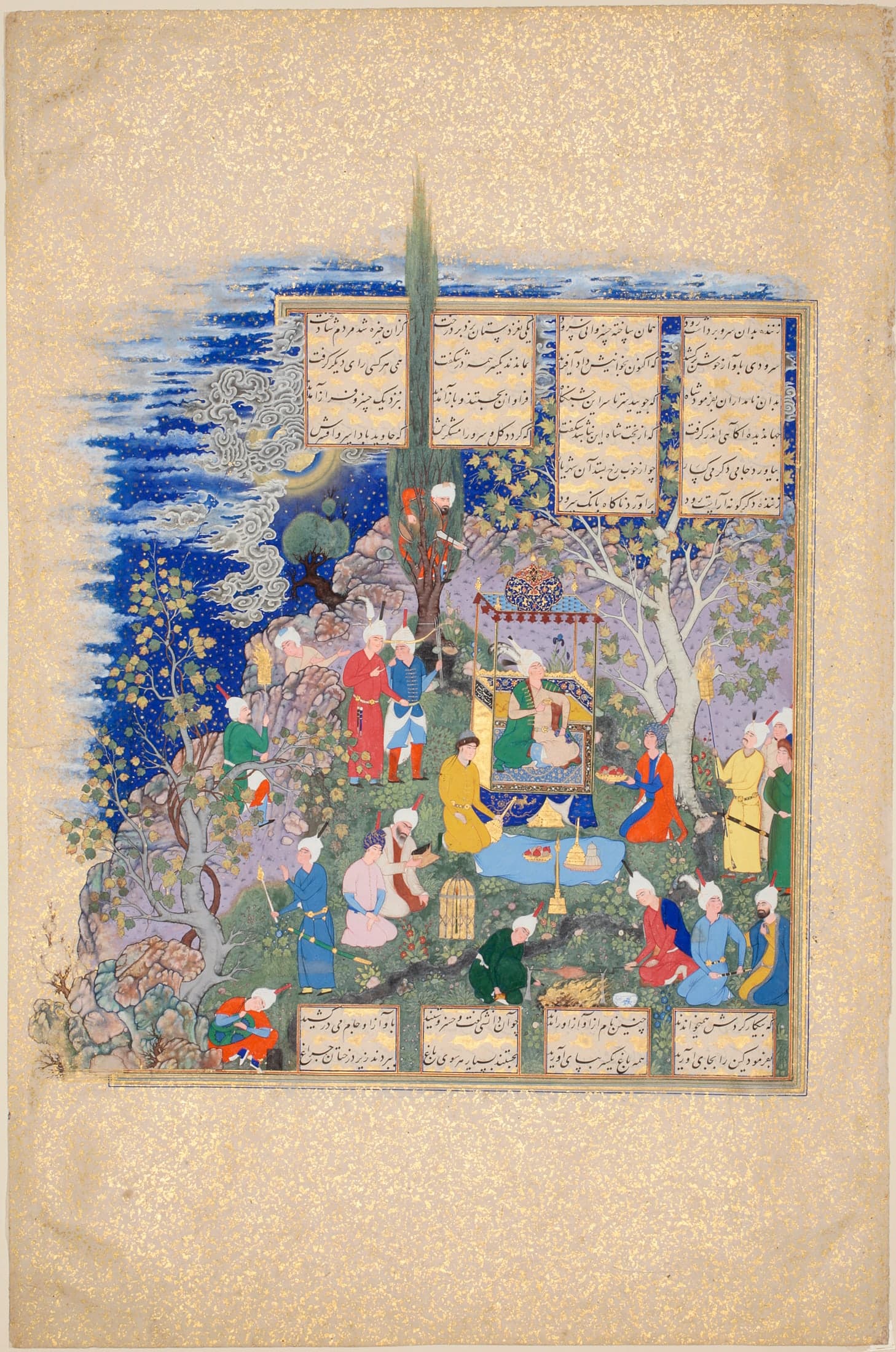
I · THE OBJECT · BRITISH MUSEUM
Shahnameh of Shah Tahmasp
▶ Listen · narrated
This manuscript took two decades to paint and four centuries to stay whole. Then, in the 1970s, someone pulled it apart and sold it in pieces.
At a glance
- Date
- 17th century
- Type
- Illuminated manuscript
- Original extent
- 759 pages, 258 miniatures
- Current locations
- Metropolitan Museum of Art, Tehran Museum of Contemporary Art, Aga Khan Museum, Nasser D. Khalili Collection, and others
Look closer
The scale of the commission
The manuscript contained seven hundred and fifty-nine pages when it was complete. Two hundred and fifty-eight of those were miniatures — individual paintings made by hand. The page size is approximately forty-eight by thirty-two centimetres. The text was written in Nastaʿlīq script, a calligraphic style prized for its fluidity and refinement. The sheer number of painted pages suggests a workshop effort sustained over years, not the output of a single artist.
What the Shahnameh is
The Shahnameh — the Book of Kings — is the national epic of Greater Iran, a long poem recounting the history and mythology of Persia from the creation of the world to the Arab conquest. It was composed by the poet Ferdowsi. Illustrated manuscripts of the Shahnameh were made across centuries, but this one is unusual for the density of its painted pages: more than a third of the total.
The imperial workshop
The miniatures were painted by artists working in an imperial workshop. These workshops were attached to the court and brought together calligraphers, painters, and illuminators under royal patronage. The artists worked under two rulers: the manuscript was begun under Shah Ismail I and completed under Shah Tahmasp I. The work was done in Tabriz, the capital of the Safavid dynasty at the time.
The story
An illuminated manuscript is a handwritten book in which the text is accompanied by decoration — borders, ornamental letters, and in this case full-page paintings. The Shahnameh of Shah Tahmasp is an illuminated copy of Persia's national epic, the Shahnameh, a long poem that recounts the mythological and historical past of Iran from the creation of the world through to the Arab conquest in the seventh century. The poem was composed by Ferdowsi, and it became the subject of illustrated manuscripts for centuries afterward.
This particular manuscript was made in the imperial workshop at Tabriz under the patronage of two Safavid rulers: Shah Ismail I, who founded the dynasty, and his son Shah Tahmasp I. The work began under Ismail and was completed under Tahmasp. It is sometimes called the Houghton Shahnameh, after a later owner, but its usual name ties it to the shah who saw it finished.
The manuscript contained seven hundred and fifty-nine pages. Two hundred and fifty-eight of those were miniatures — individual hand-painted illustrations. The page size is approximately forty-eight by thirty-two centimetres. The text was written in Nastaʿlīq, a calligraphic script developed in Iran and prized for its flowing, elegant proportions. Both the painting and the calligraphy were of exceptional quality, the products of a workshop that assembled the most skilled artists available to the court.
The number of miniatures is striking. Not every illustrated Shahnameh was painted so densely; many contained far fewer images. The decision to illustrate more than a third of the pages reflects both the resources of the Safavid court and the importance placed on the project. The work took years — possibly decades — to complete.
Upon completion, the manuscript was given as a gift to the Ottoman Sultan Selim II in 1568. Diplomatic gifts of this kind were not unusual between rival courts, and a manuscript of this scale would have been understood as a statement of cultural and artistic prowess. The Shahnameh remained intact for centuries after that.
In the 1970s, the manuscript was broken up. The pages were separated and sold individually. They are now dispersed across multiple collections around the world, including the Metropolitan Museum of Art, the Tehran Museum of Contemporary Art, the Aga Khan Museum, and the Nasser D. Khalili Collection of Islamic Art. Some pages remain in private hands. The dispersal means that no single institution holds the manuscript as it was made, and no visitor can see it whole.
Why it mattered then
The manuscript was a project of the Safavid court, and it served several purposes at once. It was a demonstration of the dynasty's cultural ambition and its command of resources — the ability to sustain a workshop of this calibre over years. It was also a claim on Persian identity. The Shahnameh was already centuries old by the time this manuscript was made, but it had become a text through which Persian-speaking courts asserted continuity with a pre-Islamic past, even as they ruled over an Islamic empire. Commissioning an illustrated copy of exceptional scale was a way of aligning the Safavid dynasty with that tradition. The gift to the Ottoman Sultan Selim II in 1568 placed the manuscript in a diplomatic context. The Safavids and the Ottomans were rivals, competitors for territory and influence across the region. A gift of this kind was a complex gesture: it acknowledged the sultan's status while also displaying what the Safavid court could produce. The manuscript carried a message about Persian artistic achievement that would have been legible to anyone who saw it.
Why it matters now
The manuscript's dispersal in the 1970s altered its significance. It is no longer an object that can be experienced as it was made — a bound volume in which text and image unfold across hundreds of pages. Instead, it exists as fragments held in different cities, seen by different audiences, studied in isolation from one another. Scholars can compare images across collections, but the original sequence and rhythm are lost. The breaking-up of the manuscript is part of a larger pattern in the trade of Islamic art during the twentieth century. Manuscripts, albums, and other bound works were sometimes separated because individual folios could be sold for more than the whole. The practice is now widely condemned, but it happened often enough that many collections contain pages from dismembered books. The Shahnameh of Shah Tahmasp is an especially prominent example because of the scale of the original and the quality of its painting. The pages that survive continue to be studied for what they reveal about Safavid painting, workshop practice, and the ways in which the Shahnameh was visualised across different periods. Each miniature is a record of how artists working under imperial patronage interpreted scenes from the epic — which moments they chose to depict, how they composed space and figure, what details they included or left out. Even scattered, the pages remain evidence of a particular moment in the history of Persian book arts.
The surprising detail
The manuscript remained intact for four centuries after it was made, passing through the hands of the Ottoman court and later owners. It survived wars, changes of dynasty, and shifts in taste. Then, in the 1970s, it was deliberately taken apart. The decision to break it up was driven by the art market: individual pages could be sold to collectors and institutions more easily than a single, extremely valuable manuscript. The dispersal was not the result of damage or loss over time; it was a calculated act, and it was legal under the laws that applied at the time. The pages are now separated by thousands of miles, and no one alive has seen the manuscript as it was made.
What is disputed
The dating of the manuscript is sometimes given as beginning in the 1520s and ending in the 1530s or 1540s, but the verified sources here record only a 17th-century inception. The discrepancy may reflect different interpretations of the evidence or ambiguity in the records. The exact sequence of the work — which miniatures were painted when, and by whom — is also debated among scholars, as the manuscript itself does not identify individual artists or provide dates for each page.
How it got here
The manuscript was gifted to the Ottoman Sultan Selim II in 1568 and remained in Ottoman and later private hands for centuries. In the 1970s it was broken up and the pages sold separately. The dispersal was legal under the laws that applied at the time, but it is now widely regarded as a loss to scholarship and to the integrity of the work. Pages are held in institutions including the Metropolitan Museum of Art, the Tehran Museum of Contemporary Art, the Aga Khan Museum, and the Nasser D. Khalili Collection of Islamic Art, as well as in private collections. No repatriation claims are recorded in the sources provided, but the breaking-up of the manuscript is itself a matter of ongoing scholarly and ethical discussion.
Remember this
Seven hundred and fifty-nine pages, painted over decades, then broken apart and sold piece by piece — a manuscript made to last that now exists only in fragments.
Test yourself
Why might the decision to illustrate more than a third of the manuscript's pages have been significant in its original context?
The density of illustration — two hundred and fifty-eight miniatures across seven hundred and fifty-nine pages — required sustained effort from a large workshop over years, possibly decades. That level of investment signalled the resources and ambition of the Safavid court. It also shaped how the manuscript would be read: with a painted page appearing every few pages, the experience of moving through the text was constantly interrupted by visual interpretation. This was not a book made for private, rapid reading; it was made for display, for slow viewing, and for demonstrating what the court's artists could achieve. The scale of illustration turned the manuscript into a statement about the dynasty's cultural authority, not just a copy of a beloved text.
Go deeper
- Shahnameh of Shah Tahmasp · Wikipedia
- Shahnameh of Shah Tahmasp — Wikidata · Wikidata
- Shahnameh of Shah Tahmasp — collection record · metmuseum.org
Image: Khalili Collections / CC-BY-SA 3.0 IGO. Licence: CC BY-SA 3.0 igo. Source.