III · THE WORK · ART HISTORY
The Music Lesson
▶ Listen · narrated
Two figures share a room and an instrument. What Vermeer withholds about them is as carefully placed as the light falling through the window.
At a glance
- Artist
- Johannes Vermeer
- Date
- 1662
- Medium
- Oil on canvas
- Dimensions
- 74.1 × 64.6 cm (2 ft 1 in)
- Collection
- Royal Collection, Buckingham Palace
- Inventory
- RCIN 405346
Look closer
The pair at the instrument
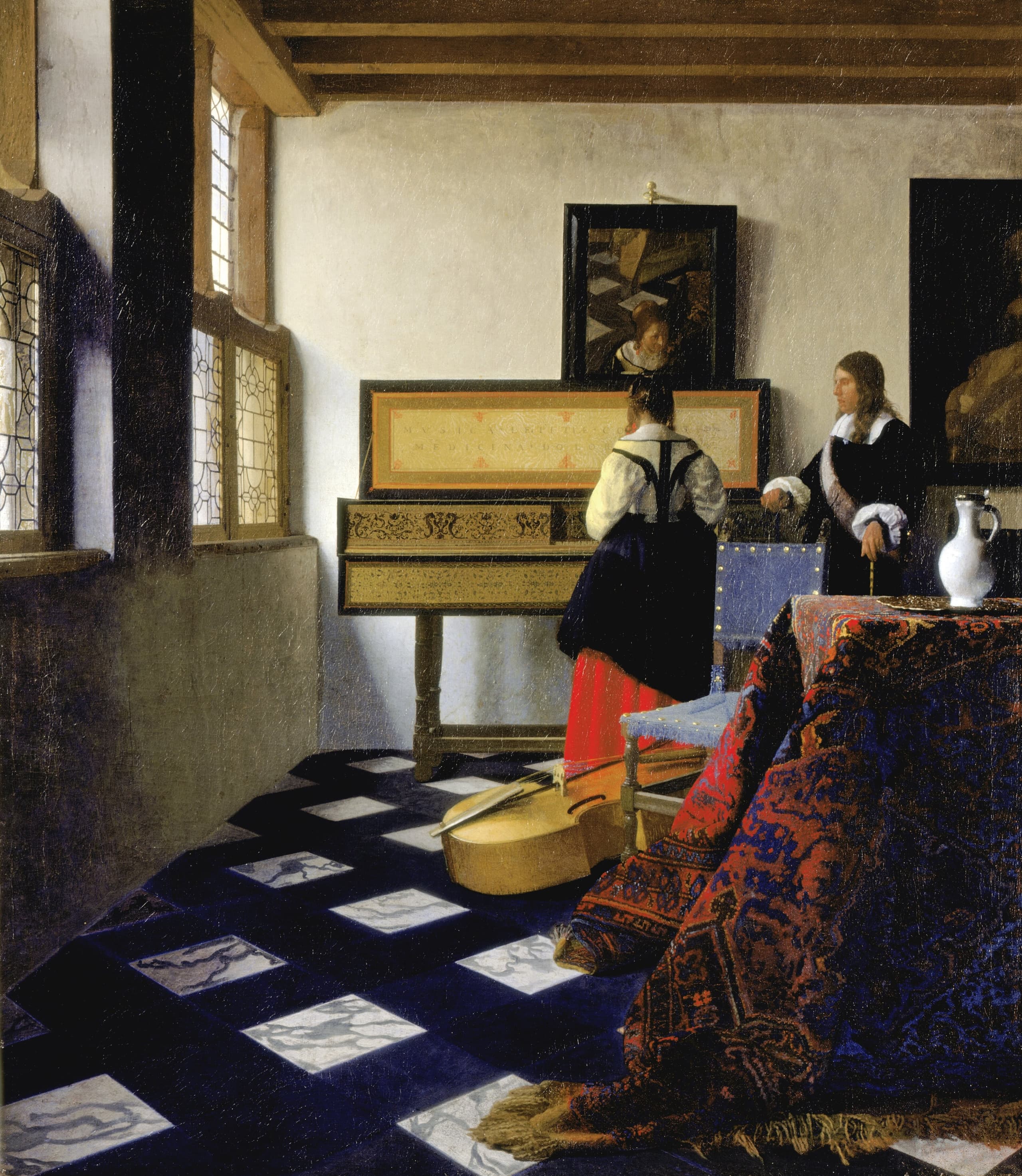
A young woman sits at a virginal; a man stands close beside her. His mouth is slightly open, which can read as if he is singing with whatever she plays. The painting does not declare whether this is instruction, courtship, or both. Music and love were a familiar pairing in Dutch genre painting of the period, and Vermeer leaves the tone deliberately unsettled: the lesson is visible; the feeling between them is not.
Light as architecture
Daylight enters from the windows and models the room without theatrical glare. It picks out the woman’s dress, the polished surfaces, and the quiet geometry of wall and floor. Vermeer returns often to this vocabulary — windows that control shadow, a tiled floor that measures space — so that light does as much compositional work as the figures themselves.
The room’s recurring furniture
A draped rug, a white water jug, instruments, and a patterned tiled floor appear here much as they do elsewhere in his work. These are not casual props. They build a shallow, legible interior and slow the eye as it moves from threshold objects toward the two people at the keyboard. The domestic setting is ordinary; the arrangement is not.
The story
The Music Lesson shows a spare, sunlit interior in which a young woman sits at a virginal and a man stands at her side. It is oil on canvas, a little under three-quarters of a metre high, and belongs to the strain of Dutch Golden Age painting usually called genre art: scenes of everyday life that often carried an undercurrent of meaning without spelling it out.
What we are given is specific and limited. She plays; he attends. His mouth is slightly agape, which suggests he may be singing along, though the paint stops short of proving it. The painting’s title, and its alternate names — Woman Seated at a Virginal, A Lady at the Virginals with a Gentleman — all keep the emphasis on the lesson. They do not settle whether the lesson is the whole subject or the cover for another.
Around the pair, Vermeer builds the room from a familiar kit of objects. A rug is draped rather than laid flat. A white water jug catches the light. Instruments are present as both tools and signs. The floor is tiled, so space can be counted in receding squares. Windows admit daylight that falls across wall and figure with a steadiness that feels observed rather than staged. He used these elements repeatedly across his interiors; here they serve to fix the two people in a credible private world and to slow the viewer’s path toward them.
Compositionally the painting is quiet rather than crowded. The figures occupy a measured share of the surface. Empty wall, furniture, and floor are given as much attention as faces. That balance is part of how the picture works: nothing points with a label, yet almost everything points toward the exchange at the keyboard. We are placed as if just inside the room, close enough to watch, not invited to interrupt.
The theme itself was common. In Dutch art of this period, music-making was often linked with harmony between people, and with love. A man and a woman at an instrument could be read as pupil and teacher, as courting couple, or as both at once. Vermeer does not choose for us. The open mouth, the proximity, the shared instrument — each detail allows more than one reading, and the paint refuses to rank them.
After Vermeer’s death the painting left his household when his family was forced to sell works that had remained with him. It later entered the Royal Collection. It is now at Buckingham Palace. The path from a private Delft interior to a royal picture gallery is part of the object’s later life; the image itself still behaves as if we have only just stepped into the room.
Why it mattered then
In the Dutch Golden Age, genre scenes of music lessons belonged to a wider habit of picturing private life with a moral or amorous edge. A woman at a virginal and a man beside her would have been legible to contemporary viewers as more than a simple snapshot of tuition. Music stood for harmony; shared music could stand for attraction. Painters returned to the motif because it let them show skill — fabrics, instruments, perspective, light — while leaving the human situation open enough to hold attention. Vermeer’s version sits inside that expectation and tightens it. By stripping the room to a few repeated objects and a controlled fall of daylight, he makes the encounter feel both ordinary and closely watched. The painting does not need allegory painted on a cartouche; the arrangement itself does the work. For a culture that prized finely made domestic interiors and the coded play of courtship, that restraint was a form of eloquence.
Why it matters now
The picture still matters because it shows how much a painting can withhold without becoming empty. Modern viewers often come to Vermeer for light and quiet; they stay for the social ambiguity. We still recognise the tension of two people sharing a task that might also be a performance for each other. The Music Lesson remains a study in looking: we are close enough to see the open mouth and the hands at the keys, far enough that motive stays out of reach. It also offers a clear case of how genre painting works when it is at its most careful — not as a window onto unmediated life, but as a composed argument about space, attention, and relationship. In a museum culture that can over-explain pictures, this one rewards the opposite habit: staying with what is visible until the unanswered part of the scene becomes its centre.
The surprising detail
This was among the paintings that remained in Vermeer’s own household until his death, when his family was forced to sell them. A work built to feel like a private room had, for a time, actually lived in one. It later passed into the Royal Collection and is kept at Buckingham Palace — a long journey from the domestic interior it depicts to the formal setting in which it is now seen.
What is disputed
Whether the man is teaching, courting, or both is not settled by the painting and should not be presented as if it were. The slightly open mouth suggests singing, but that remains an impression rather than a documented intention. Readings that treat the scene as an allegory of love draw on wider habits in Dutch genre painting; they are plausible contexts, not proofs of Vermeer’s aim.
Remember this
Vermeer stages a music lesson so precisely that the relationship between the two figures becomes the real subject — and remains unread.
Test yourself
The man’s slightly open mouth is a small mark in the paint. Why does that detail change how the whole scene can be read?
Because it allows the man to be more than a silent supervisor. If he is singing, the two figures are joined in the same music, not only in the same room. That possibility pulls the picture toward the familiar Dutch pairing of music and love, without forcing a single story. Remove the open mouth and the scene leans toward plain instruction; keep it and the lesson and the relationship stay entangled. The painting’s reserve depends on that single, undecided cue.
Go deeper
Image: Johannes Vermeer, Public domain. Licence: Public domain. Source.