III · THE WORK · ART HISTORY
The Alchemist Discovering Phosphorus
▶ Listen · narrated
Completed in 1771, this oil painting stages a widely told chemical story as if it were a sacred rite. The real subject is how light behaves on canvas.
At a glance
- Artist
- Joseph Wright of Derby
- Date
- 1771
- Medium
- Oil on canvas
- Dimensions
- 127 × 101.6 cm (3 ft 4 in)
- Collection
- Derby Museum and Art Gallery
- Inventory
- 1883-152
Look closer
The light that is not daylight
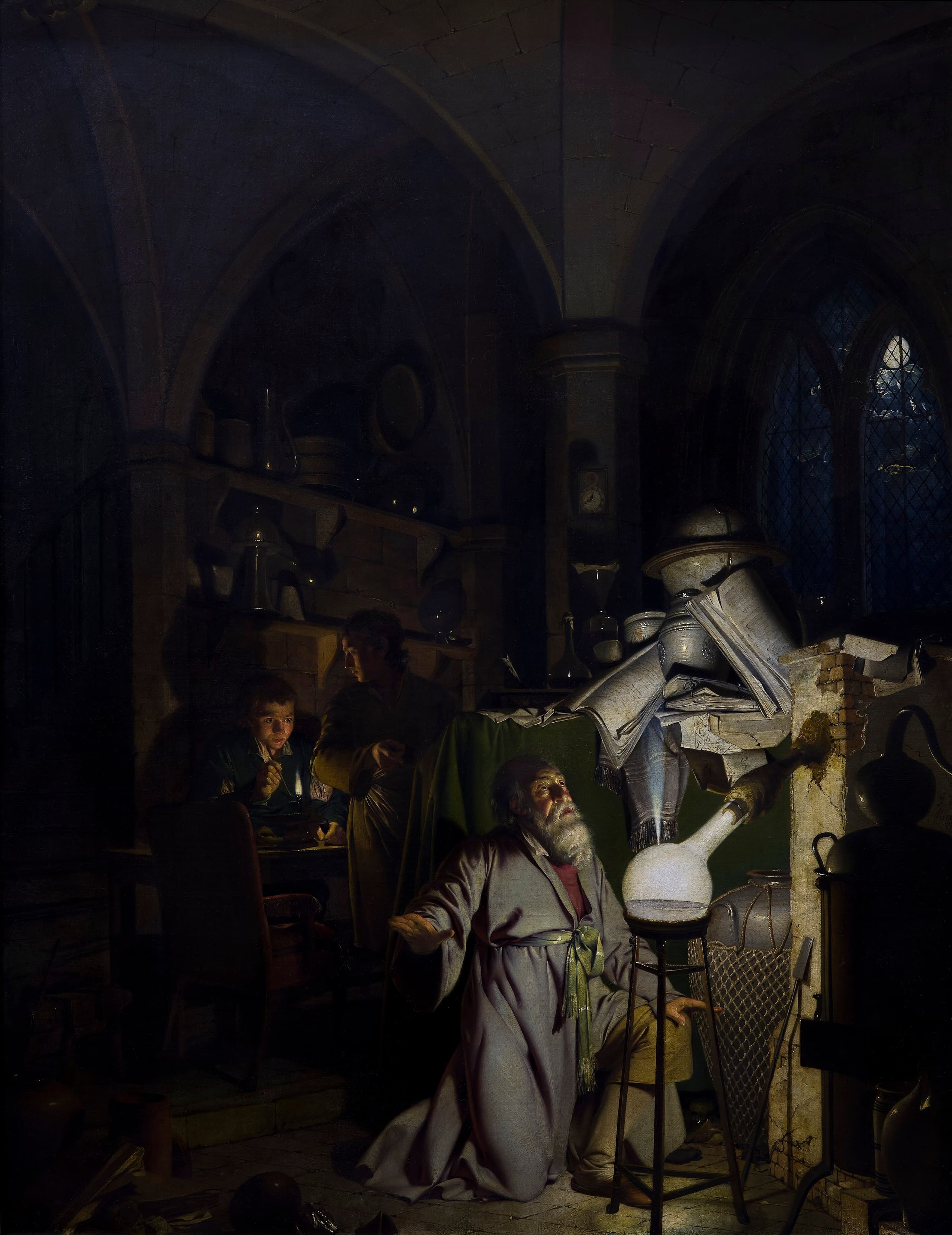
The composition is built around a single artificial radiance from the vessel at the heart of the operation. Surrounding surfaces — apparatus, fabric, the alchemist’s face and hands — are modelled by that glow. Wright seems less concerned to inventory every tool than to record what a dark room becomes when one object begins to shine.
A posture the title names
The full title states that the alchemist “prays for the successful Conclusion of his operation, as was the custom of the Ancient Chymical Astrologers.” The central figure is not staged as a modern experimenter coolly noting a result. He is held in the older attitude the title itself insists upon: discovery framed as petition.
Genre, not portrait
The work is classed as genre art. It does not present itself as the likeness of a named living chemist. It stages a type — the seeker after the philosopher’s stone — at the instant a different substance altogether announces itself, and leaves the historical identity of the man open.
The story
Joseph Wright of Derby finished this painting in 1771. It is oil on canvas, 127 centimetres (4 ft 2 in) high and 101.6 centimetres (3 ft 4 in) wide, and it belongs to the Derby Museum and Art Gallery, where it remains. The inventory number is 1883-152. Catalogued as genre art, it stages a type and an action rather than offering a formal portrait of a known sitter.
The full title is unusually explicit: The Alchymist, in Search of the Philosopher's Stone, Discovers Phosphorus, and prays for the successful Conclusion of his operation, as was the custom of the Ancient Chymical Astrologers. Those words do narrative work a shorter label could not. They name the false goal, the unexpected result, the gesture of prayer, and the older tradition in which such a gesture belonged. The man has been hunting one substance and has made another. His response, the title says, follows custom rather than the cool note-taking of later laboratory practice.
It has been suggested that the scene refers to the discovery of phosphorus by the Hamburg alchemist Hennig Brand in 1669. That story was often printed in popular chemical books during Wright’s lifetime and was widely known. The suggestion is plausible and useful; it is not, on the evidence here, proof that Wright set out to reconstruct Brand’s room with documentary care. The painting offers a dramatic laboratory — dark, intent, organised by a single glow — rather than a surveyed historical interior.
What the picture does insist upon is light. Phosphorus can shine. Wright builds the composition around that property so that the vessel of the operation becomes the lamp of the room. Flesh and glass are modelled by the same radiance. In a period still sorting the language of alchemy from the language of chemistry, the canvas holds both at once: the seeker after the philosopher’s stone, and the accidental product that would help render the older quest obsolete.
The work was reworked in 1795, more than twenty years after the first version. The facts record the reworking without listing each alteration. For anyone looking closely, the date alone matters. Wright returned to the image long enough after 1771 for the public conversation around experiment, and around his own night scenes, to have moved. The painting now in Derby is not only a document of its first year.
Why it mattered then
In the early 1770s Wright already had a practice of dark interiors governed by one artificial light. A subject drawn from the popular literature of chemistry fitted that practice with unusual neatness. Phosphorus arrived with a ready-made plot: long labour, sudden luminosity, a seeker surprised by his own result. The full title adds a moral and historical frame — prayer, custom, the ancient chymical astrologers — so that the scene reads as more than a technical demonstration. Viewers who knew the Brand story from books were given the illustration those pages lacked. Viewers who did not could still follow the title’s plot. Either way, the painting stood at a hinge between alchemical romance and experimental culture, using the means of genre art to give a chemical anecdote the gravity of a vigil.
Why it matters now
The painting still earns attention because it will not flatten the past into a simple victory of science over superstition. The alchemist is not ridiculed, and he is not quietly rewritten as a modern chemist ahead of his time. He prays; he has found something other than what he sought. That mixed tone remains useful. It keeps in view the tangle of motives — curiosity, the dream of gold, piety, method — that attended early chemical work. It is also still a rigorous exercise in pictorial light: an attempt to make a nearly invisible property, the glow of phosphorus, legible as the organising fact of a room. As a holding in Derby and as a widely discussed image, it continues to show how the eighteenth century pictured the century before it.
The surprising detail
The canvas was reworked in 1795, some twenty-four years after its inception. Wright did not leave the first solution alone. Whatever the precise changes — and the facts used here do not itemise them — the return itself is striking: a painter revisiting a night laboratory across a generation, after the culture of experiment around him had continued to shift.
What is disputed
The identification of the scene with Hennig Brand’s 1669 discovery of phosphorus is a suggestion grounded in the story’s currency in Wright’s lifetime, not a documented commission or inscription. The painting was reworked in 1795; the precise extent of those changes is not detailed in the facts used here.
Remember this
Wright turns the discovery of phosphorus into a scene of prayer, holding alchemy and chemistry in the same glow.
Test yourself
The painting is classed as genre art rather than history painting. What does that classification change about how we read the kneeling figure?
It steers us away from treating him as a fixed, nameable hero of science and toward reading him as a type — the alchemist at the crisis of an operation. The suggested link to Hennig Brand can still inform the picture, but the genre label keeps the scene general: a custom, a posture, a widely told story, rather than a verified likeness of one man’s laboratory in 1669.
Go deeper
- The Alchemist Discovering Phosphorus · Wikipedia
- The Alchemist Discovering Phosphorus — Wikidata · Wikidata
Image: Joseph Wright of Derby, Public domain. Licence: Public domain. Source.