I · THE OBJECT · BRITISH MUSEUM
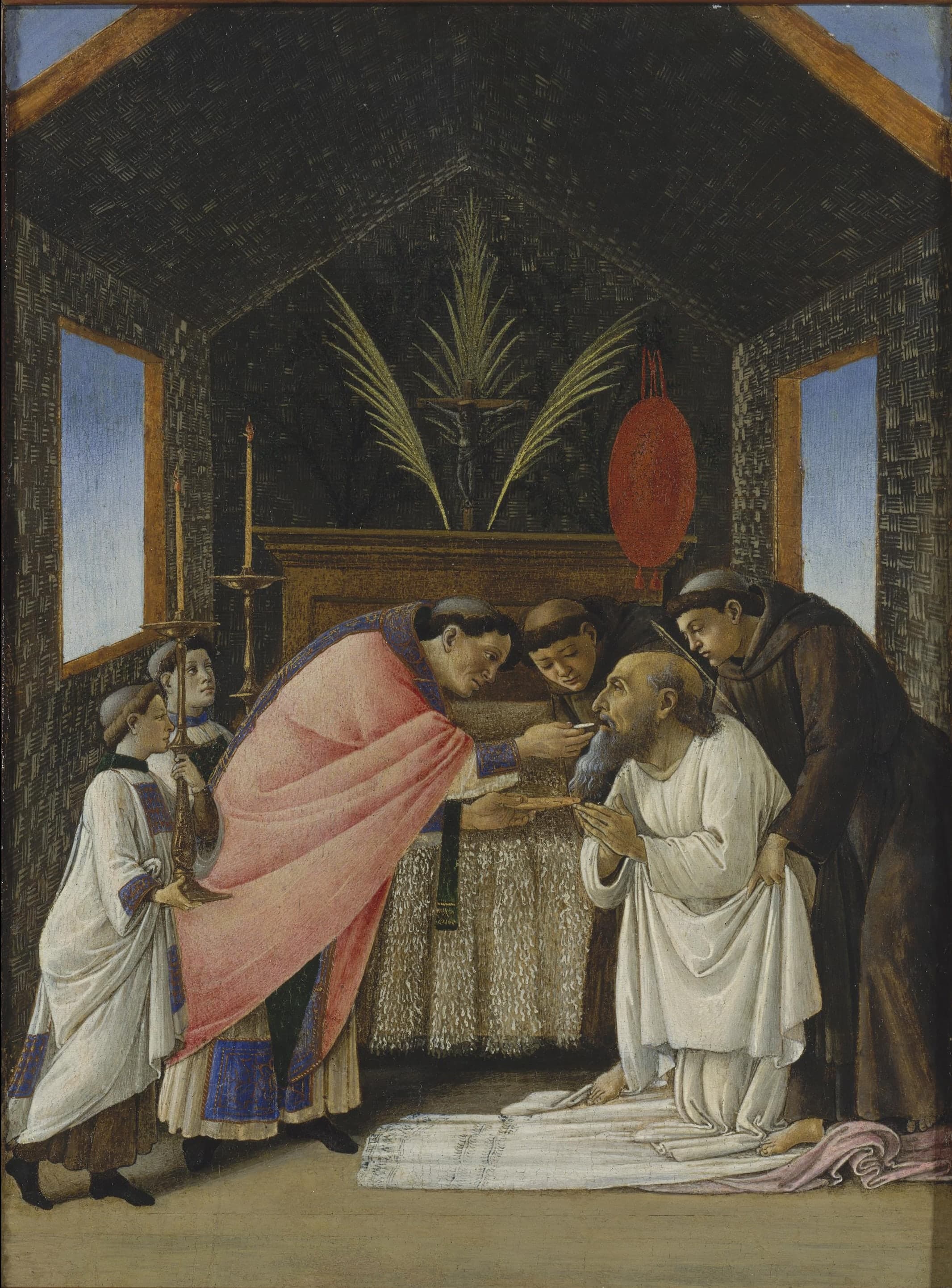
The Last Communion of Saint Jerome
▶ Listen · narrated
Jerome kneels to receive the wafer one final time, his body failing, his companions gathered close — a scene no ancient writer described.
At a glance
- Artist
- Sandro Botticelli
- Date
- 1495
- Material
- Tempera on panel
- Dimensions
- 34.3 × 25.4 cm
- Collection
- Metropolitan Museum of Art
- Inventory number
- 14.40.642
Look closer
A scene from a medieval letter, not an ancient one
The moment Botticelli depicts — Jerome on his knees, asking for the host as he dies — comes from a medieval text that presents itself as a letter from Eusebius to Damasus describing Jerome's death. No ancient author is known to have written such an account. The letter circulated widely in manuscript, and between 1471 and 1487 it was printed several times in Italy. Botticelli painted a scene that late medieval readers believed was historical, but which scholars now recognise as a later invention.
The patron was a follower of Savonarola
Francesco del Pugliese, who commissioned the panel, was a noted follower of Girolamo Savonarola, the Dominican preacher whose sermons dominated Florence in the 1490s. Savonarola's supporters found in the medieval letter about Jerome's death what they took to be a vision of early Christian simplicity and direct faith. One scholar has suggested that del Pugliese, commissioning this particular scene around 1495, may have been thinking of parallels between Jerome and Savonarola — between the dying saint and the living preacher whose own death would come a few years later.
Tempera on a small panel
The painting is tempera on wood panel, measuring just over 34 centimetres tall and 25 wide — small enough to hold in two hands. Tempera, made by binding pigment with egg yolk, dries quickly and allows fine detail but does not blend as oil paint does. The technique was standard in Italian panel painting through the fifteenth century, though oil was beginning to spread from the north. Botticelli worked in tempera throughout his career.
The story
The panel shows Jerome, the fourth-century scholar who translated the Bible into Latin, at the moment of his death. He is on his knees on a linen sheet, his body visibly failing, surrounded by his monastic companions. A priest approaches with the consecrated host — the body of Christ in the form of a wafer — and Jerome reaches forward to receive communion one last time.
The scene derives from a medieval text that circulated under the name of Eusebius, bishop of Caesarea, addressed to Damasus. The letter claims to describe Jerome's final hours: how he gathered his brothers around him, asked to be lifted to his knees despite his weakness, and professed his faith in the presence of Christ in the Eucharist as the priest came near. The text was widely copied in manuscript and, between 1471 and 1487, printed several times in Italy. Readers took it as a historical account. No ancient author, however, is known to have described this scene, and scholars now classify the letter as pseudepigraphical — written later and attributed to Eusebius falsely.
Botticelli painted the panel around 1495, during years when Florence was dominated by the preaching of Girolamo Savonarola. Savonarola, a Dominican friar, called for moral reform and a return to what he presented as the simplicity of early Christianity. His followers found in the medieval Jerome letter a vision that matched their own: a saint at the threshold of death, stripped of worldly concern, affirming his faith in the sacrament. Francesco del Pugliese, who commissioned the painting, was a noted supporter of Savonarola.
One scholar has proposed that del Pugliese may have seen a parallel between Jerome and Savonarola, and that the choice of this particular scene — a holy man's last communion, witnessed by his community — carried a contemporary charge. Whether del Pugliese intended that reading or not is not recorded. What is clear is that the subject resonated in Florence at that moment, and that Botticelli, himself influenced by Savonarola's preaching, painted it.
The subject was taken up again by later painters. Agostino Carracci, working in Bologna in the Baroque period, painted a version now in the Pinacoteca Nazionale there. Domenichino painted another, now in the Vatican. But Botticelli's panel, small and intimate, belongs to the moment when the medieval text and the Florentine present seemed to speak to one another.
Why it mattered then
The panel mattered in Florence in 1495 because it visualised a text that Savonarola's followers read as a model of Christian devotion stripped to its essentials. The medieval letter about Jerome's death had been reprinted several times in Italy in the preceding decades, and it circulated among readers who believed it described a historical event. For Savonarola's supporters, the image of Jerome kneeling to receive communion as he died — professing faith in the real presence of Christ in the host — embodied the kind of direct, unornamented piety the preacher called for. Francesco del Pugliese, commissioning the work, was part of a circle that saw in early Christian figures like Jerome a rebuke to the wealth and complexity of the contemporary Church. Whether or not del Pugliese intended viewers to think of Savonarola himself when they looked at the dying Jerome, the painting carried the weight of a contemporary argument about what Christian life should look like.
Why it matters now
The panel matters now as evidence of how a painting can be made to carry more than one layer of meaning at once. On its surface it depicts a fourth-century saint at the moment of death, drawing on a text its original audience believed was ancient. Beneath that it reflects the concerns of Florence in the 1490s, when Savonarola's preaching had convinced many that the Church needed reform and that early Christian simplicity was the standard. The painting does not announce that second layer — it does not name Savonarola or gloss its own context — but the choice of subject, the patron who commissioned it, and the moment it was made all point to it. It is a reminder that religious images are not only devotional objects but also arguments, and that a scene from the past can be made to speak to the present without a word of explanation added to the frame.
The surprising detail
The medieval text that Botticelli's painting illustrates — the letter supposedly from Eusebius describing Jerome's death — was treated as historical for centuries. It was copied, printed, and read as a reliable account of how Jerome died. Scholars now classify it as pseudepigraphical, meaning it was written later and falsely attributed to Eusebius. No ancient author is known to have described the communion scene it depicts. The text's popularity in late fifteenth-century Italy, and its appeal to Savonarola's followers, rested on a belief in its authenticity that turned out to be unfounded. Botticelli painted a scene that never happened, based on a letter that was not what it claimed to be, for a patron who saw in it a vision of early Christian truth.
What is disputed
One scholar has suggested that Francesco del Pugliese, commissioning the painting, may have intended viewers to see a parallel between Jerome and Savonarola, and that the choice of this deathbed communion scene may have been meant to evoke the preacher's own situation. That reading is plausible given del Pugliese's documented support for Savonarola and the timing of the commission, but it is not recorded in any contemporary account. The painting does not announce such a reading, and whether del Pugliese or Botticelli intended it remains a matter of interpretation rather than documented fact.
Remember this
A deathbed communion from a medieval text, painted for a patron who saw in Jerome's last act of faith a mirror of his own moment.
Test yourself
Why might Francesco del Pugliese have chosen this particular moment from Jerome's life to commission, rather than the more common images of Jerome as a scholar in his study or as a penitent in the desert?
The communion scene, unlike the study or the desert, shows Jerome at the threshold of death, stripped of scholarly work and worldly concern, affirming his faith in the Eucharist in front of his monastic community. For a follower of Savonarola in 1495, that image aligned with the preacher's call for a return to simple, direct Christian devotion and the centrality of the sacraments. The scene also comes from a text that Savonarola's circle read as a window into early Christianity, which they held up as a model against the wealth and complexity of the contemporary Church. A scholar at his desk or a hermit in solitude would not have carried the same charge. The choice of subject was not neutral — it was a choice about what kind of holiness mattered.
Go deeper
- The Last Communion of Saint Jerome (Botticelli) · Wikipedia
- The Last Communion of Saint Jerome — Wikidata · Wikidata
Image: Sandro Botticelli / Bartolomeo di Giovanni, Public domain. Licence: Public domain. Source.