I · THE OBJECT · BRITISH MUSEUM
The Penitent Magdalen
▶ Listen · narrated
Georges de La Tour painted religious subjects as if they were night interiors. This canvas is one of several candlelit Magdalens, and it still holds a gallery wall at the Metropolitan Museum.
At a glance
- Artist
- Georges de La Tour
- Date
- c. 1625–1640 (undated)
- Material
- Oil paint on canvas
- Dimensions
- 133.4 × 102.2 cm (3 ft 4 in)
- Inventory
- 1978.517
- Genre
- Religious art
Look closer
Two flames, one candle
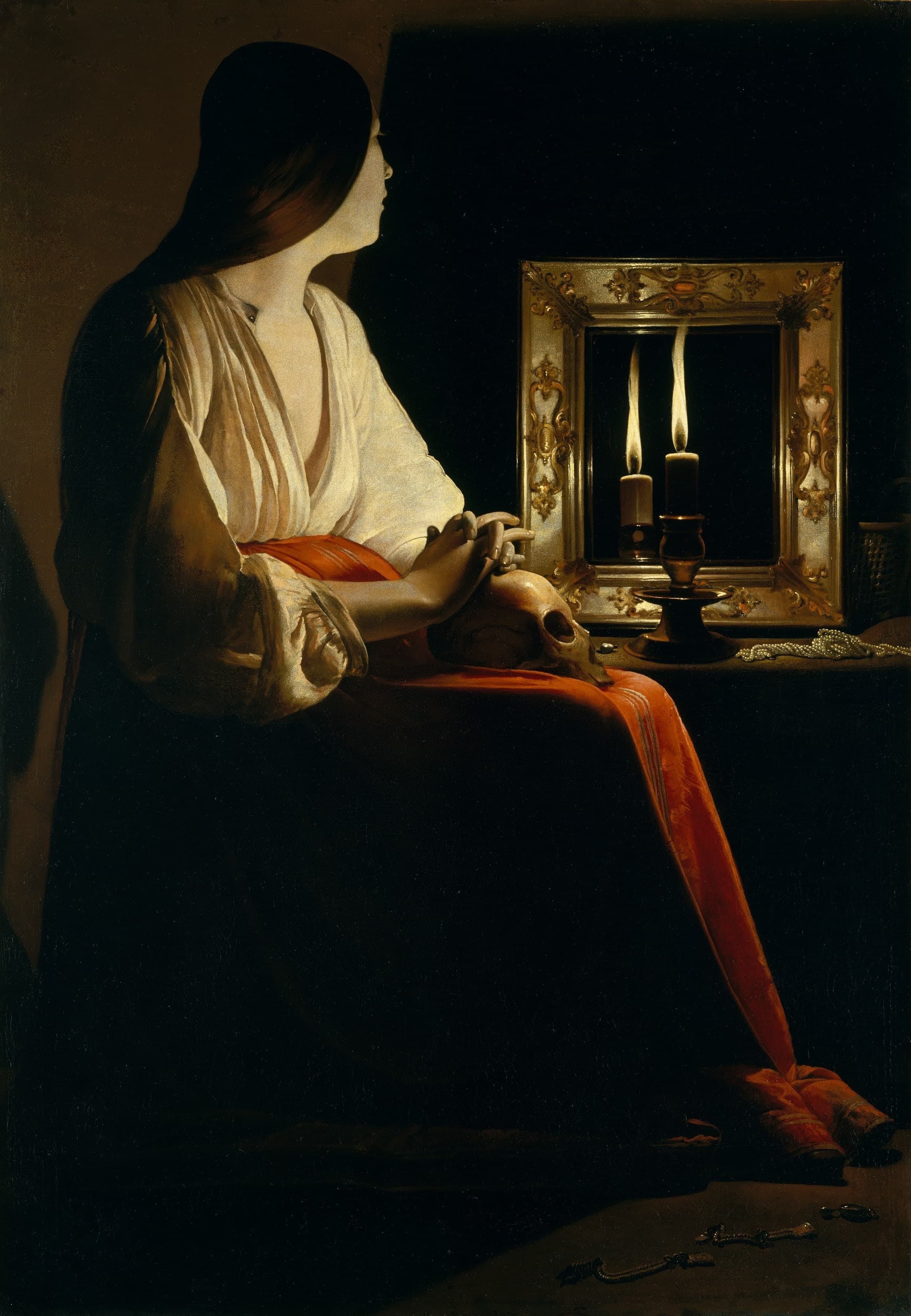
The light source is a single candle, but the mirror returns a second flame. That doubled light is what gives the painting its other common title, Magdalene with Two Flames. The real flame lights her face and breast; the reflected one deepens the dark around them. You are looking at a simple optical fact made into the whole structure of the picture.
Skull, jewels, stillness
She holds a human skull and sits before discarded jewellery. The candle and the skull read as reminders of how briefly life lasts; the abandoned ornaments stand for worldly goods set aside. Nothing in the pose is theatrical. The body is quiet, the hands occupied, the gaze turned inward rather than out toward the viewer.
Light cut against dark
The brightly lit face and breast sit against a composition otherwise given over to darkness. That contrast — a strong chiaroscuro — is not decoration. It isolates the figure, strips away setting, and forces attention onto the few objects that remain: flame, glass, bone, and skin. The room almost disappears so the meditation can hold the frame.
The story
The Penitent Magdalen is an oil painting on canvas by the French painter Georges de La Tour. It belongs to the Metropolitan Museum of Art in New York, where it hangs under inventory number 1978.517. The work is undated. The available dates place its making somewhere in the span from 1625 to 1640; around 1640 is the figure often attached to it, but the canvas itself does not settle the question.
What it shows is clear enough. Mary Magdalene, companion of Christ, appears not in a narrative scene from the Gospels but in a private act of penance and contemplation. She has exchanged a worldly life for this quieter one. La Tour seats her in a meditative pose before a mirror, lit by a candle. The light from that candle and from its reflection in the glass creates a sharp division between the parts of her that catch the flame and the darkness that claims the rest of the canvas.
The props are few and deliberate. She holds a human skull. Jewellery lies discarded. Both the candle and the skull have long been read as metaphors for the fragility of life; the abandoned jewels for the thin value of worldly possessions and for atonement. Nothing here is crowded. The painting works by subtraction: almost no furniture, almost no depth of room, almost no colour that is not pulled toward the warm light or the surrounding black.
This canvas is one of several by La Tour that show a candlelit Mary Magdalene. The type clearly mattered to him. He returns to the same subject under the same kind of night light, testing how much religious feeling can be carried by a single flame, a seated body, and a handful of emblems. The result is religious art that behaves like a night interior — intimate, local, and slow rather than grand or public.
The painting entered the Metropolitan Museum of Art in 1978 as a gift from Mr. and Mrs. Charles Wrightsman. It remains in that collection and on view in that museum. Whatever path it took before that gift is not set out in the facts at hand; what is certain is the artist, the medium, the approximate date range, the subject, and the institution that now holds it.
Why it mattered then
In the early modern period a painting of the penitent Magdalene was not an obscure private whim. Mary Magdalene was a recognised figure of conversion: a companion of Christ who turned from a worldly life to penance and contemplation. Artists returned to her because the subject let them stage repentance as something visible — a body at rest, worldly goods set down, a mind fixed on death and on what outlasts it. La Tour’s version belongs to that tradition but narrows it. Instead of a crowded sacred narrative he offers a night scene built around one candle. The mirror, the skull, and the discarded jewellery do the doctrinal work without inscriptions or a cast of other figures. For a seventeenth-century viewer fluent in those emblems, the picture would have been legible at once: life is brief, ornament is empty, attention should turn inward. The strong contrast of light and dark was not only a painter’s device; it matched the subject’s moral binary of what is kept and what is renounced. That he painted more than one candlelit Magdalene suggests the theme held him. The type allowed religious art to occupy the same quiet register as a domestic night scene, which may have suited both devotion and the taste of patrons who wanted sacred subjects without spectacle.
Why it matters now
The painting still matters because it shows how little a religious image can contain and still hold. A candle, a mirror, a skull, cast-off jewels, and a seated woman are enough. Modern viewers who no longer share the full emblem tradition can still read the economy of the scene: light against dark, ornament against bone, a face half claimed by flame and half by shadow. It also matters as a clear example of Georges de La Tour’s habit of treating sacred subjects as night interiors. That habit has kept his work legible outside specialist circles. People stop for the light before they stop for the theology, and then the two begin to work together. In a museum crowded with louder baroque drama, this canvas asks for a slower kind of looking — the same kind of looking the figure herself is performing. Finally, it is one of several related Magdalens by the same hand. Seeing it as part of a repeated investigation, not a single masterpiece claim, is useful. Repetition here is evidence of seriousness: an artist circling a problem of light, penitence, and stillness until the arrangement holds.
The surprising detail
The painting is often known by two titles at once: The Penitent Magdalen and Magdalene with Two Flames. The second name is not poetic embroidery. It points to a plain fact in the picture — the candle and the flame reflected in the mirror — and that optical doubling is the engine of the whole composition. La Tour did not invent a crowded miracle; he trusted one light source and a sheet of glass.
What is disputed
The painting is undated. Sources place its inception across 1625 and 1640, with around 1640 often given as a working date, but the canvas itself does not fix a year. Treat the date as a range, not a settled fact.
How it got here
In 1978 Mr. and Mrs. Charles Wrightsman gave the painting to the Metropolitan Museum of Art, New York, where it remains (inventory number 1978.517). Earlier ownership is not detailed in the facts supplied here.
Remember this
One candle, its twin in a mirror, a skull, and cast-off jewels: La Tour builds penance from night light and a few plain objects.
Test yourself
Why does the painting’s second title, Magdalene with Two Flames, describe more than a poetic mood?
Because the second flame is literal: the candle is reflected in the mirror before which Mary Magdalene sits. That doubled light creates the strong contrast between her lit face and breast and the surrounding darkness. The title names the optical fact that organises the whole picture, not only the spiritual atmosphere.