I · THE OBJECT · BRITISH MUSEUM
The Annunciation
▶ Listen · narrated
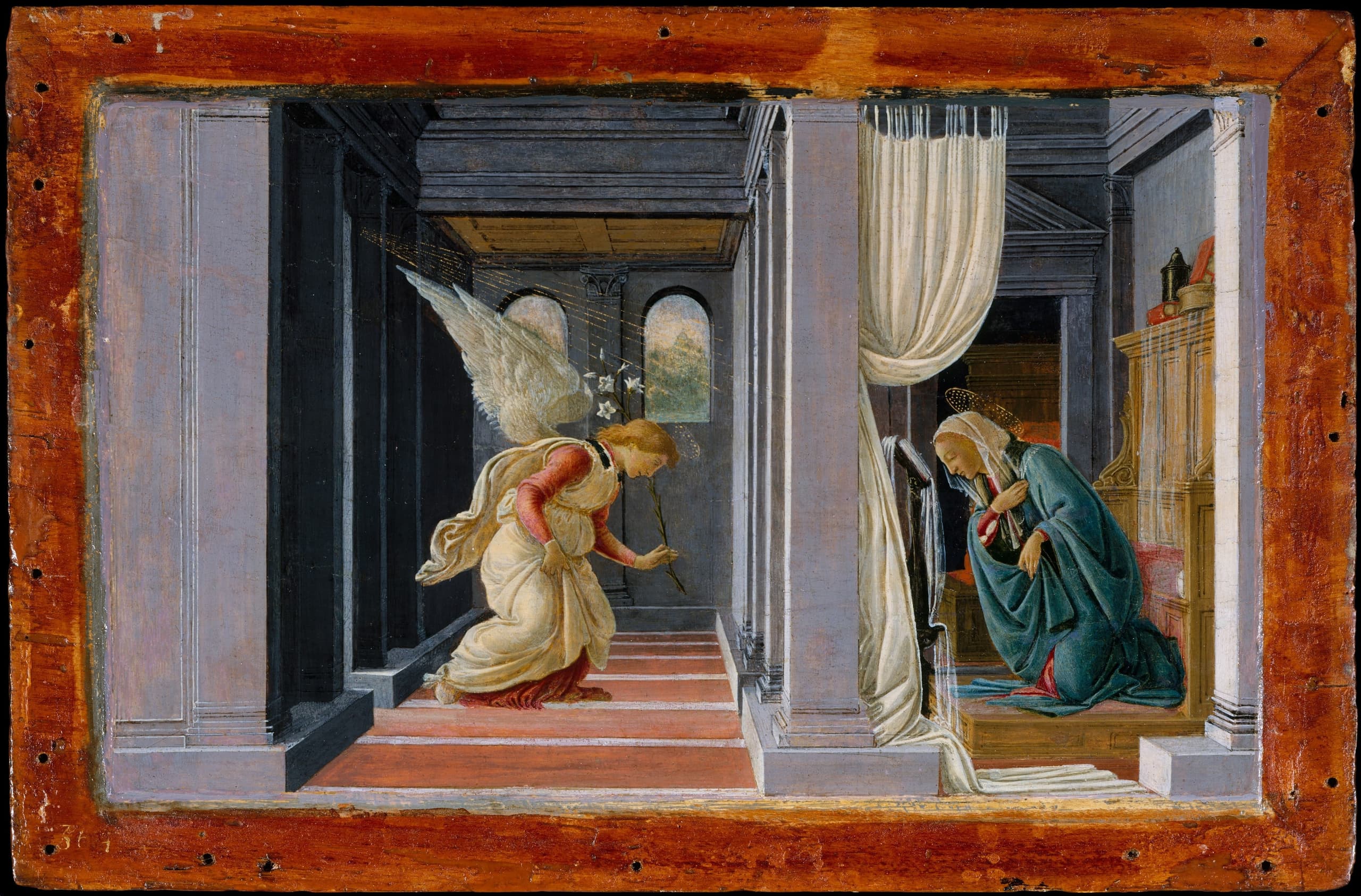
At barely nineteen centimetres high, this painting was made to be held close. Its materials and size say as much about Renaissance piety as the scene itself does.
At a glance
- Date
- 15th century
- Artist
- Sandro Botticelli
- Material
- Tempera, gold leaf, wood
- Dimensions
- 19.1 × 31.4 cm (1 ft)
- Movement
- Early Renaissance
- Inventory
- 1975.1.74
Look closer
Built for close looking
At 19.1 centimetres (8 in) high and 31.4 centimetres (1 ft) wide, the panel is modest even by domestic standards. The Metropolitan Museum of Art judges that it was painted as a single image for private devotional use, not as one unit in a predella strip beneath a large altarpiece. The horizontal format suits a scene of approach and reply without needing the vertical reach of a public church picture.
Tempera, gold, wood
The support is wood; the paint is tempera, with gold leaf applied where the design required it. Tempera sets quickly and keeps a firm edge, which suited the clear contours favoured in Early Renaissance religious painting. Gold leaf answers to candlelight and daylight alike, marking sacred presence on a surface small enough to sit within arm's reach.
A familiar sacred subject
The genre is religious art; the subject is the Annunciation. That choice placed the panel inside one of the most often painted Christian narratives of the period, while the Early Renaissance movement around it pressed painters to give such encounters human scale, readable space and a gravity that still served prayer.
The story
The Annunciation now in the Metropolitan Museum of Art is a small painting by Sandro Botticelli, made in the fifteenth century. It is tempera and gold leaf on wood, 19.1 centimetres (8 in) high and 31.4 centimetres (1 ft) wide, inventoried as 1975.1.74. It belongs to the museum's collection and is classed as religious art of the Early Renaissance.
The subject is the angel's greeting to Mary — a scene so central to Christian narrative that painters returned to it across whole careers. Botticelli did so more than once. Beside this New York panel he painted the Cestello Annunciation for Santa Maria Maddalena dei Pazzi and another Annunciation associated with San Barnaba in Florence, now in Glasgow. The Metropolitan picture is not a reduced echo of those works. It is a separate treatment, cut to a different purpose and a different scale.
That purpose, as the Metropolitan reads it, was private devotion. The museum holds that the panel was painted as a single image rather than as one of a set of predella scenes below the main field of an altarpiece. Nothing in the surviving object forces the opposite conclusion: the dimensions are self-contained, and no companion panels are securely tied to it. Fifteenth-century owners often kept such pictures in chambers or small oratories, where the painting could be approached daily rather than glimpsed across a nave.
The panel's later life is clearer than its first commission. It is known to have been in the Barberini family collection in Rome in the seventeenth century, a fact reflected in Palazzo Barberini's place among its recorded locations. Centuries on it entered the Robert Lehman Collection, which was donated to the Metropolitan Museum of Art in 1969. The inventory number belongs to that gift and to the museum's subsequent care of the work.
What remains, then, is not a scrap lifted from a larger machine of public worship but a complete object meant for sustained attention at close range. The wood, the tempera surface and the gold leaf are still the physical terms on which the subject was offered. Scale is not a minor fact about the painting; it is part of how the Annunciation was meant to be received.
Why it mattered then
In the fifteenth century the Annunciation was among the most frequently painted subjects in Christian art. It fixed the moment when sacred message and human reply met, and it gave painters a compact drama of gesture, space and deference. A panel of this size could serve a household or private oratory without the cost or bulk of a full altarpiece, while still carrying the authority of a known Early Renaissance hand. Tempera and gold leaf on wood were durable, conventional materials for such work. Whether the image hung in a church complex or rested in a domestic room, it had to remain legible as prayer and as story. Botticelli's other Annunciations from the broader period show how often patrons asked for this subject; the New York panel shows how the same subject could be scaled down for intimacy rather than display.
Why it matters now
The painting still matters because it shows a major Early Renaissance artist handling a core sacred subject at a scale built for the hand and the chamber. Public collections often introduce Botticelli through large mythologies or monumental church pictures; this object restores the quieter side of the same practice. Its path from the Barberini holdings in Rome to the Robert Lehman gift in 1969 also traces how Renaissance panels moved from aristocratic collections into public American museums. The materials remain readable on the surface, so the facts of making are still available to anyone who stands before it. And the museum's own distinction between a free-standing devotional image and a detached predella panel keeps a live question in view: how the same sacred story changes when it is made for one person's repeated looking rather than for a public ensemble.
The surprising detail
For a Botticelli Annunciation, the panel is strikingly small — just over nineteen centimetres high and barely thirty-one wide. The Metropolitan treats it as an independent image for private devotion, not a strip panel cut from beneath a larger altarpiece. That reading turns on size and self-containment rather than on a surviving contract, and it changes the whole imagined life of the object: from public church furniture to something kept close.
What is disputed
The core record fixes the work in the fifteenth century without a single secure year. Finer dating within that century remains a matter of stylistic judgement. Whether the panel was always independent or once belonged to a larger complex is likewise inferred from size and self-containment rather than from a documented commission; the Metropolitan's private-devotion reading is persuasive but not proven by contract.
How it got here
The painting is known to have been in the Barberini family collection in Rome in the seventeenth century and is associated with Palazzo Barberini among its recorded locations. It later formed part of the Robert Lehman Collection, donated to the Metropolitan Museum of Art in 1969, where it is held under inventory number 1975.1.74.
Remember this
A fifteenth-century Botticelli Annunciation in tempera and gold, scaled for private devotion and now in the Metropolitan Museum of Art.
Test yourself
Why does the Metropolitan Museum of Art's view that this was a single private-devotional image, rather than a predella panel, change how we understand the painting?
A predella panel is one unit in a strip of scenes below a large altarpiece, designed to be read as part of a public ensemble. A free-standing private image is complete in itself and made for close, repeated looking in a domestic or oratory setting. The panel's modest dimensions and the absence of a securely linked companion set support the museum's reading. The same Annunciation subject therefore does different work depending on whether it answers to a church sequence or to a single person's prayer.
Go deeper
Image: Sandro Botticelli, Public domain. Licence: Public domain. Source.