II · THE DISCOVERY · HISTORY OF SCIENCE
Laser
Before 1960, no device could produce light that stayed in a tight beam over distance or could be focused to a spot small enough to cut metal.
At a glance
- Discovery date
- 16 May 1960 (Wikidata P575)
- Built by
- Theodore Maiman at Hughes Research Laboratories
- Based on
- Theoretical work by Charles H. Townes and Arthur Leonard Schawlow
- Name origin
- Acronym for light amplification by stimulated emission of radiation
Look closer
The date is precise to the day
Wikidata records the discovery as 16 May 1960 — a specific day rather than a vague year. That precision reflects a single experimental success: the moment Theodore Maiman's device at Hughes Research Laboratories produced its pulse of amplified light. The device itself was built on theoretical work by others, and Gordon Gould had patented an optical amplifier design, but the working laser came on that May day.
Coherence is what makes it different
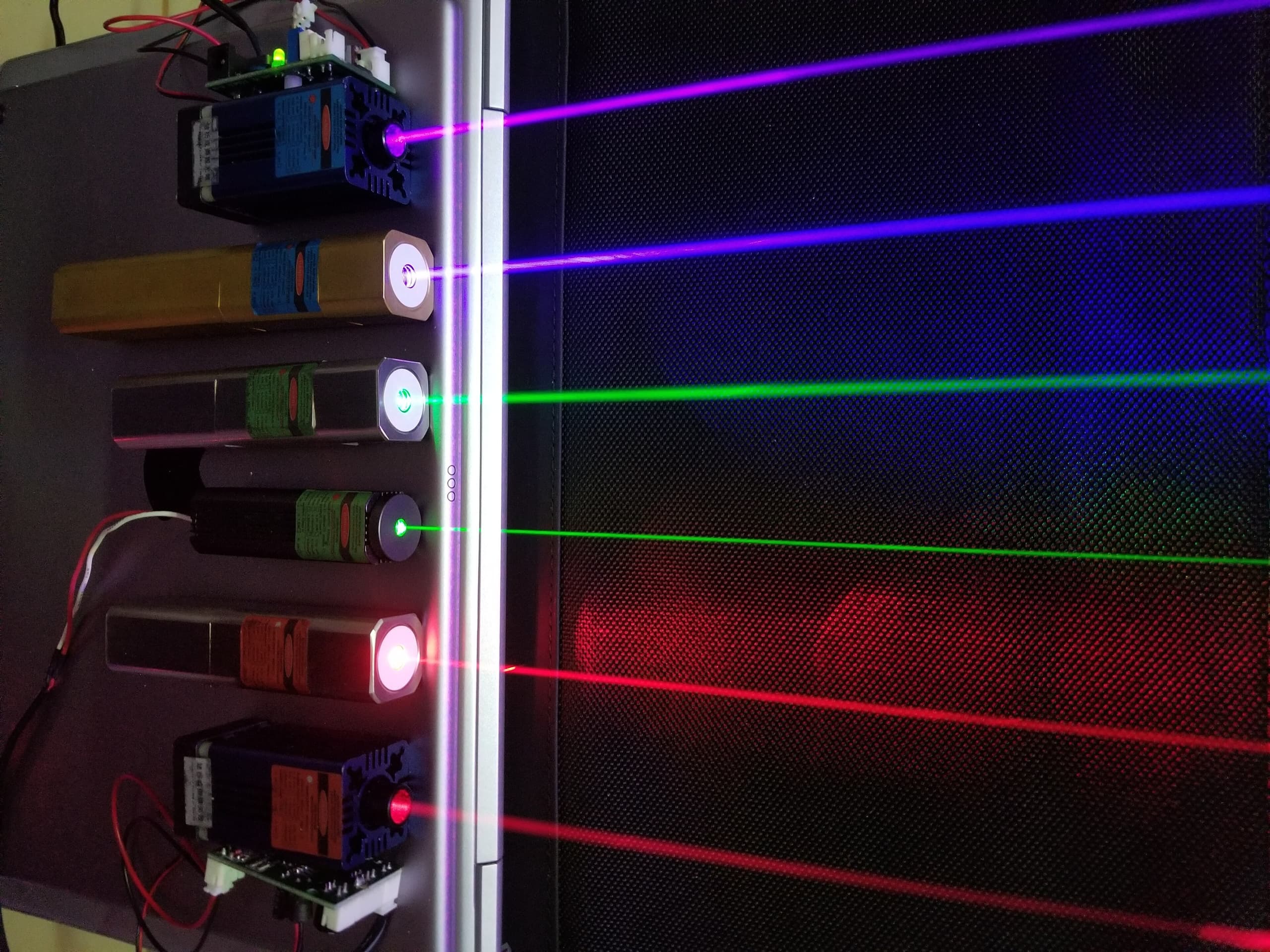
A laser emits light that is coherent — meaning the light waves march in step with one another, rather than jumbled like the light from a bulb or the sun. Spatial coherence is what allows a laser beam to be focused to a tight spot, narrow enough to cut through metal or etch patterns on a semiconductor chip. It also lets the beam stay narrow over great distances, which is why a laser pointer makes a visible dot across a room and why free-space optical communication works.
The name was an acronym, now a word
The word laser originated as an acronym: light amplification by stimulated emission of radiation. Stimulated emission is the process at the heart of it — radiation of one wavelength triggers atoms to release more radiation of the same wavelength, building up the signal rather than just passing it through. The acronym has since become the ordinary word for the device, written in lowercase and pronounced as a single syllable.
The story
Theodore Maiman built a laser in 1960 at Hughes Research Laboratories. It was based on theoretical work by Charles H. Townes and Arthur Leonard Schawlow, and an optical amplifier design patented by Gordon Gould. The device that Maiman built produced a pulse of red light on 16 May 1960, marking the moment a working apparatus amplified light through stimulated emission.
A laser differs from other sources of light in that it emits light that is coherent. Coherence means the light waves are aligned with one another — they march in step, rather than arriving at random intervals and angles the way light from a bulb or the sun does. There are two kinds of coherence that matter.
Spatial coherence allows a laser to be focused to a tight spot, which is what makes laser cutting, lithography — the process of etching patterns onto semiconductor chips — and optical communication possible. It also allows a laser beam to stay narrow over great distances, a property called collimation, which is used in laser pointers, lidar — a method of measuring distance by bouncing light off a surface — and free-space optical communication, where signals travel through air rather than cables.
Lasers can also have high temporal coherence, which permits them to emit light with a very narrow frequency spectrum — meaning the light is nearly all of one colour, one wavelength. Temporal coherence can also be used to produce ultrashort pulses of light with a broad spectrum but durations measured in attoseconds — a billionth of a billionth of a second.
The principle behind a laser is stimulated emission of electromagnetic radiation. When an atom or molecule is in an excited state — holding more energy than usual — it can release that energy as light. Normally this happens spontaneously and at random. But if light of the right wavelength passes by the excited atom, it can trigger the atom to emit its light immediately, and the emitted light matches the triggering light in wavelength, direction, and phase. That is stimulated emission. In a laser, this process happens again and again: one photon stimulates the emission of another, which stimulates another, amplifying the signal as it goes.
Why it mattered then
Before the laser, no light source could produce a beam that stayed narrow over distance or could be focused to a spot small enough to work at the scale of a cell or a circuit. Ordinary light spreads out. A laser beam does not, because the light waves within it are coherent — aligned with one another in space and time. That difference made new kinds of precision possible. Within a few years of Maiman's device, researchers were using lasers in experiments that required light of a single, pure wavelength, and engineers were exploring what could be done with a beam that could be focused to a point smaller than the width of a hair.
Why it matters now
Lasers are used in fibre-optic and free-space optical communications, optical disc drives, laser printers, barcode scanners, semiconductor chip manufacturing — both photolithography, which etches circuit patterns, and other fabrication steps — laser surgery and skin treatments, cutting and welding materials, military and law enforcement devices for marking targets and measuring range and speed, and in laser lighting displays for entertainment. The coherence that makes a laser beam stay narrow is the same property that allows it to carry information through a glass fibre without spreading, to read the microscopic pits on a disc, and to cut through steel plate. The principle Maiman demonstrated in 1960 now underpins communication networks, manufacturing, medicine, and measurement.
The surprising detail
The word laser was an acronym before it was a word. It stood for light amplification by stimulated emission of radiation, a phrase that described the process rather than the object. The acronym has since lost its capital letters and become the ordinary English word for the device, pronounced as a single syllable and written lowercase. The same thing happened to radar, which began as an acronym for radio detection and ranging. Both terms moved from technical shorthand into plain language, shedding the periods and capitals as they went.
What is disputed
The reference material names Theodore Maiman as the builder of the device in 1960, and credits theoretical work to Townes and Schawlow and a patent to Gordon Gould. The material does not describe a priority dispute or contested credit, but it does name three people whose work preceded the working device. The lesson follows the material in naming Maiman as the builder and the others as contributors, without claiming to resolve questions of credit the material does not address.
Remember this
A laser produces light that is coherent — the waves march in step — which is why the beam stays narrow and can be focused to a tiny spot.
Test yourself
A laser beam stays narrow over great distances, while light from a bulb spreads out. What property of laser light makes that difference?
Coherence. In a laser, the light waves are aligned with one another in space and time — they march in step rather than arriving at random angles and intervals. That alignment, called spatial coherence, is what allows a laser beam to stay narrow over distance and to be focused to a tight spot. Light from a bulb or the sun is incoherent: the waves are jumbled, so the light spreads out as it travels. Coherence is not about brightness or colour; it is about the relationship between the waves, and it is the defining difference between a laser and other light sources.