IV · THE GAME · MAJOR LEAGUE BASEBALL
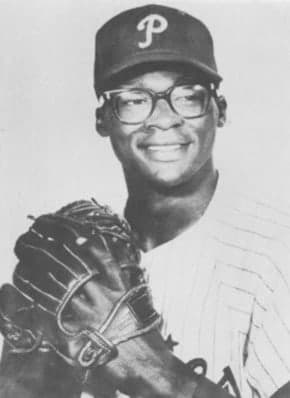
Dick Allen
Allen's debut was a shutout win in Milwaukee with two hits for the visiting side and none for the home. The numbers that followed took fifteen years to accumulate.
At a glance
- Career
- 1,749 games · 1,848 hits · 351 home runs · 1,119 runs batted in · .292 average
- Debut
- 3 September 1963, aged 21, at Milwaukee County Stadium
- Last game
- 19 June 1977, for the Oakland Athletics
- Clubs
- Philadelphia · St. Louis · Los Angeles · Chicago · Oakland
Look closer
The debut was late in the calendar and short on offence
On 3 September 1963 the Philadelphia Phillies made seven hits at Milwaukee County Stadium and the Milwaukee Braves made two. Philadelphia scored once in the fourth inning and once in the ninth; Milwaukee never scored at all, which is why the bottom of the ninth shows a dash rather than a nought — the home side does not bat when it trails and cannot win. The whole thing took two hours and eighteen minutes in front of 4,949 people. Allen's first ten games produced seven hits in twenty-four at-bats, two of them doubles and one a triple, but no home runs.
The highest single-season total came in his fourth year
In 1966, his fourth season, Allen hit forty home runs in five hundred and twenty-four at-bats for the Philadelphia Phillies. That remained his highest total. The next-highest came in 1972 with the Chicago White Sox: thirty-seven home runs in five hundred and six at-bats. The third-highest was thirty-four, in 1970 with the St. Louis Cardinals. The career total of three hundred and fifty-one was built from these peaks and the seasons in between, not from any single extraordinary year.
Five clubs in fifteen seasons, with Philadelphia twice
Allen played for the Philadelphia Phillies from 1963 to 1969, then moved to the St. Louis Cardinals in 1970, the Los Angeles Dodgers in 1971, and the Chicago White Sox from 1972 to 1974. He returned to Philadelphia for 1975 and 1976, then finished with the Oakland Athletics in 1977. The career spanned fifteen distinct seasons and fifteen years from debut to last game. The longest continuous stretch with one club was his time with Philadelphia from 1963 to 1969; the shortest was the single season in St. Louis and the single season in Los Angeles.
The story
On the evening of 3 September 1963, the Philadelphia Phillies visited Milwaukee County Stadium and beat the Braves 2–0. Philadelphia made seven hits, Milwaukee made two. Philadelphia scored once in the fourth inning and once in the ninth; Milwaukee never scored, so the home side did not bat in the bottom of the ninth — hence the dash in that half-inning rather than a nought. The game took two hours and eighteen minutes. Attendance was 4,949.
Allen's first ten games, all in September 1963, produced seven hits in twenty-four at-bats. Two were doubles, one was a triple, none were home runs. He drove in two runs, struck out five times, and did not draw a walk. His batting average for those ten games was .292, his on-base percentage .280, his slugging percentage .458. The season ended there.
The following year, 1964, he played all one hundred and sixty-two games for Philadelphia. He made two hundred and one hits in six hundred and thirty-two at-bats, including thirty-eight doubles, thirteen triples, and twenty-nine home runs. He drove in ninety-one runs, scored one hundred and twenty-five, struck out one hundred and thirty-eight times, and walked sixty-seven times. His batting average was .318, his on-base percentage .382, his slugging percentage .557. That season established the shape of what followed: a high number of at-bats, a high number of hits, a high number of home runs, and a high number of strikeouts.
The highest single-season home-run total came in 1966, his fourth year: forty, in five hundred and twenty-four at-bats. The next-highest was thirty-seven in 1972, with the Chicago White Sox. The third was thirty-four in 1970, with the St. Louis Cardinals. The career total of three hundred and fifty-one home runs was accumulated from these peaks and the seasons in between, not from any single extraordinary year.
Allen played for five clubs across fifteen seasons. He spent 1963 to 1969 with Philadelphia, moved to St. Louis for 1970, Los Angeles for 1971, and Chicago for 1972 to 1974. He returned to Philadelphia for 1975 and 1976, then finished with Oakland in 1977. The longest continuous stretch was with Philadelphia from 1963 to 1969; the shortest were the single seasons in St. Louis and Los Angeles.
His last game was on 19 June 1977. By then he had played 1,749 games, made 1,848 hits in 6,332 at-bats, hit 351 home runs, driven in 1,119 runs, and struck out 1,556 times. His career batting average was .292, his on-base percentage .378, his slugging percentage .534. The debut in Milwaukee had given away none of this. The seven hits in ten games said nothing about the fifteen years that followed.
Why it mattered then
Allen's career unfolded during a period when the balance between pitching and hitting shifted visibly from year to year. In 1968, widely called the Year of the Pitcher, his batting average dropped to .263 — his lowest full-season mark — even as he hit thirty-three home runs. The following year, with the rules adjusted to favour hitters, his average rose to .288 and his home runs to thirty-two in fewer at-bats. These swings were not unique to him, but they show how the context around a player's numbers could change from season to season without the player himself changing. His movement between clubs also reflected the way teams managed rosters in that era. Players did not control their destinations as freely as they would a decade later, and a trade could mean a complete change of city and role. Allen played for clubs in Philadelphia, St. Louis, Los Angeles, Chicago, and Oakland. Each move reset the environment — different pitchers, different parks, different expectations — but the numbers he produced remained recognisably his: power, patience at the plate, and strikeouts in roughly equal measure. The debut itself, a shutout win on a Tuesday night in front of fewer than five thousand people, was typical of late-season games in 1963. The schedule was longer than it had been a decade earlier, but shorter than it would become. Attendance figures like 4,949 were not unusual for a weeknight game between two clubs out of contention. The linescore records what happened, but it does not record what anyone thought of it at the time.
Why it matters now
Allen's career totals — 351 home runs, 1,119 runs batted in, a .292 batting average — sit in a range that makes them visible but not easily categorised. They are high enough to mark him as a significant hitter, but not so high that they place him in the most frequently cited tier of career leaders. This is partly a function of how long he played and partly a function of how the numbers were distributed: no single season dominates the record, and no single club claims the majority of his at-bats. The question of how to evaluate a career like this remains open. Should the peak years — 1966, 1972 — carry more weight than the total? Should the movement between clubs be read as instability or adaptability? Should the strikeout totals — 1,556 across fifteen seasons — be weighed against the walks, the home runs, the on-base percentage? The figures themselves do not answer these questions. They describe what happened, not what it meant. What the record does show is that a player can produce significant numbers over a long stretch without ever having a season that eclipses all the others. Allen's highest home-run total was forty, his highest batting average .318, his highest on-base percentage .420. None of these figures is small, but none of them is the kind of outlier that makes a single season unforgettable. The career was built from many good years rather than one extraordinary one, and that shape — steady, substantial, distributed across time and place — is harder to summarise than a single peak.
The surprising detail
Allen's career spanned fifteen seasons and five clubs, but he played more than one hundred and fifty games in a season only twice: one hundred and sixty-two in 1964 and one hundred and fifty-five in 1971. Every other season was shorter, sometimes by a handful of games, sometimes by half. In 1973 he played seventy-two games; in 1977, fifty-four. The career total of 1,749 games is large, but it was not accumulated by playing every day for fifteen years. It was accumulated by playing most days in most years, with gaps that the record does not explain. The debut linescore shows a game that took two hours and eighteen minutes in front of 4,949 people, but it does not say whether Allen started or came off the bench, or which of the seven hits were his.
What is disputed
Every figure here comes from the MLB Stats API. Statistical categories were not all recorded consistently across the fifteen seasons covered, and the debut linescore records what the official scorer entered on the night. The totals are the ones the league publishes today rather than anything independently recomputed here. The fact sheet supplies no attendance, salary, award, or ranking data, so none appears in the lesson.
Remember this
351 home runs across fifteen seasons and five clubs, with no single year accounting for more than forty of them.
Test yourself
Allen's career batting average was .292, but his 1964 season average was .318 and his 1975 season average was .233. What does this tell you about how career averages are built?
A career average is not a simple mean of seasonal averages — it is the total number of hits divided by the total number of at-bats across all seasons. Allen had 632 at-bats in 1964 and only 416 in 1975, so the high-average season contributed more hits to the career total than the low-average season did. A season with many at-bats has more influence on the career figure than a season with few, regardless of the average in that season. This is why a player's career average can sit between their best and worst seasonal marks without being the arithmetic mean of those marks: the denominator changes from year to year.
Go deeper
- Dick Allen — MLB Stats API player record · MLB Advanced Media
- Dick Allen — career hitting totals (MLB Stats API) · MLB Advanced Media
- Debut game linescore — MLB Stats API game 148298 · MLB Advanced Media
- Dick Allen — Wikidata · Wikidata
Image: Unknown author, Public domain. Licence: Public domain. Source.