III · THE WORK · ART HISTORY
Lion Monument
▶ Listen · narrated
Far from Paris, a wounded lion is carved into a Lucerne cliff face. It stands for soldiers who died defending a foreign palace, and for how grief can be made public.
At a glance
- Design
- Bertel Thorvaldsen
- Carving
- Lukas Ahorn
- Date
- 1821
- Material
- Sandstone
- Form
- Sculpture; memorial; public art
- Movement
- Neoclassicism
Look closer
A body that will not rise
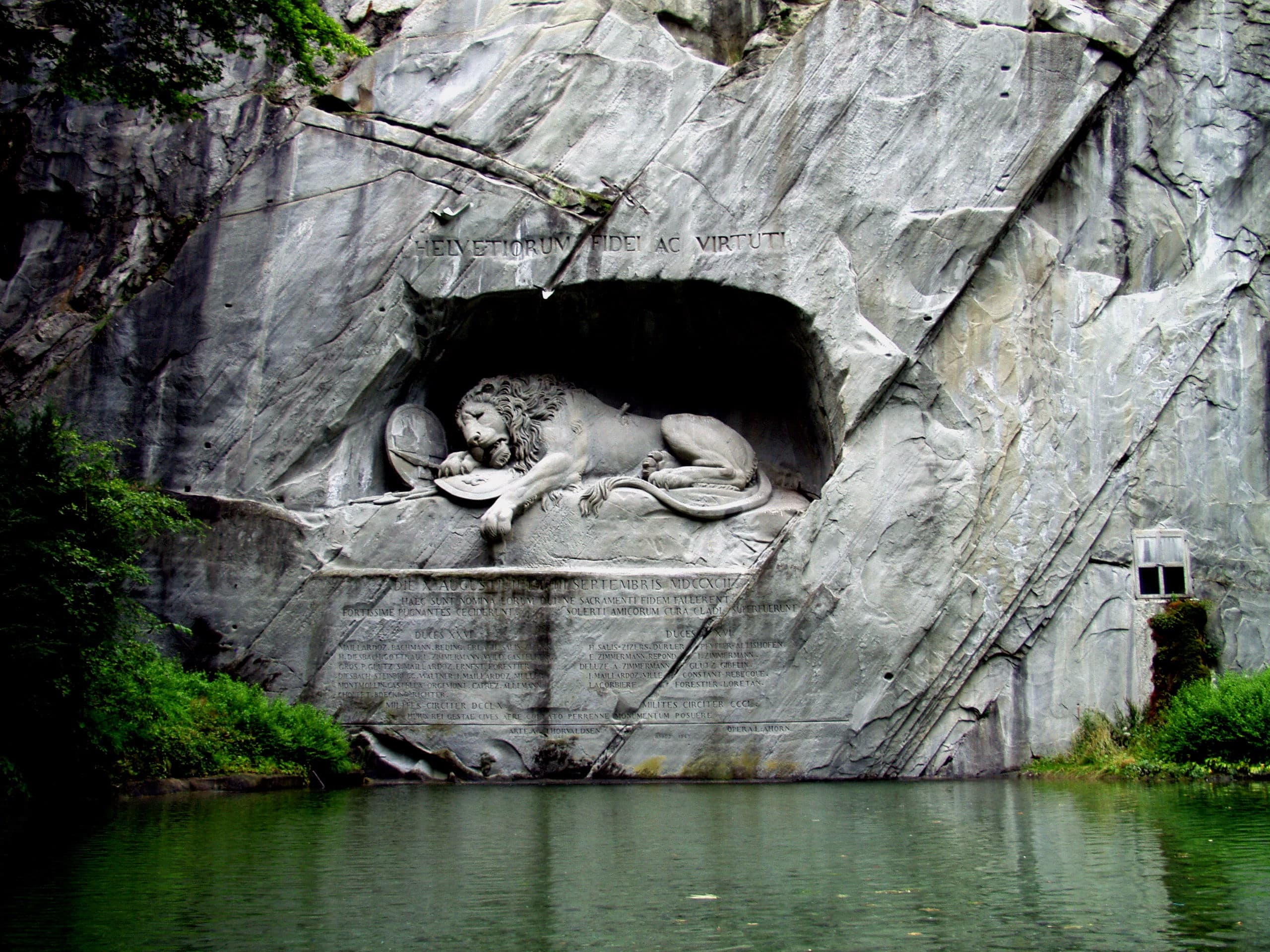
The lion is not roaring or springing. It is stretched low against the rock, head sunk, weight collapsed along its side. The pose is the whole argument: strength has been spent, and what remains is endurance rather than attack. In a Neoclassical memorial this matters. The animal is not a crest or a badge; it is a body in the last stage of resistance, offered as the image of men who could not hold their ground.
Stone that was already there
This is a rock relief, not a free-standing block brought to a square. The sandstone face of the cliff is both support and setting. Ahorn cut the figure into material that remains continuous with the hillside, so the memorial never quite separates from the place that holds it. The unfinished rock around the carving is not background decoration; it is part of how the work was made and how it is meant to be met.
Two hands, one surface
Thorvaldsen designed; Ahorn hewed. The split is ordinary in large stone work and easy to forget when the finished surface looks single-minded. Design here means the composition and the pathos of the dying animal; carving means months of cutting into a cliff, translating a model into sandstone at full scale. The monument is public art precisely because that labour had to happen outdoors, in place, where passers-by would eventually stand.
The story
The Lion Monument in Lucerne is a sandstone rock relief completed in 1821. Bertel Thorvaldsen designed it; Lukas Ahorn carved it. It is at once a sculpture, a memorial and a piece of public art, and it belongs to the Neoclassical movement that shaped so much commemorative work in the early nineteenth century.
What it shows is deliberately simple: a lion, mortally wounded, laid out against the rock. There is no crowded battle scene and no parade of named officers. The animal’s body does the remembering. In Neoclassical terms that choice is clear enough. A lion already carried meanings of courage and fidelity; a dying lion could hold loyalty and loss in the same form without needing a long inscription to explain the mood.
The event behind the stone is remote from Lucerne. In 1792, during the French Revolution, revolutionaries stormed the Tuileries Palace in Paris. Swiss Guards in the service of the French monarchy were killed in the fighting. The monument does not re-enact that day. It translates it. Soldiers who fell in a foreign capital are given a quiet cliff face in Switzerland and an animal that cannot speak their names but can still look defeated.
The making of the work splits cleanly between invention and labour. Thorvaldsen’s design set the composition — the low, spent posture, the sense that the figure is both noble and finished. Ahorn’s cutting, into sandstone already fixed in the landscape, turned that design into a relief continuous with the rock. Visitors do not walk around a freestanding statue so much as stop before a wound in the hillside. That is part of the memorial’s force: the stone was not imported to a pedestal; the place itself was opened and shaped.
As public art the monument has always been meant to be approached without ceremony. It sits in the open, readable at a glance and still slow to leave. Later fame has only thickened that public character. The American writer Mark Twain called it the most mournful and moving piece of stone in the world — praise that sticks because it matches what the carving asks for: not awe at skill alone, but a pause before an image of service that ended badly.
In 2006 the work was placed under Swiss monument protection. By then it had long been one of the country’s most visited memorials, drawing on the order of a million and more people a year. Protection of that kind is a modern legal frame around an older impulse: to keep a public grief from being altered, moved or worn away beyond recognition. The lion remains where Ahorn cut it, still doing the quiet work Thorvaldsen gave it — standing in for men who died far from home, in a form almost anyone can read.
Why it mattered then
In the early nineteenth century, states and cities needed ways to honour military loyalty without always glorifying victory. The Swiss Guards had died in Paris in 1792, not in a Swiss war and not in triumph. A Neoclassical memorial could answer that awkwardness. By choosing a wounded lion rather than a portrait group or a triumphal relief, Thorvaldsen’s design kept the focus on fidelity and sacrifice. Carving the figure into a Lucerne rock face rooted a foreign death in Swiss ground. Public art of this kind turned private mourning and national reputation into something a passer-by could meet without a ticket or a ceremony. The date of completion, 1821, places the work in a Europe still sorting the wreckage and loyalties of the revolutionary and Napoleonic years; a sandstone animal that would not recover was a fit emblem for service that had already been spent.
Why it matters now
The monument still works because its means are plain. A dying animal in rock needs little translation, and that clarity keeps the memorial usable long after the politics of 1792 have faded from common speech. It also raises a lasting question about public memory: how far a single, wordless image can stand for many named deaths, and whether beauty of form softens or sharpens the fact of loss. Legal protection since 2006 and heavy visitor numbers only underline the point. The carving is no longer only a local act of remembrance; it is a site where tourism, national self-image and genuine grief share the same sandstone surface. Looking closely now means noticing both the pathos Thorvaldsen built into the pose and the outdoor, shared life the work has always had as public art.
The surprising detail
The monument’s fame rests partly on a foreigner’s sentence. Mark Twain, writing as a traveller rather than a Swiss official, called the mortally wounded lion the most mournful and moving piece of stone in the world. The line has followed the sculpture ever since, and it is striking because it praises feeling over triumph. A memorial to soldiers might have invited talk of heroism or design alone; Twain fixed attention on sorrow in the stone itself. That the praise came from outside Switzerland, and stuck, says something about how public art travels — not only through copies and photographs, but through a few words that teach strangers how to stand in front of it.
What is disputed
The verified record is firm on date, material, makers and purpose. Finer points of the original commission, the precise working relationship between Thorvaldsen’s design and Ahorn’s cutting, and how early viewers in Lucerne received the work are not settled in the facts supplied here and should not be filled in with guesswork.
Remember this
A dying lion cut into Lucerne sandstone turns the deaths of Swiss Guards in 1792 into public, wordless grief.
Test yourself
Why does it matter that this memorial is a rock relief carved into a cliff, rather than a freestanding statue set on a square?
Because the sandstone face is both material and site. Ahorn cut the lion into rock that stays part of the hillside, so the memorial cannot be read as an object delivered to a pedestal. The place itself was opened and shaped. That binds a death which happened in Paris to Swiss ground, and it makes the work public in a literal sense: the carving lives outdoors, continuous with the landscape people already walk through, rather than inside a separate sculptural frame.
Go deeper
Image: Lukas Ahorn / Bertel Thorvaldsen, CC BY-SA 3.0. Licence: CC BY-SA 3.0. Source.