III · THE WORK · ART HISTORY
The Geographer
▶ Listen · narrated
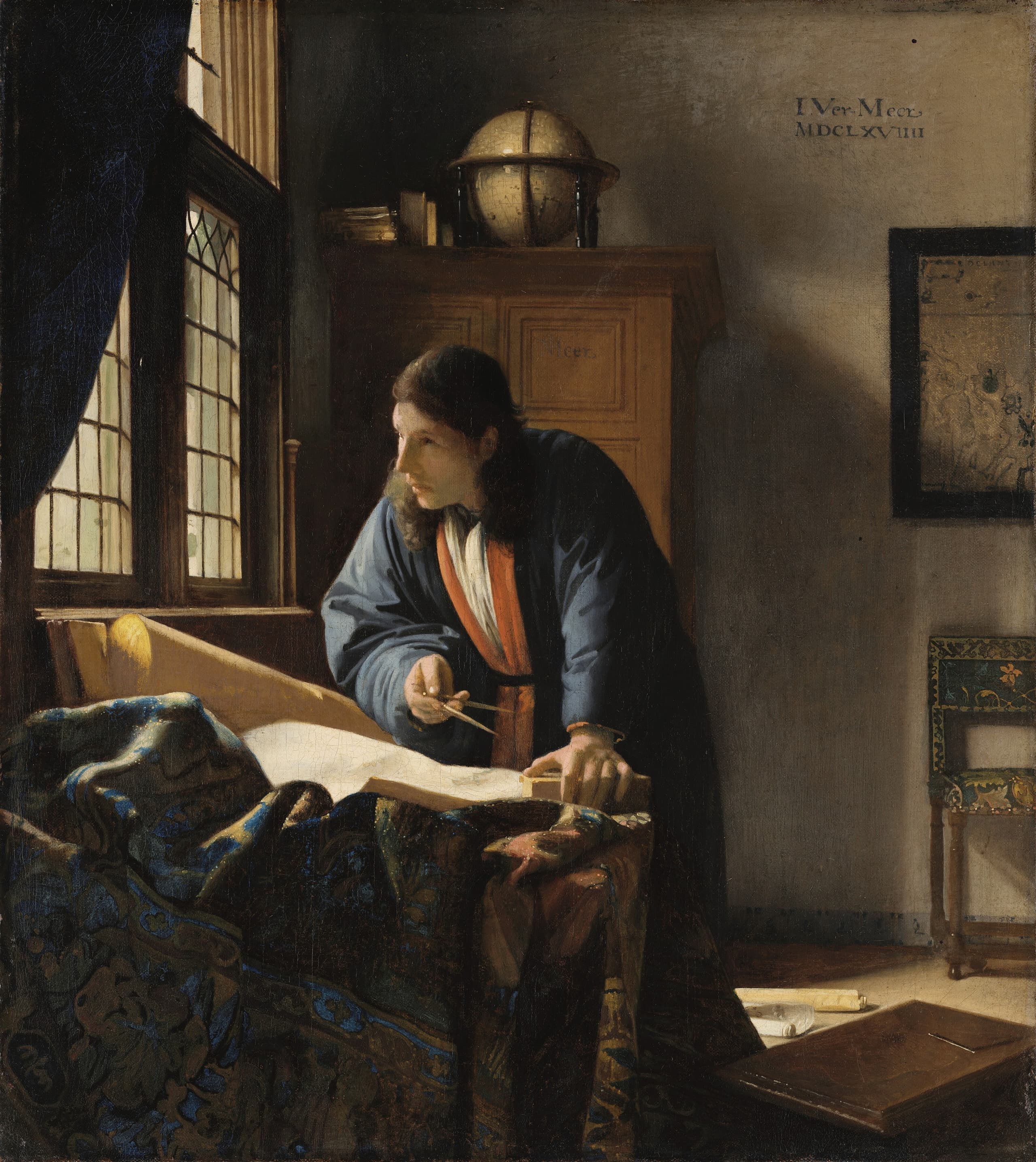
The painting does not show a discovery. It shows the moment just before one — a body turned toward the window, instruments still open on the table.
At a glance
- Artist
- Johannes Vermeer
- Date
- 1668
- Medium
- Oil on canvas
- Collection
- Städel Museum
- Inventory
- 1149
- Movement
- Dutch Golden Age painting
Look closer
The interrupted stance
The geographer does not sit squarely at his labour. He stands, weight inclined, robe loose at the collar, one hand still on the chart while the other keeps the dividers. His face has turned toward the light rather than down at the work. Vermeer builds the whole picture around that half-turn: the tools remain in use, yet the mind has already left the page.
Light as a working tool
Illumination enters from the window at the left and travels across face, hands and papers before it thins into the room. Nothing in the upper air is theatrical. The light behaves like equipment — a practical condition for reading a chart — and Vermeer lets it rank the objects by how much of it they receive.
The table’s clutter
Globe, sheets and measuring instruments occupy the bright lower field with a patterned textile hanging over the edge. These are not emblems arranged for a lecture; they are surfaces given the same careful paint as the sitter’s features. The profession is argued through stuff within arm’s reach.
The story
Johannes Vermeer painted The Geographer in 1668, in oil on canvas. The picture is modest in scale — recorded at about fifty-three centimetres high and a little under forty-seven wide, with a second, slightly smaller pair of measurements also attached to the work — and it now belongs to the Städel Museum in Frankfurt. Earlier it formed part of the Demidov collection and was at the Villa San Donato.
Cataloguers have classed it as both portrait and genre art, which is a fair hesitation. We are given one man, absorbed enough to feel individual, yet the surviving facts do not name him as a known sitter. What we see is a type made particular: a scholar of the mapped world, caught inside a room that explains his trade without inscriptions.
He stands at a table rather than settling into a pose. Dividers rest in his hand; papers and a globe take the window light; a textile droops over the table’s edge. The composition is simple and firm. Space is shallow, the far wall close, the window the only strong source of day. Vermeer does not open the interior onto a harbour or a skyline. Geography, here, is an indoor practice — measurement, comparison, the pause before the next line is drawn.
That pause is the true subject. The man’s attention has lifted. Calculation is not finished, and it is not abandoned. The painting holds the second in which looking away is still part of the work. In the register of Dutch Golden Age painting this kind of quiet professional concentration was a saleable pleasure: small enough for a private room, clear enough in its objects to be read at once, reserved enough to reward a longer stare.
The Geographer is closely related to Vermeer’s The Astronomer. The same model appears in the same dress, and a 2017 study indicated that the two canvases came from the same bolt of material. They have sometimes been considered pendant paintings. The shared cloth and repeated figure place their making in a tight practical relationship; whether they were planned as a formal pair remains a matter of interpretation rather than a documented fact. Even so, the kinship matters. Vermeer returned to one wardrobe, one body and one supply of canvas when he wanted men who measure the world — sky in one picture, earth in the other — and he gave each the same unhurried dignity of interrupted thought.
Why it mattered then
In the Dutch Republic of the later seventeenth century, charts, globes and the measurement of distance were tied to trade and navigation, not only to bookish curiosity. A picture of a geographer at work could speak to that culture without allegory spelled out in labels. Vermeer’s choice of a domestic scale, and of genre rather than court portraiture or history painting, fits a market that bought careful interiors for private walls. The objects on the table would have been legible as the real equipment of a learned trade. Whether or not a specific scholar sat for the head, the type was contemporary: authority resting on paper, instrument and daylight.
Why it matters now
The painting still matters because it stages knowledge as a bodily pause rather than a triumph. No discovery is unveiled; a person simply thinks with his hands full. That restraint continues to feel exact. The link with The Astronomer keeps the work inside a live argument about how Vermeer planned pictures — shared model, shared bolt of canvas, possible pairing — and about how much of what we see is workshop practice rather than a room copied whole. Close looking remains the right method. Posture, light and the weight of ordinary objects on a table still carry the meaning.
The surprising detail
The Geographer and The Astronomer do not only rhyme in subject. A 2017 study indicated that their canvases came from the same bolt of material, and both use the same model in the same dress. They have sometimes been read as pendants. Two of Vermeer’s absorbed scholarly interiors may thus have been cut from one length of cloth and peopled by one repeated figure — a quiet workshop fact with large consequences for how closely he built the two paintings around each other.
What is disputed
Height and width are recorded in two close pairs (53 and 51.6 centimetres (1 ft 8 in) high; 46.6 and 45.4 centimetres (1 ft 6 in) wide); the facts given here do not settle which pair reflects trimming or frame. Inception is given as 1668, though related museum descriptions sometimes lean toward 1669. Whether The Geographer and The Astronomer were conceived as pendants remains a scholarly suggestion, supported by model, dress and shared canvas supply, not by a documented commission.
Remember this
A small oil of 1668: one man, open instruments, and a pause that Vermeer treats as the whole event — kin, in model and canvas bolt, to The Astronomer.
Test yourself
The Geographer is often set beside The Astronomer. Setting aside whether they were true pendants, what does evidence of a shared canvas bolt actually establish, and what does it leave open?
A shared bolt establishes that the two supports came from the same length of material, which places their preparation in a close practical relationship and makes a near moment of making more likely. It does not prove that Vermeer designed them as a pair to hang together, or that he fixed a single programme of meaning across both. Pendant status still depends on subject, model, dress and scale as much as on the cloth. The bolt tightens the workshop story; it does not end the argument about display.
Go deeper
Image: Johannes Vermeer, Public domain. Licence: Public domain. Source.