I · THE OBJECT · BRITISH MUSEUM
Astor Court
▶ Listen · narrated
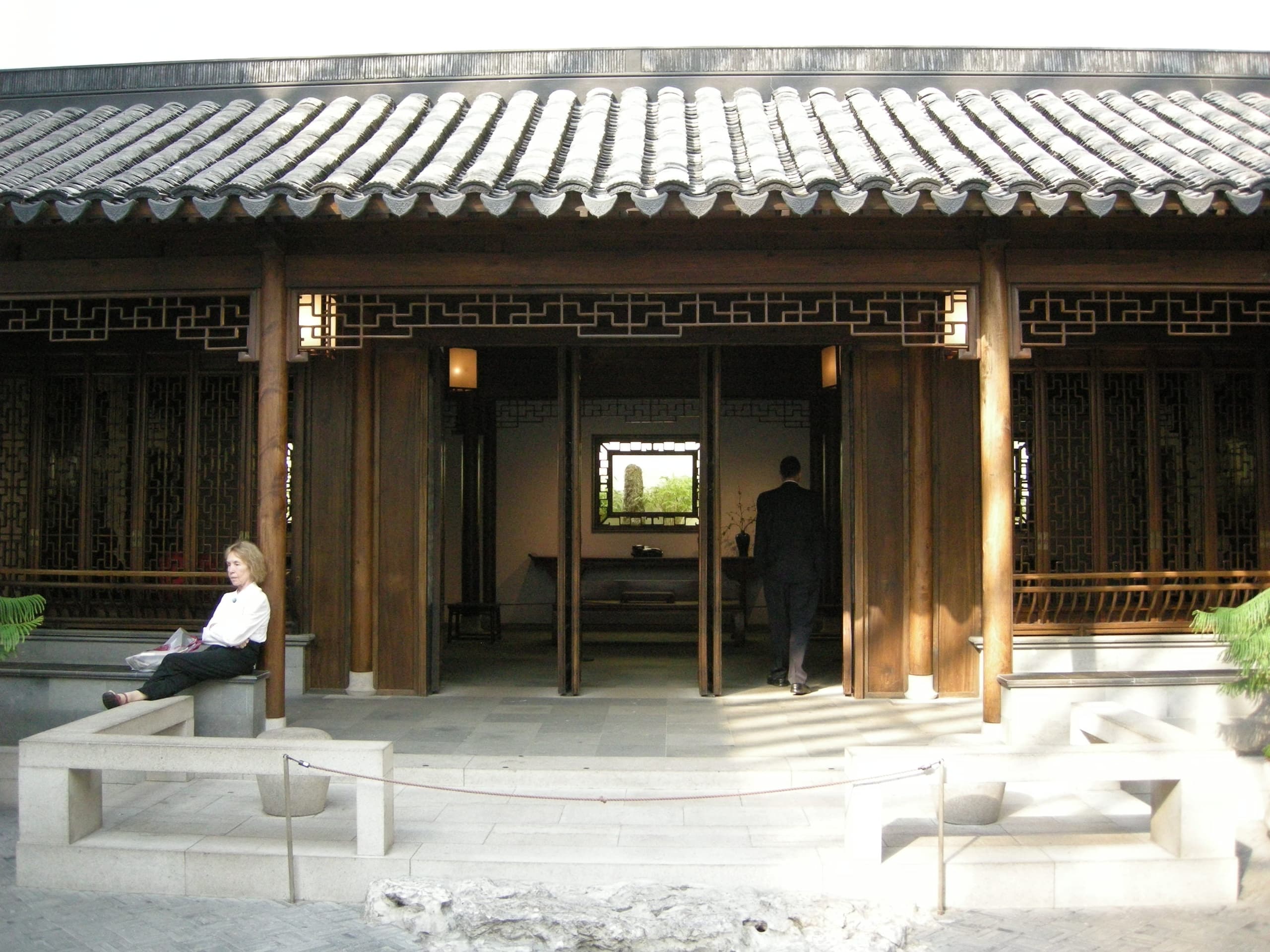
Completed in 1981 and conceived by Brooke Astor, this re-created Chinese garden courtyard was assembled in New York by expert craftsmen from China using traditional methods and hand tools.
At a glance
- Collection
- Metropolitan Museum of Art
- Type
- Period room; Chinese garden
- Completed
- 1981
- Also known as
- Ming Hall (明軒)
- Conceived by
- Brooke Astor, museum trustee
Look closer
Craft as the exhibit
The courtyard was created and assembled by expert craftsmen from China using traditional methods, materials and hand tools. The construction itself was part of what the museum received. Visitors are looking not only at a finished Ming-style space but at the residue of work done by hand, according to practices that industrial fabrication would have erased.
Garden and period room at once
Astor Court is listed as both a period room and a Chinese garden. That double classification is precise. Period rooms usually reconstruct interiors; this one reconstructs a courtyard form, an architectural type meant for pause and measured movement rather than for the linear path of a picture gallery. The garden is the subject, not a backdrop for other objects.
Two names on one room
The installation is known as Astor Court and also as the Ming Hall, or 明軒. One name records the American patronage that brought the project into being; the other names the Chinese architectural tradition it follows. Brooke Astor conceived it; Chinese craftsmen built it. The room still carries both histories in the names by which it is called.
The story
Astor Court stands inside the Metropolitan Museum of Art in New York City. It is a re-creation of a Ming dynasty-style Chinese garden courtyard, and it is also known as the Ming Hall, or 明軒. In the museum’s own terms it is a period room; in form it is a garden. Those two descriptions are not in conflict. They describe what the space does and what it is made to resemble.
The project was conceived by Brooke Astor, a trustee of the museum. Conception here meant more than a gift of funds for a display case. The courtyard was created and assembled by expert craftsmen from China, who used traditional methods, materials and hand tools. The installation was completed in 1981.
That date is not incidental. The courtyard was the first permanent cultural exchange between the United States and the People's Republic of China. A space built by Chinese hands, in Chinese methods and materials, was left to stand inside an American museum as a lasting presence rather than as a temporary loan or a travelling show that would one day go home.
What a visitor enters is therefore not a selection of Chinese objects arranged for study against neutral walls. It is a courtyard made according to the logic of a Ming garden court. The architectural type itself is the exhibit. Most period rooms reconstruct rooms people lived or worked in; this one reconstructs an outdoor form brought under a roof, complete with the craftsmanship that once produced such places.
The Met’s willingness to receive a permanent installation of this kind, and to host the labour that made it, was itself part of the exchange. The room remains in the collection under both of its identities — garden and period room — and under both of its names. Nothing in the surviving account requires us to treat those doubles as accidents. They are how the project was framed from the start.
Why it mattered then
In 1981 the diplomatic relationship between the United States and the People's Republic of China was still comparatively new. A permanent cultural installation — not a loan exhibition scheduled to travel home, but a courtyard built to remain — carried weight beyond aesthetics. Astor Court was the first such permanent exchange. It showed that craft, architecture and garden design could serve as the medium of contact, and that a major American museum would commit gallery space indefinitely to a Chinese-built room. For the craftsmen who came to assemble it, and for the institution that received their work, the project was a concrete act of exchange rather than a symbolic gesture alone.
Why it matters now
The courtyard still functions as what it was meant to be: a Ming-style garden space inside a Western museum, made by Chinese hands with traditional methods and tools. Visitors can still walk through a period room that is also a garden, and still meet the evidence of that labour rather than a facsimile produced entirely off-site. In a museum full of objects moved from their original settings, Astor Court remains an argument for making a space rather than only displaying things. It also records a specific moment in United States–China cultural relations that has not been overwritten. The room’s double name — Astor Court and Ming Hall — continues to hold both sides of that history in view.
The surprising detail
The first permanent cultural exchange between the United States and the People's Republic of China was not a painting, a treaty text or a conventional diplomatic gift. It was a courtyard garden, assembled on site by Chinese craftsmen with hand tools, and left to stand as a working architectural space inside the Metropolitan Museum. A museum trustee, Brooke Astor, stands at the origin of that exchange rather than a government ministry alone.
How it got here
Astor Court was conceived by Brooke Astor, a trustee of the Metropolitan Museum of Art, and created for that museum by expert craftsmen from China. The installation was completed in 1981 and remains in the museum’s collection as a period room and Chinese garden. It was made for the Met rather than acquired from an earlier owner.
Remember this
A Ming-style courtyard built by Chinese craftsmen in 1981, still standing as the first permanent cultural exchange between the United States and the People's Republic of China.
Test yourself
Why does it matter that Astor Court was created by Chinese craftsmen using traditional methods and hand tools, rather than fabricated as a modern museum replica of a Ming courtyard?
Because the exchange was not only about the finished appearance of a Ming-style space but about the transmission of craft itself. The room is evidence of how such courtyards were made, not only of how they looked. That labour is part of what made the installation a cultural exchange rather than a decorative set-piece.
Go deeper
Image: I, Sailko. Licence: CC BY-SA 3.0. Source.