I · THE OBJECT · BRITISH MUSEUM
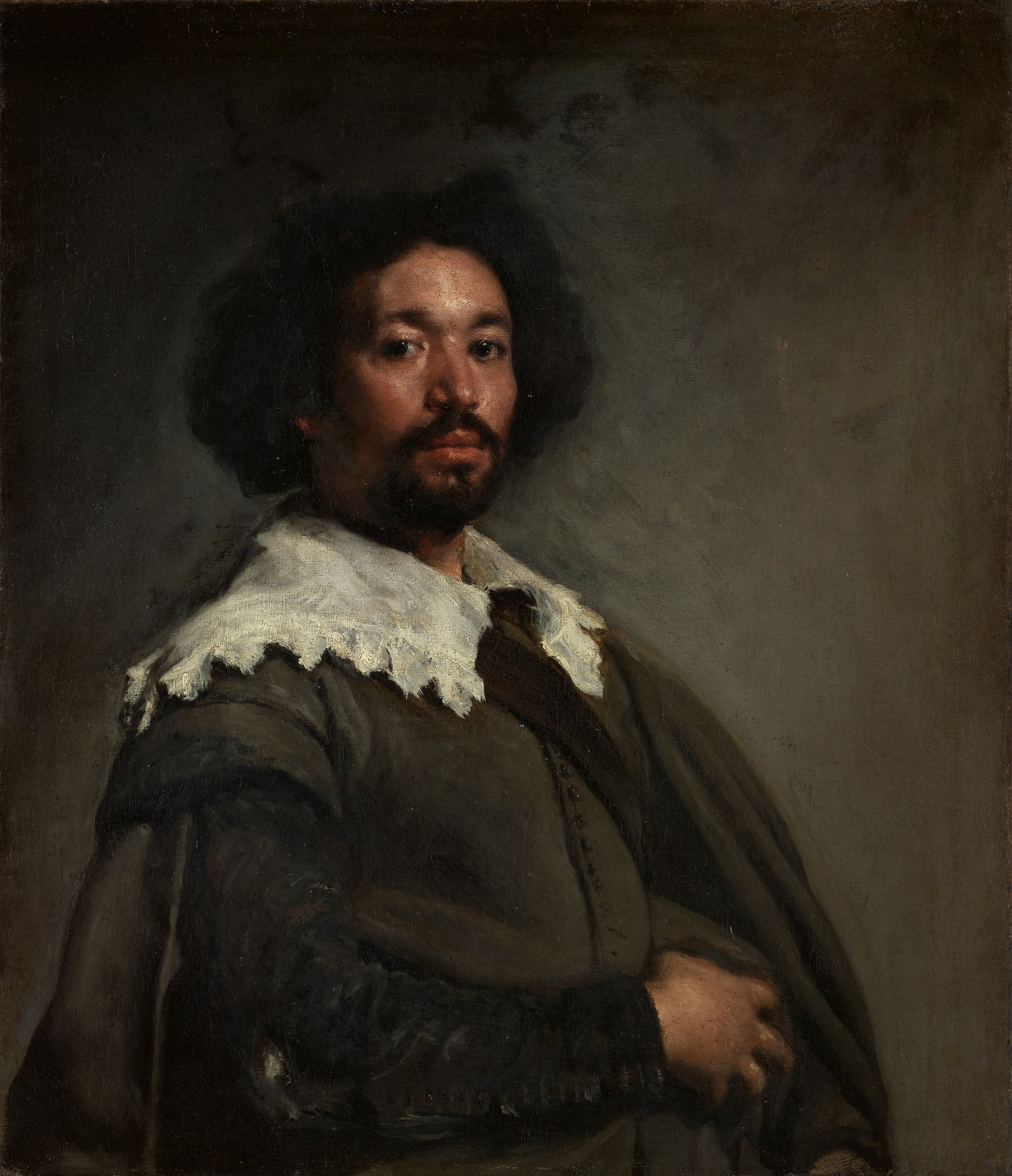
Portrait of Juan de Pareja
▶ Listen · narrated
This painting connects a maker, a sitter and a museum collection, while reminding us that even a well-known work can retain gaps in its documented history.
At a glance
- Maker
- Diego Velázquez
- Type
- Portrait painting
- Material
- Oil paint and canvas
- Size
- 81.3 × 69.9 cm (2 ft 4 in)
- Inventory
- 1971.86
Look closer
A vertical format
The listed height, 81.3 centimetres (2 ft 8 in), exceeds the width of 69.9 centimetres (2 ft 4 in). The painting is therefore vertically oriented: a format that gives the represented person a clear, upright presence within a relatively contained canvas.
Paint on canvas
The museum record identifies oil paint and canvas. Those two materials establish this as a painted object rather than a drawing, print or panel painting, and they direct attention to the painted surface carried by a textile support.
The collection number
Inventory number 1971.86 is a small but consequential part of the object. It identifies this particular painting within the Metropolitan Museum of Art’s collection, separating the museum record from the broader history suggested by the portrait’s title.
The story
Portrait of Juan de Pareja is a painting, classified as a portrait, made with oil paint on canvas. Its creator is recorded as Diego Velázquez, and its movement as Baroque. It is in the collection of, and located at, the Metropolitan Museum of Art.
The title gives the sitter’s name: Juan de Pareja. That direct naming matters. A portrait is not simply an image of an unidentified figure; here, the work’s title preserves a connection between a particular person and a particular artist. The supplied background for this lesson describes Pareja as a painter in his own right, and says that he was enslaved by Velázquez when the painting was completed. It also places the painting in Rome in 1650. Those details are not part of the verified object record supplied here, so they should be read as background rather than as fully established by that record.
The dimensions, 81.3 by 69.9 centimetres (2 ft 4 in), make this a vertical canvas. Its scale is concrete enough to resist the vagueness that often gathers around famous names: this is an object with measured edges, a material support and a collection number, 1971.86.
The date field is less straightforward. The supplied record gives two inception dates, 1650 and 1689, without explaining their relationship. It would be unsafe to turn that pair into a neat chronology. The same restraint is needed for the question of discovery. None of the supplied facts says where the painting was found, who identified it, or how it travelled before reaching the museum.
That incompleteness is not a failure of attention. It is part of what an object record can reveal. The painting can be securely named, measured and located, while important parts of its earlier history remain outside the information provided here.
Why it mattered then
Within the supplied record, the painting belongs to the Baroque movement and carries the date entries 1650 and 1689. It mattered first as a portrait: a work whose title identifies Juan de Pareja and whose maker is Diego Velázquez. The supplied background adds a difficult social fact, describing Pareja as enslaved by Velázquez at the time of completion. That relationship makes the act of naming the sitter especially significant, though the verified record alone does not explain the painting’s original purpose or reception.
Why it matters now
The painting still matters because it is held in a public museum collection and because its title keeps Juan de Pareja’s name attached to the work. It also invites careful reading of museum information. Some facts are precise: the medium, dimensions, maker, collection and inventory number. Other questions, including the route by which the painting reached the museum and the meaning of the two date entries, are not resolved by the supplied record. Both kinds of knowledge deserve attention.
The surprising detail
The supplied record gives not one inception date but two: 1650 and 1689. Without further explanation, neither can simply be treated as the painting’s single date of making. A compact catalogue field can preserve uncertainty as well as certainty.
What is disputed
The supplied record lists two inception dates, 1650 and 1689, but does not explain why both appear. It also does not provide evidence for a discovery history or an original location.
How it got here
The supplied background says that the Metropolitan Museum of Art purchased the painting in 1970, while the verified object record gives inventory number 1971.86. The information provided does not document the painting’s earlier ownership, route to the museum, or any contested-ownership or repatriation claim.
Remember this
A named portrait can seem complete, yet its record may still leave crucial parts of its history unresolved.
Test yourself
Why is it useful to distinguish between what a museum record states precisely and what a background account adds about a painting?
Because the two kinds of information do different work. The record securely identifies the maker, medium, dimensions, collection and inventory number. Background can provide vital context about the sitter and circumstances, but where it is not confirmed by the supplied record, it should be presented with appropriate care rather than folded into an unqualified account.
Go deeper
Image: Diego Velázquez, Public domain. Licence: Public domain. Source.