III · THE WORK · ART HISTORY
The Rape of Proserpina
▶ Listen · narrated
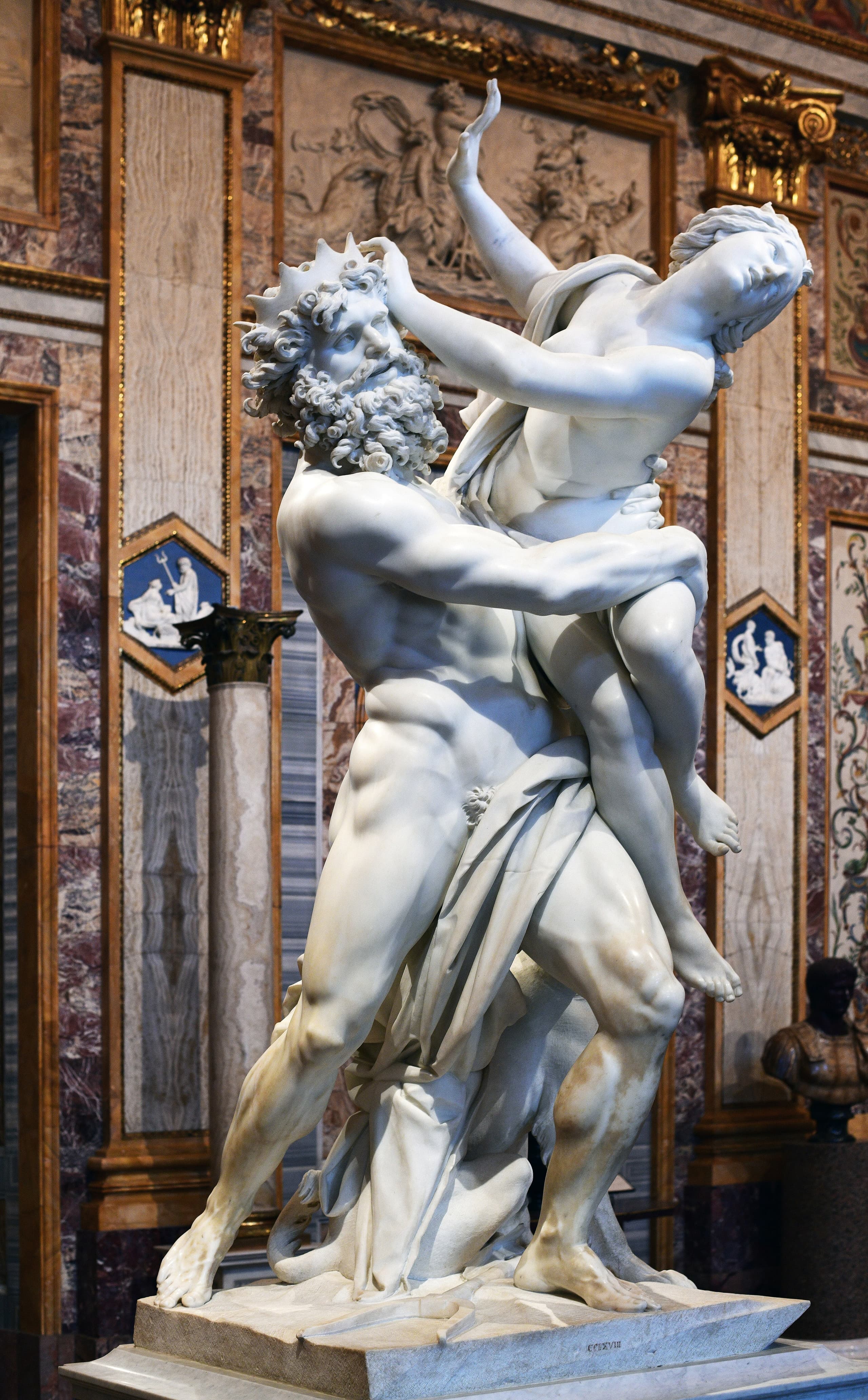
Finished in 1624, Bernini’s group stages the abduction of Proserpina as weight, grip and resistance cut into white marble over two metres high.
At a glance
- Artist
- Gian Lorenzo Bernini
- Date
- 1624
- Material
- White marble
- Height
- 255 cm (8 ft 4 in)
- Location
- Galleria Borghese
- Movement
- Baroque
Look closer
Two bodies, one spiral
The group is built as a rising twist. Pluto’s stride and lifted load drive the mass upward; Proserpina’s body wrenches away on a counter-curve, so that arms, torso and drapery read as a single turning movement rather than two figures set side by side. From most angles the silhouette keeps changing: what looks stable from the front becomes precarious as you walk round.
Marble made to yield
Where Pluto’s hands close on Proserpina, the stone is cut as if flesh had given under pressure. Fingers sink; the surrounding surface swells. Elsewhere hair, skin and the coarser flanks of the underworld dog are distinguished not by colour but by how light breaks on differently worked marble. The material never stops being stone, yet it is made to mimic the behaviour of things that are not.
The border at their feet
At the base, Cerberus anchors the myth in place. The three-headed dog marks the threshold of the underworld that Pluto is forcing Proserpina across. It is not a decorative extra: without that lower mass the abduction would float; with it, the lift has a destination and the struggle a ground.
The story
The subject is the moment the Roman myth turns irreversible. Pluto, god of the underworld, seizes Proserpina and carries her down from the world of the living. Bernini does not show the before or the after. He shows the lift itself: one body taking another off the ground while she still fights the motion.
The sculpture is a group in the strict sense — more than one figure carved so that their limbs and draperies interlock into a single mass. At 255 centimetres (8 ft 4 in) high it stands at a human, slightly monumental scale. White marble is the only material. There is no colour to separate god from goddess, skin from hair, living flesh from the dog of the underworld. Distinction is left to cutting, polish and the fall of light.
Compositionally the work is a spiral. Pluto steps and rises; Proserpina twists up and away; arms cross the central axis; drapery snaps into the turn. The viewer is not given a single correct station. Move a few paces and the balance of force shifts: his grip looks surer, her escape nearer, the whole group more or less stable. That demand to walk round the marble is part of how the narrative is told. Abduction here is not a picture plane. It is a volume you negotiate.
The lower register settles the story in space. Cerberus, the multi-headed guard of the underworld, crouches at the pair’s feet. He is the border. Pluto is not merely lifting a woman; he is carrying her across a threshold the dog makes visible. The myth’s geography is compressed into the base of the group.
What has always drawn close looking is the treatment of contact. Where hands press into Proserpina’s side and thigh, the marble is hollowed and raised as if soft tissue had yielded. Tears on her face, strands of hair, the open cry of the mouth — these are small decisions, but they keep the struggle readable at the distance of a room and still legible a step away. None of this requires us to believe marble has become flesh. It requires us to notice how completely a hard medium has been made to describe pressure, weight and resistance.
The work belongs to the Borghese Collection and stands in the Galleria Borghese. It is inventoried as CCLXVIII. In genre it is at once a mythological group and a study of the nude under extreme torsion. In movement it is Baroque: not because of ornament piled on, but because the narrative is forced into a single instant of unstable motion and then offered to a mobile viewer.
Bernini’s name is secure; the date attached in the museum record is 1624. How far the carving was influenced by earlier sculptors and painters is a matter of comparison rather than of a single documented source. What the marble itself shows is clearer than any pedigree: a myth of forced descent staged as intertwined bodies, a dog at the threshold, and stone persuaded to behave like skin under a grip.
Why it mattered then
In the early seventeenth century a mythological marble group of this ambition was a courtly and cardinal object as much as a devotional or civic one. The Borghese collection context places the work inside a culture of display in which classical narrative, technical bravura and the nude body were expected to reinforce one another. To choose the abduction of Proserpina was to choose a story already thick with meanings — seasonal death and return, the violence of desire, the border between upper and lower worlds — and to fix it at the instant of taking. Baroque sculpture of this kind also answered a practical demand: it had to hold a room. A spinning, multi-figure group that changes as the viewer moves rewards the kind of gallery or villa circulation cardinals and their guests actually used. The height, the open silhouette and the legibility of strain from several angles are not only expressive choices; they are social ones. The marble performs for an audience that walks.
Why it matters now
The group remains hard to dismiss as pure virtuosity because its subject is coercion. Close looking still finds the same passages — the sinking fingers, the twisted torso, the cry — but contemporary viewers bring different questions about what it means to aestheticise an abduction. That tension is not a flaw in the encounter; it is part of why the work stays active. The sculpture does not resolve into a comfortable allegory on first circuit. It also remains a concise lesson in what marble can be made to do without paint. In an age of digital surface and easy illusion, the slow fact of a subtractive medium describing soft pressure still stops people. You can walk round it. You can see the decisions. The medium never disappears, and that honesty is part of the force.
The surprising detail
The inventory number is still the old Borghese mark, CCLXVIII — a reminder that the sculpture’s identity was for a long time a matter of a private collection’s counting as much as of public fame. The group has stayed with that collection’s descendant institution, the Galleria Borghese, rather than travelling into the generic space of ‘famous statues everywhere’. Its meaning is still partly the meaning of a room in Rome.
What is disputed
Wikidata gives the inception date as 1624; other accounts place the execution slightly earlier, in the first years of the 1620s. The commission history and any precise literary or visual sources Bernini used are not settled by the core catalogue facts alone and should be treated as interpretive rather than fixed.
Remember this
Bernini turns the abduction of Proserpina into a spiral of grip and resistance in white marble, anchored at the base by the dog that marks the underworld’s edge.
Test yourself
Why does Cerberus at the base matter to the story the sculpture is telling, beyond adding a familiar mythological attribute?
Because the dog fixes a destination. Pluto’s lift could otherwise read as pure struggle in mid-air; Cerberus makes the motion a crossing — from the world above toward the underworld the hound guards. The lower mass gives the spiral a threshold, so the abduction is not only a clash of bodies but a forced change of place.
Go deeper
Image: Gian Lorenzo Bernini, CC BY-SA 4.0. Licence: CC BY-SA 4.0. Source.