II · THE DISCOVERY · HISTORY OF SCIENCE
Artificial satellite
Before 1957, orbit was theory. After it, orbit was a destination — and within months, a crowded one, as nations raced to place objects where gravity and velocity balanced.
At a glance
- Achieved
- 4 October 1957
- Definition
- An object placed into orbit around a celestial body
- Orbit maintained by
- Velocity high enough to balance gravitational pull
- Common orbits
- Low Earth orbit and geostationary orbit
Look closer
Orbit is a balance, not a fixed position
A satellite stays in orbit not by sitting still but by moving sideways fast enough that as it falls toward Earth, the planet's surface curves away beneath it at the same rate. The velocity must be high enough to avoid drag from the atmosphere — which thins with altitude but does not vanish — and the orbit must lie above the Roche limit, the distance at which tidal forces would tear the object apart. Propulsion, usually chemical or ion thrusters, adjusts or maintains that orbit over time.
Geostationary means fixed relative to a point on the ground
A satellite in geostationary orbit circles the Earth at the same rate the Earth rotates, so from the ground it appears to hang motionless in the sky above a fixed point. This orbit is useful for communications and weather observation, where a ground station can point its antenna at the same spot continuously. Low Earth orbit, by contrast, means the satellite passes overhead repeatedly, scanning different parts of the planet with each pass.
Most satellites are designed to be lightweight
Launch cost to space is high, so satellites are built to be as light and robust as possible. Many use a standardised structure called a bus to save cost and design effort, and some are small enough to fit in a hand — these are CubeSats. Communication satellites typically carry dozens of transponders, devices that receive a signal from the ground, amplify it, and transmit it back down, each with a bandwidth of tens of megahertz.
The story
An artificial satellite is a spacecraft placed into orbit around a celestial body. The orbit is not a resting place: the satellite is falling continuously toward the body it orbits, but moving sideways fast enough that the surface curves away beneath it at the same rate. Velocity and gravity balance, and the object stays aloft.
The orbit must be high enough to avoid significant drag from any atmosphere, and above the Roche limit — the distance at which tidal forces would pull the object apart. Once in orbit, the satellite can adjust or maintain its position using propulsion, usually chemical or ion thrusters.
Satellites have a variety of uses. Communication satellites relay signals between distant points on Earth. Weather satellites monitor atmospheric conditions. Navigation systems such as GPS depend on the predictable orbits and signal delay of satellites overhead. Earth observation satellites gather images for mapping, monitoring forests and oceans, and reconnaissance. Space telescopes take advantage of the near-perfect vacuum of space to observe across the electromagnetic spectrum without interference from the atmosphere. Crewed spacecraft that remain in orbit, such as space stations, are artificial satellites as well.
Most satellites orbiting Earth occupy one of two regions: low Earth orbit, where the satellite passes overhead repeatedly, or geostationary orbit, where the satellite circles at the same rate the Earth rotates and appears to hang motionless above a fixed point on the ground. Some imaging satellites use a Sun-synchronous orbit, which allows them to scan the entire globe with similar lighting conditions.
Except for passive satellites — objects that reflect signals without amplifying them — most satellites carry an electricity generation system, typically solar panels or radioisotope thermoelectric generators. Most also have transponders to communicate with ground stations. Similar satellites can work together as groups, forming constellations that provide continuous coverage of the Earth's surface.
As the number of satellites and the amount of space debris around Earth increases, the threat of collision has become more severe. Satellites can orbit bodies other than Earth — some orbit the Moon, Mars, or the Sun, and a small number occupy special orbits around multiple bodies at once.
Why it mattered then
The launch of Sputnik 1 on 4 October 1957 made orbit a reachable destination rather than a theoretical possibility. For the Soviet Union, it was a demonstration of rocket capability — the same technology that could place a satellite in orbit could deliver a warhead across continents. For other nations, it was a challenge: space became a domain that could be occupied, used for observation, and contested. Within months, other satellites followed, and the space above the atmosphere became a place where nations competed for presence and capability. The immediate consequence was not scientific discovery but strategic anxiety and the beginning of a race to develop the infrastructure — launch vehicles, tracking stations, orbital mechanics — needed to sustain a presence in orbit.
Why it matters now
Satellites underpin much of modern infrastructure. Navigation systems such as GPS depend on the predictable orbits and signal timing of satellites overhead. Weather forecasting relies on satellites that monitor atmospheric conditions continuously. Communications networks, particularly for remote regions and maritime traffic, use satellites to relay signals where ground-based infrastructure does not reach. Earth observation satellites provide data for climate monitoring, agriculture, disaster response, and mapping. The number of satellites in orbit continues to grow — the reference text records over twelve thousand as of mid-2025 — and with that growth comes the problem of space debris and the risk of collision, which threatens the sustainability of the orbital environment itself.
The surprising detail
A spacecraft in orbit is not weightless because gravity has stopped acting on it — gravity at the altitude of low Earth orbit is nearly as strong as it is on the ground. The sensation of weightlessness comes from continuous free fall: the spacecraft and everything inside it are falling toward Earth at the same rate, so nothing presses against anything else. The orbit is maintained not by escaping gravity but by moving sideways fast enough that the fall never reaches the ground.
What is disputed
The reference text states that Sputnik 1 was launched on 4 October 1957, and this is the date Wikidata records. The text does not name the discoverer or inventor of the artificial satellite as a concept, only the nation that launched it, so the lesson does not attribute the discovery to an individual.
Remember this
Orbit is not a place where gravity stops. It is a velocity where falling and moving sideways balance exactly.
Test yourself
A geostationary satellite appears to hover motionless above a fixed point on the ground. What must be true about its orbit for this to happen?
The satellite must circle the Earth at exactly the same rate the Earth rotates — once every twenty-four hours. This means it stays above the same point on the equator as the planet turns beneath it. The orbit must also be at a specific altitude where the orbital period matches the rotation period, and it must lie in the plane of the equator. If the satellite were closer or farther away, or inclined to the equator, it would drift relative to the ground and would not appear stationary.
Go deeper
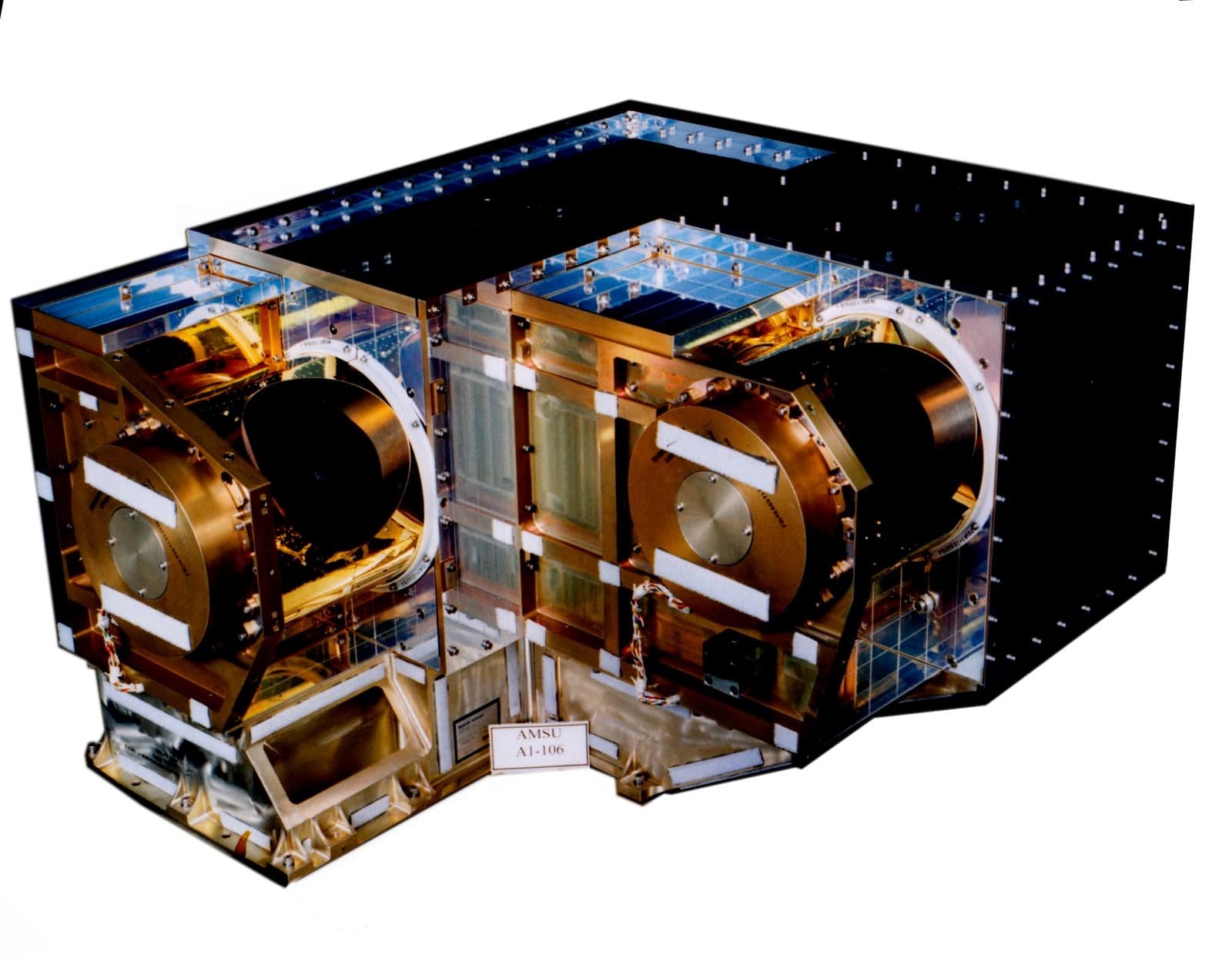
Image: NOAA-L brochure, NOAA Observation of the Earth and its Environment Survey of Missions and Sensors by: Dr H.J. Kramer, Public domain. Licence: Public domain. Source.