I · THE OBJECT · BRITISH MUSEUM
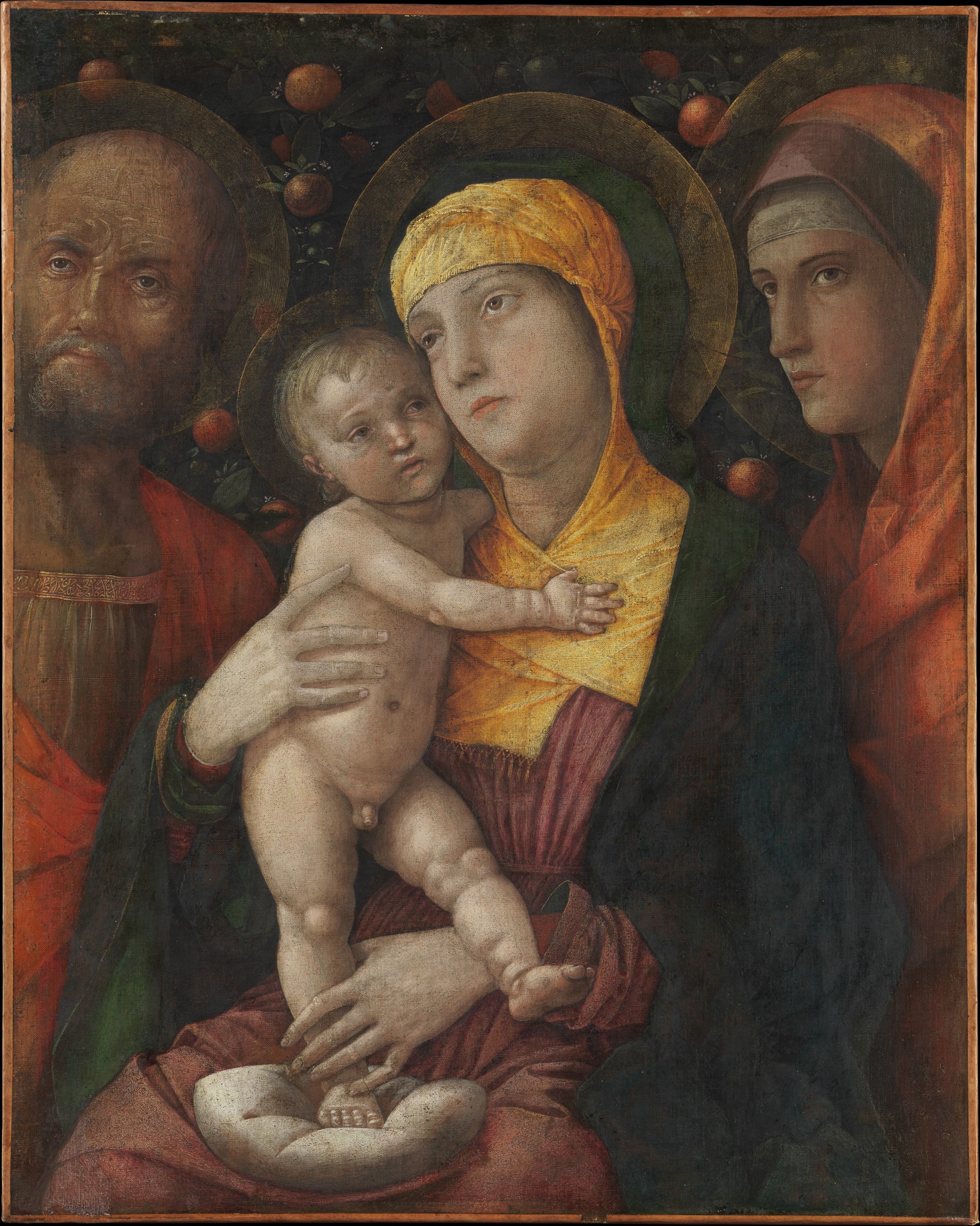
The Holy Family with Saint Mary Magdalen
▶ Listen · narrated
Andrea Mantegna painted this Holy Family with Saint Mary Magdalen around 1495. Its quiet scale and long private life are part of why it still rewards close looking.
At a glance
- Artist
- Andrea Mantegna
- Date
- 1495
- Material
- Tempera
- Dimensions
- 22.5 × 18 in
- Inventory
- 14.40.643
- Collection
- Metropolitan Museum of Art
Look closer
A fruit hedge behind the figures
Behind the Holy Family runs a hedge heavy with fruit. The same kind of densely packed greenery appears in other late Madonnas by Mantegna, including the Trivulzio Madonna and the Madonna della Vittoria. It is not empty decoration: it closes the space like a garden wall and keeps the sacred group near the picture plane, almost within arm’s reach of the viewer.
Canvas rather than panel
The support is canvas, worked in tempera with gold. For an artist long associated with fresco and panel, the choice of canvas belongs to his later practice. Together with the fruit hedge and other stylistic links, it is one of the reasons the painting is placed in Mantegna’s late period rather than earlier in his career.
Mary Magdalen among the Holy Family
The title is exact: this is not only Virgin, Child and Joseph. Saint Mary Magdalen stands with them. Her presence turns a familiar family group into a slightly wider company of devotion, inviting the viewer to read the scene as both intimate household and gathering of holy figures rather than a strict Nativity or Madonna and Child alone.
The story
The Holy Family with Saint Mary Magdalen is a small religious painting by Andrea Mantegna, now in the Metropolitan Museum of Art under the inventory number 14.40.643. It is painted in tempera, with gold, on canvas, and measures 22.5 by 18 inches. The date attached to it is 1495, though the wider window sometimes given for the work rests on its support and on comparisons with other pictures from the painter’s later years.
What we see is a compact sacred group: the Holy Family joined by Saint Mary Magdalen, set against a fruit-laden hedge. That hedge is not incidental. It links the painting to other Madonnas from Mantegna’s late production, among them the Trivulzio Madonna and the Madonna della Vittoria, where similar greenery presses close behind the figures. The effect is less an open landscape than a shallow, almost garden-like enclosure. The sacred persons remain near us; the world does not open behind them into distance.
The use of canvas belongs to the same late phase. Mantegna is often remembered for hard, sculptural form and for work on wall and panel; here the support is cloth, the medium tempera with gold, and the whole object is modest in size. Nothing in the verified record presents it as a great public altarpiece. It reads instead as a picture made for close, private looking — the kind of object that could hang in a room and be approached rather than surveyed from a nave.
How the painting was first known is less certain than its present home. It has been suggested that this may be the work once seen in the Ospedale degli Incurabili in Venice and described by Marco Boschini as similar to another Holy Family with a female saint, now in Verona. That identification is possible rather than proven. What can be followed more securely is the modern trail. In 1902 the Neapolitan count Agosto d’Aiuti sold it to an English antiquarian in London. After it had passed through further private hands, the American collector Benjamin Altman acquired it in 1912. He bequeathed it to the Metropolitan Museum in 1913. The painting has also been associated with the Galerie Weber in Hamburg among its earlier recorded locations. Today it is shown among the museum’s European paintings.
The picture is sometimes called the Altman Madonna, a name that remembers the donor rather than the subject. Both titles are useful. One tells us who stands in the frame; the other tells us how a Renaissance religious painting entered a public collection in New York and why this particular object, rather than another, sits under this inventory number.
Why it mattered then
In the years around 1495 a Holy Family remained one of the central subjects of Christian art: a way to hold the Incarnation inside an image of kinship, care and human scale. Adding Saint Mary Magdalen widened the circle without breaking it. She was a figure of penitence and close witness; her presence beside the Virgin and Child offered a model of devotion that a private viewer could share. Mantegna’s late preference for canvas and for tightly bounded settings, including fruit hedges that recall his other Madonnas of the period, belongs to a moment when sacred images were still required for prayer and contemplation, yet could also be refined objects for cultivated patrons. A painting of this size did not need a church wall. It could live in a domestic or institutional interior and still carry the full weight of religious genre. Whether or not this is the canvas Boschini later noted in Venice, the type itself — Holy Family with a female saint, compact, carefully finished — was already part of how sacred art circulated beyond the altar.
Why it matters now
The painting still matters because it is a secure point of contact with Mantegna’s late religious work outside Italy, held in a major public collection and open to ordinary looking. Its small format forces a different kind of attention from large altarpieces: you approach it as you would a page or a relief, not a façade. It also matters as a record of how Renaissance pictures moved. From a Neapolitan sale at the start of the twentieth century, through London and other private owners, into Benjamin Altman’s hands and then, by bequest, onto the walls of the Metropolitan Museum, the object’s modern life is unusually clear. The nickname Altman Madonna keeps that transfer visible. We do not only inherit the image; we inherit the path by which a late fifteenth-century tempera on canvas became part of a New York museum’s account of European painting.
The surprising detail
The painting is widely known by a collector’s name — the Altman Madonna — as much as by its sacred subject. Benjamin Altman bought it in 1912 and left it to the Metropolitan Museum the following year, so the donor’s surname still travels with the Holy Family. A second uncertainty clings to an earlier chapter: it may be the picture Marco Boschini saw in the Ospedale degli Incurabili in Venice and likened to another Holy Family with a female saint, but that match has never been proved. What looks like a settled museum highlight still carries a private nickname and a possible, unconfirmed Venetian sighting.
What is disputed
The inception date is given as 1495; a broader span into the early sixteenth century has also been proposed on the basis of the canvas support and stylistic links to other late Madonnas. The suggestion that this is the painting Marco Boschini saw in the Ospedale degli Incurabili in Venice remains possible rather than certain.
How it got here
In 1902 Agosto d’Aiuti, a Neapolitan count, sold the painting to an English antiquarian in London. After further private owners, Benjamin Altman acquired it in 1912 and bequeathed it to the Metropolitan Museum of Art in 1913, where it holds inventory number 14.40.643. Galerie Weber in Hamburg is among the locations recorded in its history.
Remember this
A small late Mantegna Holy Family with Mary Magdalen, painted in tempera on canvas around 1495, reached the Met through Benjamin Altman’s bequest.
Test yourself
Why does the fruit hedge behind the figures matter for placing this painting in Mantegna’s career, rather than serving only as background detail?
Because the same kind of dense fruit hedge appears in other Madonnas from his late period, including the Trivulzio Madonna and the Madonna della Vittoria. Together with the canvas support, that shared motif is one of the specific reasons the work is tied to Mantegna’s later years. The hedge is evidence of dating and authorship by comparison, not merely scenery.