III · THE WORK · ART HISTORY
Grön eld, Umeå
▶ Listen · narrated
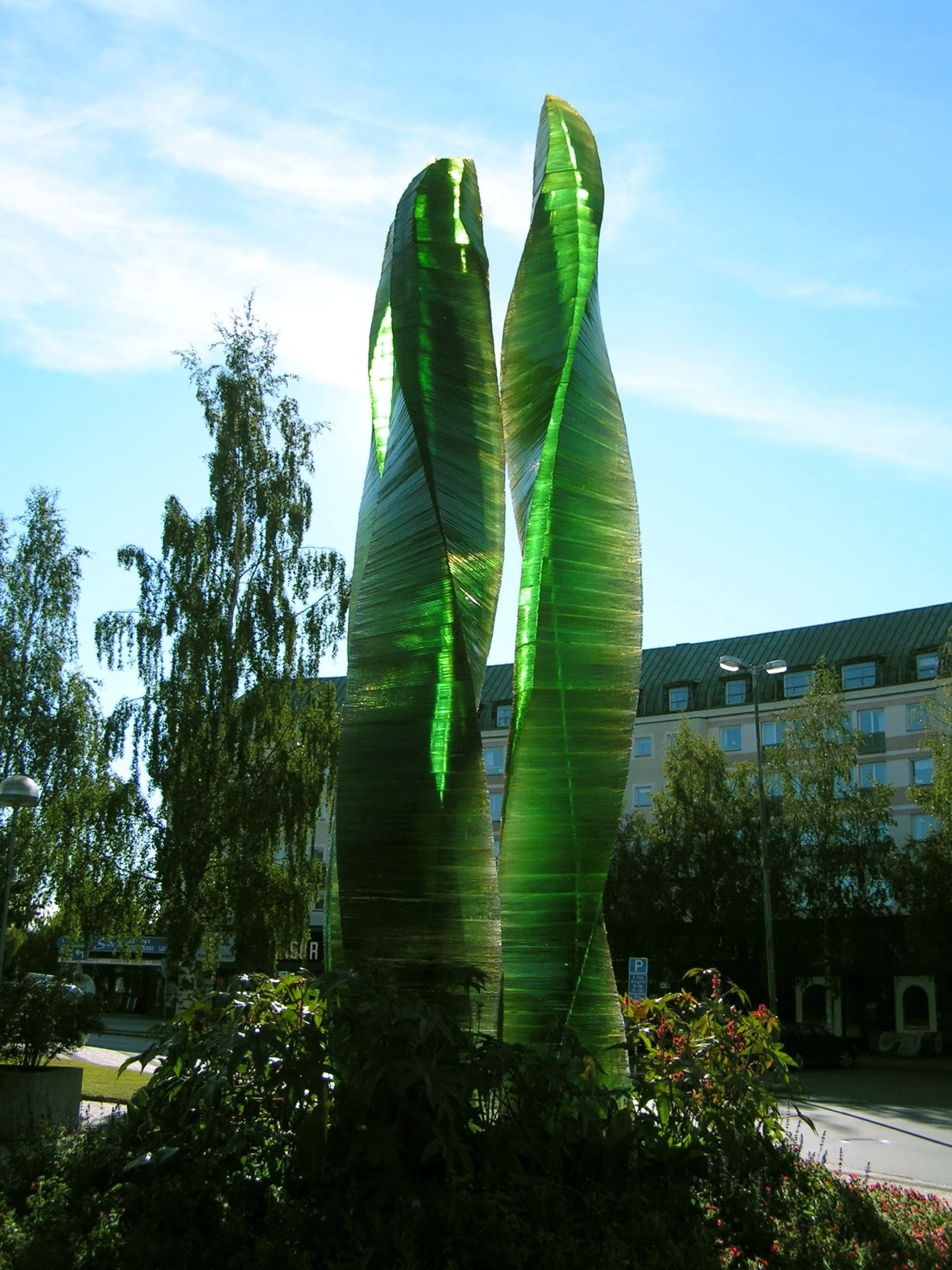
Vicke Lindstrand’s Grön eld stands where people pass through. Made of glass and classed as public art, it turns a square into the room that holds it.
At a glance
- Creator
- Vicke Lindstrand
- Date
- 1970
- Material
- Glass
- Location
- Rådhustorget, Umeå
- Type
- Public sculpture; architectural structure
Look closer
Glass as the whole body
The work is not glass applied to another frame or set behind a barrier. Glass is the material named for the piece itself. Outdoors, that choice is visible at once: the sculpture must take daylight, weather and the changing brightness of a square without the protection a gallery affords. Whatever form the eye follows, the substance remains the same from base to crown.
Sculpture and structure
Grön eld is recorded as both a sculpture and an architectural structure. The two labels pull in different directions. Sculpture suggests an object one may walk around and leave. Architectural structure suggests something that belongs to the place, fixed in the civic fabric. Standing at Rådhustorget, the work answers to both descriptions at once, and the double listing is part of how it is understood.
A square instead of a wall
The genre is public art, and the site is a square. There is no single ideal viewing distance and no controlled lighting scheme. People cross the space on other errands; looking is intermittent and repeated. The composition is therefore not only internal to the glass. It includes the open ground around it, the paths that skim its edges, and the sky against which the upper parts are read.
The story
Grön eld was created by Vicke Lindstrand and dates from 1970. Its material is glass. It stands at Rådhustorget in Umeå. In the record it is both a sculpture and an architectural structure, and its genre is public art. Those are the firm points. They are few, but they are not slight.
A glass work raised in a square is already a compositional decision before any curve or joint is considered. Glass carries a long association with windows, vessels and cases — things that frame, hold or display other matter. Here the glass is not a skin on a heavier core described in the sources; it is the substance of the piece. The sculpture must occupy ground, hold a vertical claim on the air above the paving, and accept whatever light the day happens to give. That is a different brief from glass kept indoors under even illumination.
The double classification matters for how the object is meant to be lived with. As sculpture it has a maker, a date and a form one can circle. As architectural structure it is tied to the square in a stronger sense: not a loan that might be withdrawn to storage, but part of the permanent arrangement of a public place. Public art, as a genre, sharpens the point. The audience is not first and foremost a visitor who has chosen to enter a room of art. It is anyone moving through Rådhustorget — in a hurry, in distraction, or in deliberate pause. The work has to tolerate indifference as calmly as attention.
Lindstrand’s authorship anchors the piece in a named practice, yet the surviving facts supplied for this account do not extend to a workshop narrative or a step-by-step method. What can be said without strain is that a designer known for work in glass put that material into civic space at the opening of the 1970s, and that the result was formally recognised as more than a freestanding ornament.
The title, Grön eld, pairs a colour with a force. It does not dictate a single reading. Green may be taken as hue in the glass, as a suggestion of growth, or as something cooler set against the idea of fire. Fire may be flame, energy, or simply upward movement. The name steers the eye without closing the argument. Composition, in that sense, begins before the first glance: the title prepares a tension between stillness and burn, between mineral cold and implied heat, that the glass then has to carry in daylight.
Because the piece is fixed outdoors, its making is inseparable from its siting. Joints, weight and balance — none of them itemised in the sparse record here — had to serve a life among weather and passers-by. The “room” of the work is the square itself. Edges are porous. Backgrounds change with season, hour and crowd. A close look, then, is not only a look at surface and contour. It is a look at how a modern glass object holds its place when the gallery wall has been removed and the city has been asked to act as the setting.
Why it mattered then
In 1970 the decision to instal a glass sculpture as public art in a Umeå square belonged to a wider modern argument about where art should stand. Civic space was being asked to host work that had often been reserved for controlled interiors. To use glass — a material linked to craft, display and fragility — as the body of something classed also as architectural structure was to test how far studio substance could travel into the open. The piece did not wait for a ticketed public. It met the city on the city’s terms, at ground level, in ordinary light. That was the force of the moment: not merely a new object in a square, but a claim that glass and public life could share the same weather.
Why it matters now
Grön eld still stands at Rådhustorget, and the questions it put in 1970 have not gone away. Cities continue to argue over what materials belong outdoors, how permanently a work should be fixed, and whether a sculpture is an object in a place or part of the place itself. The dual listing of this piece — sculpture and architectural structure — remains a useful pressure point. It keeps open the difference between something one looks at and something one lives beside. For anyone thinking about public art now, the work is a clear case of glass asked to do civic duty, and of a square asked to complete the composition.
The surprising detail
The same object is formally counted as both a sculpture and an architectural structure. Those categories usually part company: one names an artwork that can, in principle, be moved; the other names something bound into the built order of a site. Grön eld is held under both at once. The classification is not a flourish in a catalogue. It is a plain statement that the glass in the square is to be treated as art and as fabric of the place — a double identity that still shapes how the work is kept and understood.
What is disputed
The verified record used here places the work at Rådhustorget. Other published accounts have associated the sculpture with a different square in Umeå; the siting should not be treated as settled beyond the source in hand. Detail of manufacture, exact form and original brief are thinly documented in the facts supplied, and nothing beyond date, material, creator, location and public classification is stated as certain.
Remember this
Grön eld is glass made civic: a sculpture that is also structure, set in a square rather than on a gallery wall.
Test yourself
Grön eld is recorded as both a sculpture and an architectural structure. Setting aside taste or preference, what does that double classification change about the viewer’s relationship to the work?
It changes the status of the site. If the piece were only a sculpture, the square would be a backdrop — a convenient place to stand and look. Because it is also classed as architectural structure, the square is part of what the work is. The ground, the open air and the paths through Rådhustorget are not optional scenery; they complete the conditions under which the glass exists. The viewer is not only an observer of an object but a person already inside the structure’s setting, whether or not they came to look.
Go deeper
Image: I, MikaelLindmark. Licence: CC BY-SA 3.0. Source.