III · THE WORK · ART HISTORY
The Sphere
▶ Listen · narrated
A work of public art is usually replaceable. This one survived an event that destroyed the building it was made for, and the damage made it irreplaceable.
At a glance
- Artist
- Fritz Koenig
- Date
- 1971
- Material
- Bronze
- Height
- 7.6 metres
- Current location
- Liberty Park, New York
Look closer
The surface now
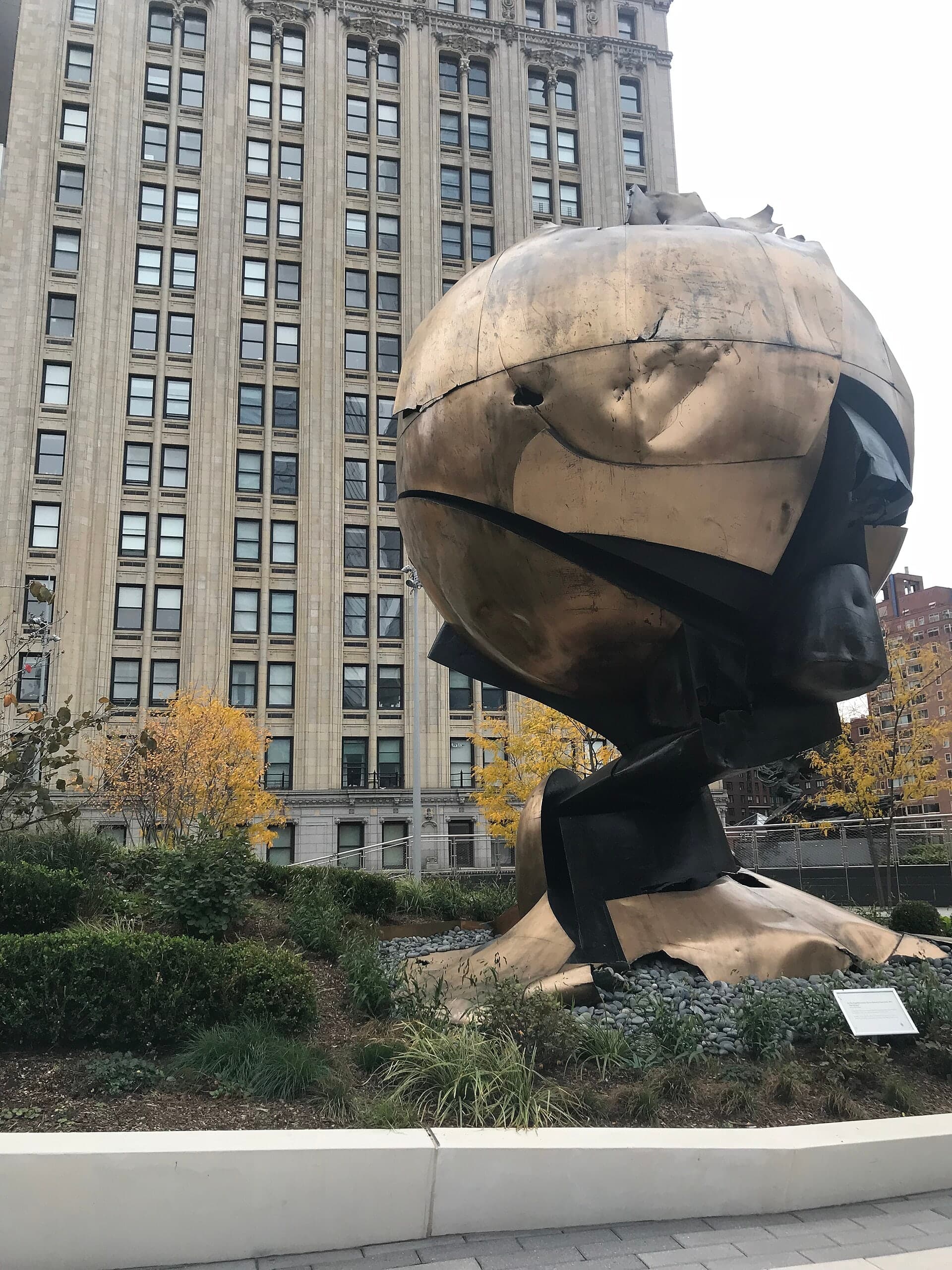
The bronze is torn and dented. Sections are crushed inward. The damage is not restoration awaiting funding or decay from weather — it is the record of what happened on a particular morning, and it has been kept. The sculpture was recovered from the ruins of the World Trade Center plaza where it had stood, and the decision was made not to repair it. What you see when you look at the surface is the force that brought down two towers, preserved in metal that did not quite give way.
The form underneath
Beneath the damage, the shape is a sphere — or was intended as one. The surface is divided into facets, like a geometric abstraction of a globe, with openings that let you see through to the other side. It was made to sit in a fountain, water running over the bronze, a piece of monumental decoration for a public plaza. The geometry is still legible under the distortion, enough to see what Koenig was making before the building he made it for ceased to exist.
The placement
The sculpture now stands in Liberty Park, a raised platform overlooking the site where it originally stood. You can see from the sculpture to the memorial pools that mark the footprints of the towers. The sight line is deliberate: the sculpture was moved in 2017 to a position where it faces its former location. It is not in the memorial itself but adjacent to it, close enough to make the connection clear, far enough to remain a separate object with its own history.
The story
Fritz Koenig completed the sculpture in 1971. It is cast bronze, 7.6 metres tall, built as a sphere divided into facets with voids cut through it. The form is geometric but not rigid — the openings give it a sense of rotation, as though you are seeing one position of something that turns. It was commissioned as a fountain sculpture, and in 1972 it was installed in the plaza of the World Trade Center in New York, between the two towers. Water ran over the bronze. It was a piece of public art in a place thousands of people passed daily, functional decoration for a corporate plaza.
When the towers collapsed during the September 11 attacks, the plaza was destroyed. The sculpture was buried in the rubble. When the site was cleared, the sphere was recovered — crushed, torn, dented, but structurally intact. It had been made to hold its shape under its own weight and the pressure of water. It was not made to withstand what happened, but it did not disintegrate. The bronze held.
After recovery, the sculpture was dismantled and stored near a hangar at John F. Kennedy International Airport. In 2002 it was installed in Battery Park, at the southern tip of Manhattan, as a temporary memorial. It remained there for fifteen years. In 2017 the Port Authority of New York and New Jersey moved it to Liberty Park, a raised park overlooking the memorial plaza that now occupies the site of the towers. The sculpture was rededicated in August 2017. It has been kept in the condition it was found in — the damage has not been repaired.
The decision not to restore it is what changed the work. A sculpture that was made as decoration, that had no commemorative function when Koenig conceived it, became a memorial because it survived and because the survival is visible. The dents and tears are not incidental to what the sculpture now means — they are the content. What you are looking at is not a fountain sculpture that was damaged. You are looking at an object that was present during an event and that carries the physical record of that presence. The form Koenig made in 1971 is still there, but it is now also a document.
Why it mattered then
When the sculpture was made and installed, it was public art of a kind common in the 1970s: large-scale, abstract, geometric, placed in a corporate or civic plaza. The World Trade Center plaza was a new space, and the fountain with Koenig's sphere was part of making it usable, making it more than a windswept gap between buildings. The sculpture had a function — it was something to look at, to orient yourself by, to meet near. It was not political. It was not a memorial. It was not particularly controversial. It was a well-made piece of monumental bronze in a place where many people would see it, doing the work that public sculpture in that period was expected to do: marking space, providing scale, giving a plaza a centre.
Why it matters now
The sculpture now does something Koenig did not design it to do. It is a memorial, but not in the usual way — it was not made to commemorate anything, and it does not represent the event it now recalls. It is a memorial because it was there, because it survived, and because the evidence of survival is preserved in the metal. The damage is what matters. A restored version would be a fountain sculpture again, historically interesting but not urgent. The unrestored version is a record. It holds information that cannot be conveyed any other way: what it felt like, physically, to be an object in that space on that day. The sculpture has become a witness. That transformation — from decoration to document — is why it still holds attention. It did not set out to mean what it now means, but the meaning is not imposed. It is in the bronze.
The surprising detail
The sculpture was made to sit in water, and for twenty-nine years it did. After the collapse, after the recovery, after the years in storage and the temporary installation in Battery Park, it was moved in 2017 to Liberty Park — and placed on dry land. It is no longer a fountain. The water that was part of the original design, that Koenig intended to run over the bronze, is gone. The sculpture now stands without it, and the absence is not treated as a loss. The fountain function has been set aside. What remains is the form and the damage, and those are now sufficient. The sculpture has been separated from the feature that gave it its working title, and it has not lost meaning. It has gained it.
Remember this
A sculpture made as decoration became a memorial because it survived, and because the survival is visible in the metal.
Test yourself
The sculpture was kept in its damaged condition rather than restored. What does that decision assume about how a memorial works?
It assumes that the physical trace of an event can carry meaning that a restored or recreated object cannot. A repaired sculpture would be the form Koenig intended in 1971 — a geometric bronze sphere, intact and functional. The damaged sculpture is that form plus the record of what happened to it. The decision to preserve the damage rather than erase it treats the sculpture as evidence, not just as art. It makes the object itself a document of the event, not a symbol of it. That only works if you believe that the dents, tears and crushed sections communicate something that words or images cannot — that the force recorded in the bronze is part of what people need to see. The decision is a claim that some kinds of memory require the physical thing, not a representation of it.
Go deeper
Image: TJ DeGroat from San Francisco, CA, Los estados unidos, CC BY 2.0. Licence: CC BY 2.0. Source.