II · THE DISCOVERY · HISTORY OF SCIENCE
Glasses
Before glasses, a person whose vision blurred with age had no remedy. The technology that changed that is older than the printing press.
At a glance
- In use since
- 1270
- Function
- Hold lenses in front of the eyes to correct vision
- Early form
- Lenses mounted in frames without arms
- Temple arms
- Added in the 1700s
Look closer
The date is a year, not a name
The record gives 1270 as the date glasses came into use, but names no inventor. That tells you something about how the evidence sits: there is enough to place the technology in a decade, but not enough to credit it to a person. The earliest ancestors were Italian reading stones — magnifying lenses that a reader held directly over a book, with no frame to keep them in place.
No arms for four hundred years
The familiar arms that hook over the ears were not part of the original design. They were added in the 1700s. Before that, a wearer had to balance the frame on the nose, hold it in place, or use a strap. The technology that let someone read with both hands free came long after the technology that made the lenses.
Correction, protection, and fashion
Glasses are used for vision correction — bringing blurred text or distant objects into focus — but also as protection. Safety glasses shield the eyes from debris or radiation in work or sport. Sunglasses reduce bright light and block ultraviolet exposure. Some glasses are worn for fashion alone, with no corrective power in the lenses at all.
The story
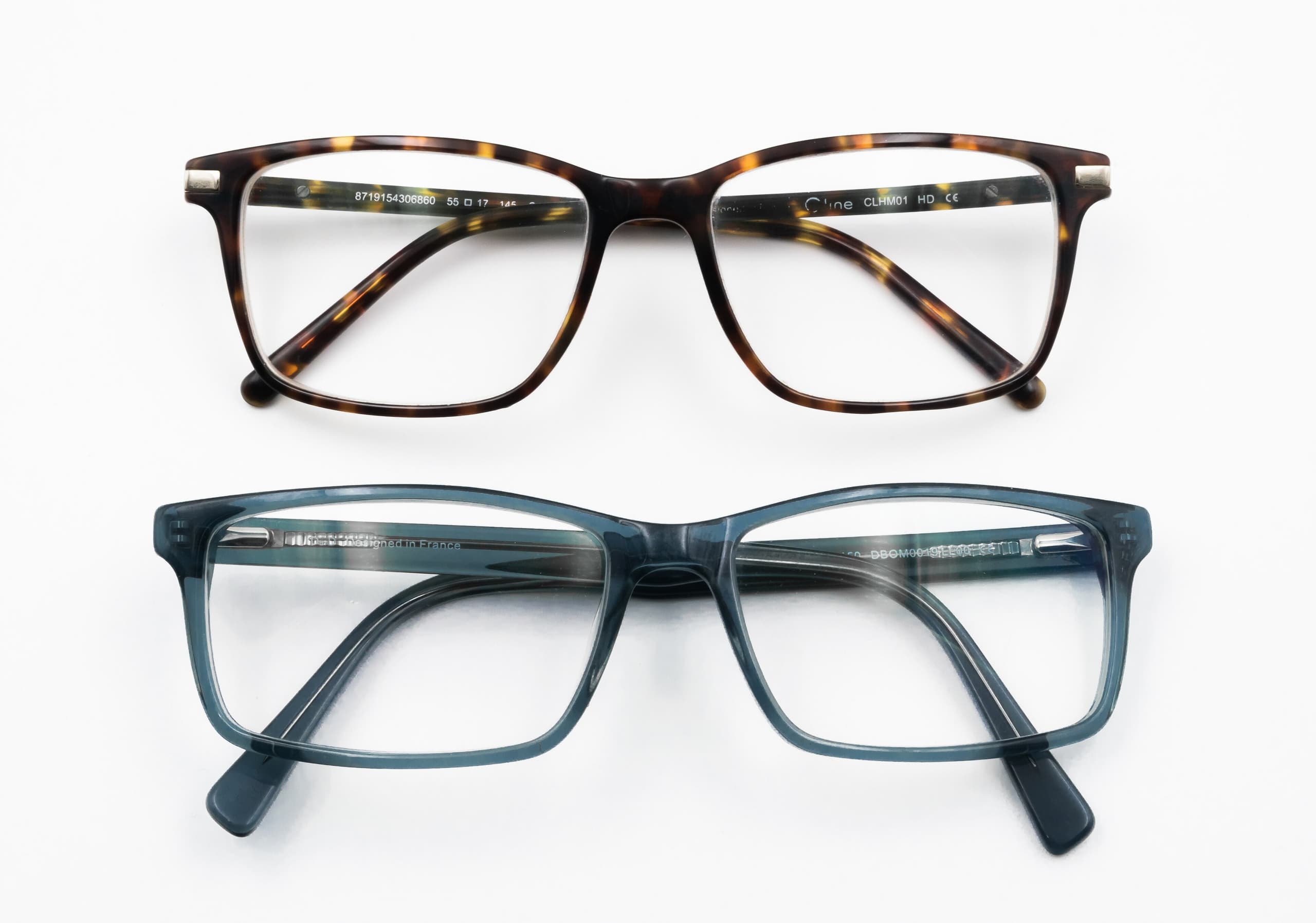
Glasses are lenses mounted in a frame that holds them in front of a person's eyes. The frame typically rests on a bridge over the nose, and in the design that became standard from the 1700s onward, hinged arms — called temples or temple pieces — hook over the ears to keep the frame steady.
The technology came into use in 1270, in Italy. The earliest form was not what we would recognise as glasses today. They were reading stones: magnifying spheres with no arms, which a reader had to hold directly over a book. The advantage was magnification; the disadvantage was that it required a hand.
The frame that could rest on the nose without being held came next, but still without the temple arms. A wearer had to balance it, or use a strap tied to the frame to prevent it slipping off. The arms that hook over the ears — the feature that lets someone wear glasses and forget they are wearing them — were not invented until the 1700s, more than four centuries after the lenses themselves.
Glasses are most commonly used to correct vision. A person whose eyes do not focus light correctly — because the lens inside the eye is too strong or too weak, or the shape of the eye is not quite right — sees a blurred image. A lens in front of the eye bends the light before it enters, compensating for the error and bringing the image into focus. Reading glasses correct for near vision; other lenses correct for distance.
But glasses are also used for protection. Safety glasses shield the eyes from debris, chemicals, or radiation, and are worn by workers in environments where the eyes are at risk. Some have protection on the sides as well as in the lenses. Sunglasses reduce the intensity of bright light and block ultraviolet radiation, which can damage the eye over time. Photochromic lenses are clear indoors but darken in ultraviolet light, switching between ordinary glasses and sunglasses depending on the conditions.
Some glasses are worn for reasons other than correction or protection. Specialised lenses let a wearer see three-dimensional images in films designed for stereoscopy. Tinted lenses reduce discomfort for people with photophobia — a condition in which normal light levels cause pain — and are sometimes worn indoors or at night. And some glasses are worn purely for fashion, with no corrective or protective function at all.
Frames are made from plastic, metal, wire, and other materials. Lenses are typically plastic, polyethylene, or glass. The range of designs is wide, and has been since glasses became common enough to be a consumer product rather than a specialist tool.
Why it mattered then
Before glasses, a person whose vision blurred with age had no solution. Reading, writing, and any close work that required fine detail became harder or impossible as the lens inside the eye lost flexibility. That is a natural process, and it affects nearly everyone who lives past middle age. Glasses changed that. A lens ground to the right curvature could compensate for the eye's loss of focus, restoring the ability to read and work. The technology appeared in the 1270s, which places it before the printing press — before there were many books to read — but in a culture where manuscripts, contracts, and record-keeping mattered. A scribe, a clerk, or a scholar whose eyes weakened could continue working. The early designs were awkward. Reading stones had to be held in place, which meant one hand was always occupied. Frames without arms had to be balanced or tied on. But even an awkward solution was better than none, and the technology spread. By the time the temple arms were added in the 1700s, glasses were common enough that the improvement was an refinement of something already in wide use, not the invention of something new.
Why it matters now
Glasses are now widely used. A large proportion of the population wears them, either all the time or for specific tasks. The condition they correct — blurred vision from an eye that does not focus light correctly — is extremely common, and without correction it limits what a person can do. The technology has been refined but not replaced. Contact lenses sit on the eye itself rather than in front of it, and surgical procedures can reshape the cornea to correct focus, but both are more recent and more invasive than glasses. For most people, glasses remain the simplest and least intrusive solution. The functions have multiplied. Glasses now correct not just for near and distance vision but for astigmatism — a condition where the eye is not symmetrically curved — and for more complex prescriptions. Bifocal and varifocal lenses combine multiple corrections in a single lens, letting a wearer switch focus without changing glasses. Photochromic lenses adjust automatically to light levels. Safety glasses and sunglasses protect against physical and optical hazards. And glasses are now a fashion item as well as a functional one. Frames are designed and marketed as accessories, and some people wear them with no corrective lenses at all. The technology that began as a reading aid for scholars is now both a medical device and a piece of everyday style.
The surprising detail
The temple arms — the parts that hook over the ears and make glasses easy to wear — came four hundred years after the lenses. That is a long time for a design to remain incomplete. The early wearers had to hold the frame in place, balance it on the nose, or tie it on with straps. The improvement that seems obvious now, and that makes modern glasses comfortable enough to forget you are wearing them, took centuries to arrive.
What is disputed
The record gives 1270 as the date glasses came into use, but names no inventor. The earliest form — Italian reading stones — is described in the reference material, but the transition from reading stones to framed lenses is not dated, and the evidence does not support a sharper account than the one given here.
Remember this
Glasses have been correcting vision since 1270, but the arms that hook over the ears were not added until the 1700s.
Test yourself
Glasses came into use in 1270, but the familiar temple arms were not added until the 1700s. What did that four-century gap mean for the people who wore them?
It meant glasses were harder to use. Without the arms, a wearer had to hold the frame in place, balance it carefully on the nose, or tie it on with straps to stop it slipping off. The lenses worked — they corrected vision — but the frame was awkward, and wearing them required either a free hand or a tolerance for something that would not stay put on its own. The temple arms solved that problem, but only after the technology had been in use for more than four hundred years.
Go deeper
Image: Jacek Halicki, CC BY-SA 4.0. Licence: CC BY-SA 4.0. Source.