I · THE OBJECT · BRITISH MUSEUM
The Circus Parade
▶ Listen · narrated
Seurat turned to popular entertainment for the first time, and painted it at night. The result is formal, symmetrical, and still harder to pin down than its subject.
At a glance
- Date
- 1887–88
- Artist
- Georges Seurat
- Material
- Oil on canvas
- Dimensions
- 99.7 × 149.9 cm (4 ft 11 in)
- Movement
- Neo-Impressionism
- Inventory
- 61.101.17
Look closer
Night, not daylight
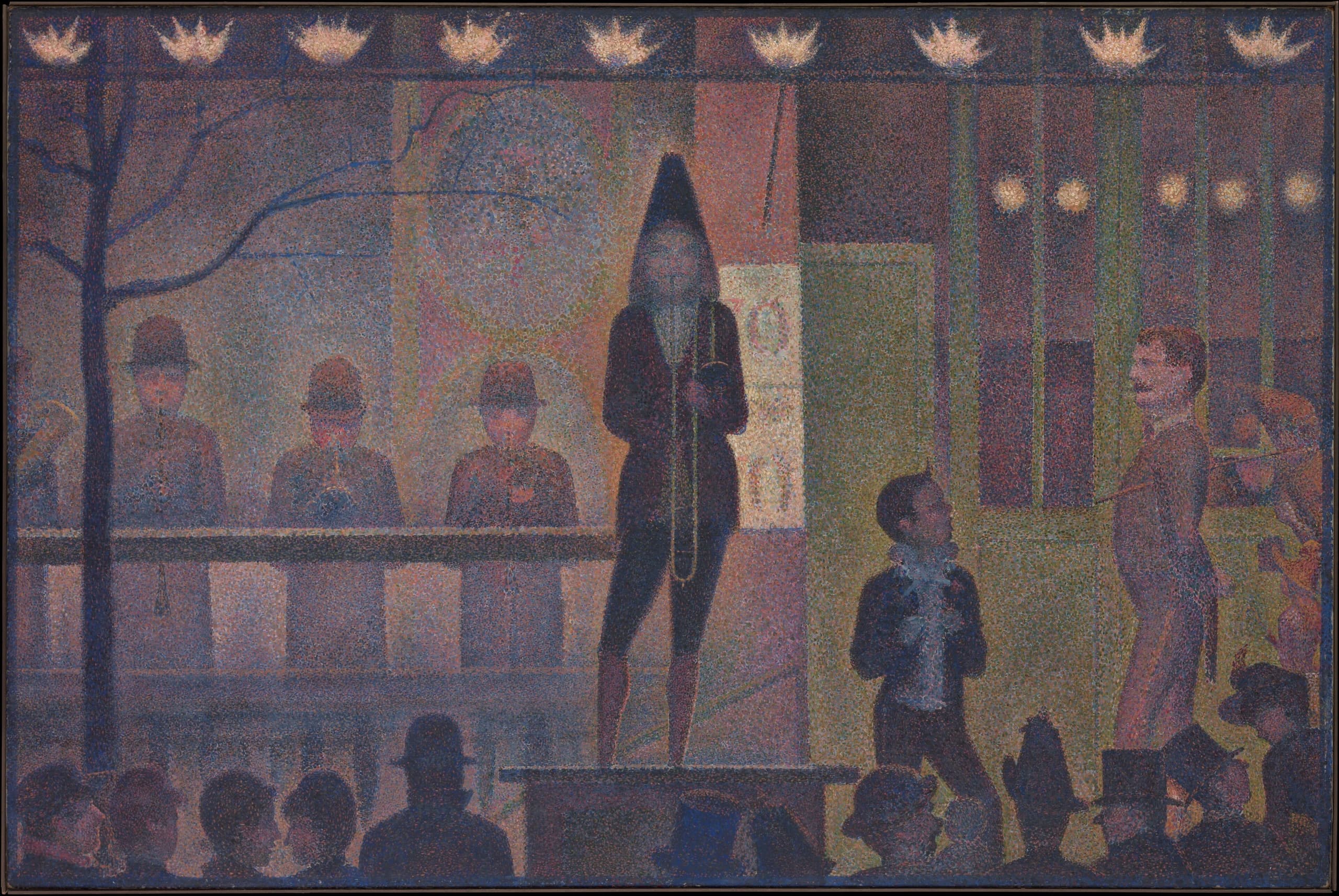
This was Seurat’s first nocturnal scene. The subject is the sideshow — the parade — of the Circus Corvi at the place de la Nation in Paris, painted as entertainment under night conditions rather than as a sunlit spectacle. The choice matters because it forces the composition to work with artificial illumination and a restricted range of tones, not the open-air colour of his earlier major canvases.
Formality before thrills
What the painting withholds is as striking as what it shows. Alfred H. Barr Jr. later singled out its formality and symmetry as highly innovative, calling it the most geometric in design, and the most mysterious in sentiment, of Seurat’s major canvases. The sideshow becomes a structured arrangement of figures and intervals more than a rush of crowd energy.
A long-worked theme
Seurat worked on the theme for nearly six years before finishing the final painting. The canvas that reached the 1888 Salon des Indépendants was therefore not a quick report from the fairground but the end of a sustained campaign on one subject: popular entertainment treated with the same deliberateness he brought to landscape and figure compositions.
The story
The Circus Parade — known in French as Parade de cirque, and in English often as Circus Sideshow — is an oil painting on canvas by Georges Seurat, begun in 1887 and completed in 1888. It measures 99.7 by 149.9 centimetres (4 ft 11 in) and belongs to the Metropolitan Museum of Art in New York, where it is inventoried as 61.101.17. In genre it is genre art; in movement it sits squarely inside Neo-Impressionism.
The subject is specific. Seurat painted the sideshow, or parade, of the Circus Corvi at the place de la Nation in Paris. A parade in this sense was the free outdoor teaser that drew passers-by toward the paid performance inside. It was his first painting of popular entertainment and his first nocturnal scene. Those two firsts sit together: night and low spectacle, treated with the same controlled method he had already applied to brighter, more elevated subjects.
He first showed the work at the 1888 Salon de la Société des Artistes Indépendants in Paris, under the title Parade de cirque, catalogue number 614. Contemporary reception was cool. It became one of his least admired works at that exhibition. The coolness is part of the object’s history, not a later embarrassment to be smoothed away. A painting that organises a circus teaser into strict geometry was never going to read as easy pleasure.
The long preparation behind the finished canvas is worth holding in view. Seurat had worked on the theme for nearly six years before completing this version. What hangs in the museum is therefore the result of repeated attention to one motif — figures, intervals, artificial light, the social fact of street entertainment — rather than a single evening’s impression fixed in paint.
Later commentary reversed the early indifference. Alfred H. Barr Jr. described Parade de cirque as one of Seurat’s most important paintings. He stressed its formality and symmetry as highly innovative and placed it as the most geometric in design, as well as the most mysterious in sentiment, among Seurat’s major canvases. That judgment does not cancel the 1888 response; it shows how slowly a difficult picture can change its public.
The painting’s afterlife also includes influence. It fed into the thinking of Fauves, Cubists, Futurists and Orphists — artists who found in its structure and its night-time popular subject a licence for their own departures from naturalist description. The canvas itself entered the Metropolitan Museum of Art by bequest of Stephen C. Clark in 1960. It remains there, a major Neo-Impressionist statement that still looks less like a crowd scene than like a carefully measured stage.
Why it mattered then
In 1888 the painting arrived at the Salon des Indépendants as Seurat’s first full treatment of popular entertainment and his first nocturnal scene. Neo-Impressionism already asked viewers to accept colour and form built by method rather than by rapid sketch. Applying that method to a circus sideshow at the place de la Nation raised the stakes: the subject was ordinary and commercial, the design severely geometric. The work’s poor reception at the exhibition is evidence of how far the picture stood from expectations of either lively genre painting or approved modern landscape. Seurat had spent nearly six years on the theme; the finished canvas was a deliberate public claim that such material belonged inside the most rigorous branch of contemporary painting.
Why it matters now
The canvas still matters because it shows a major Neo-Impressionist pressing popular night entertainment into formal, symmetrical design without softening either the geometry or the social subject. Its influence on Fauves, Cubists, Futurists and Orphists is part of the longer story of how twentieth-century artists learned to treat modern leisure as structure, not only as anecdote. Barr’s later emphasis on its mystery of sentiment keeps the painting from collapsing into a pure diagram: the coolness is expressive, not empty. At the Metropolitan Museum of Art it remains a primary object for anyone tracing how late nineteenth-century method met urban spectacle — and how a picture once among Seurat’s least admired works became central to his reputation.
The surprising detail
When it was first exhibited in 1888 it was one of Seurat’s least admired works. Decades later Alfred H. Barr Jr. would call it one of his most important paintings and the most geometric, as well as the most mysterious, of the major canvases. The gap between those two judgments is wide, and it is part of what the object carries: a sideshow picture that had to wait for its formality to be read as strength rather than chill. Seurat had already spent nearly six years on the theme before the Salon hanging; the cool first response did not reflect a casual effort.
What is disputed
The inception is recorded as both 1887 and 1888; the painting is therefore dated as a work of 1887–88 rather than a single calendar year. Early critical response at the 1888 Indépendants is summarised as among Seurat’s least admired showings, but the surviving texture of that indifference is thinner than the later scholarly consensus that elevated the canvas.
How it got here
The painting is in the Metropolitan Museum of Art, New York, inventory number 61.101.17. It entered the museum by bequest of Stephen C. Clark in 1960.
Remember this
A circus sideshow, painted at night with severe geometry — Seurat’s first popular entertainment picture, coolly received in 1888, later central to his reputation.
Test yourself
Why is it useful to hold together the painting’s cool reception in 1888 and Barr’s later praise of its geometry and mystery, rather than treating one judgment as simply wrong?
Because the two responses measure different expectations against the same object. In 1888 a nocturnal circus sideshow organised with strict formality did not meet hopes for lively genre or for more familiar Neo-Impressionist subjects; the coolness records that friction. Barr’s later emphasis on geometry and mysterious sentiment names the very qualities that made the picture hard to admire at once. Keeping both in view shows how a difficult design can change its public without the paint itself changing — and why ‘least admired’ and ‘most important’ can both be historically true.
Go deeper
Image: Georges Seurat, Public domain. Licence: Public domain. Source.