I · THE OBJECT · BRITISH MUSEUM
Bache Madonna
▶ Listen · narrated
This painting matters not because its history is fully documented, but because artist, date, medium and museum location give its small surface firm coordinates.
At a glance
- Artist
- Titian
- Date
- 1508
- Medium
- Oil paint on panel
- Size
- 43.2 × 54.6 cm (1 ft 9 in)
- Collection
- Metropolitan Museum of Art
- Number
- 49.7.15
Look closer
A paired subject
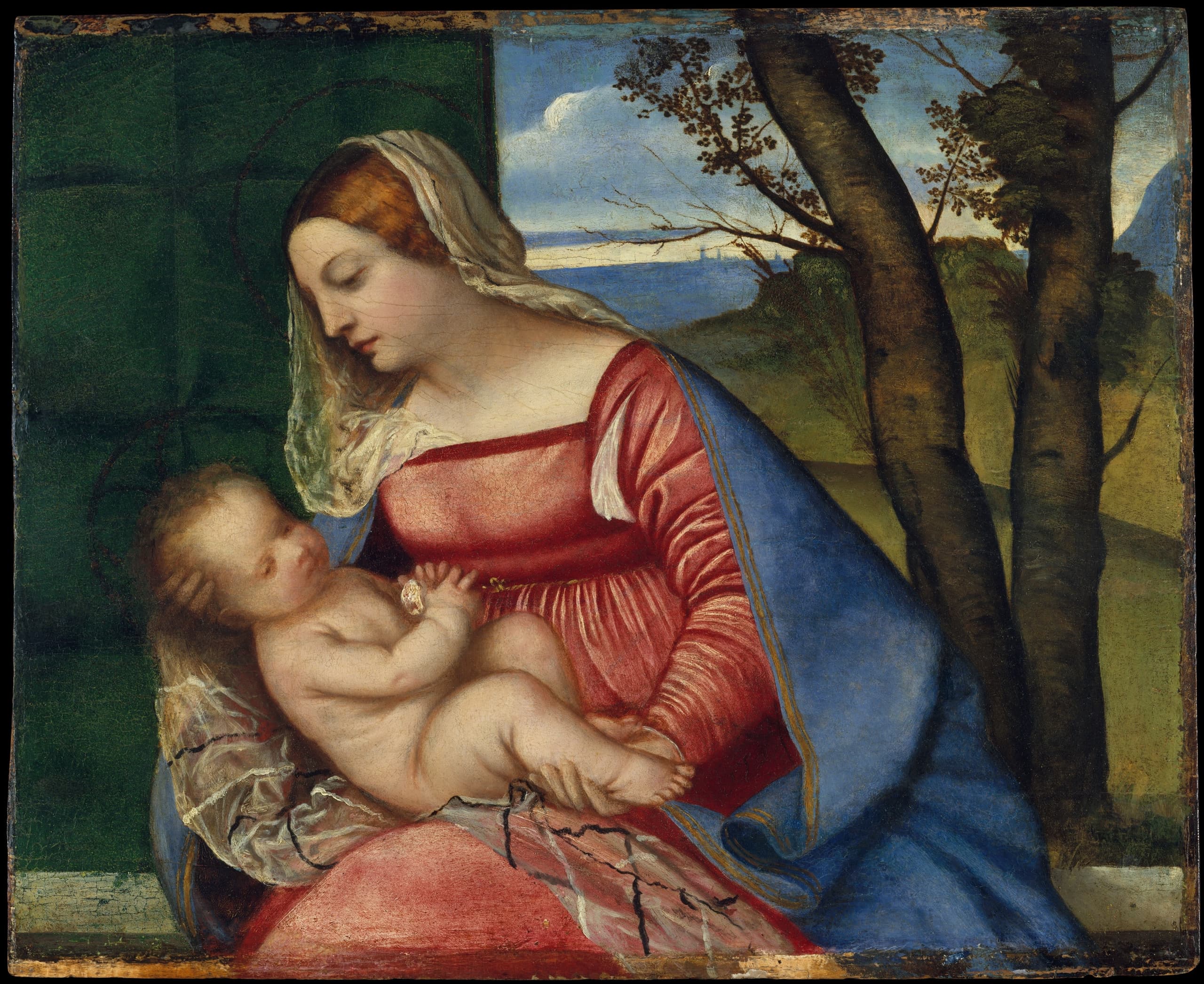
The supplied background identifies the image as Madonna and Child. That pairing is the painting’s essential visual structure: two figures held within a panel only 43.2 centimetres (1 ft 5 in) high and 54.6 centimetres (1 ft 9 in) wide.
A compact rectangle
The panel is wider than it is high. Its horizontal measure, 54.6 centimetres (1 ft 9 in), gives the composition a broad but contained field rather than the tall format often associated with a single standing figure.
An altered arrangement
The background note reports that investigation suggested an earlier arrangement with the figures seated upright near the centre. It also describes the final arrangement as less formal, with greater emphasis on their connection.
The story
Bache Madonna is a painting by Titian, made in 1508. It is religious art: an oil-painted panel showing Madonna and Child. The work belongs to the Metropolitan Museum of Art, where it is also located, under inventory number 49.7.15.
Its physical scale matters. At 43.2 centimetres (1 ft 5 in) high and 54.6 centimetres (1 ft 9 in) wide, it is a relatively compact painted panel. The work is assigned to the Venetian school and to the High Renaissance. Those classifications place it within an art-historical framework, but they do not by themselves settle every question about the painting’s making or later life.
The supplied background describes a possible change during the painting process. Investigation has suggested that the figures may first have been conceived sitting upright in the centre, in a more formal arrangement. The final pose is described as more relaxed, placing attention on the relation between mother and child. Since the available wording is cautious, that earlier design should be treated as a suggestion rather than a complete reconstruction of the painter’s intentions.
The same background notes that past cleaning has reduced some definition in the picture. This is an important limit on looking. A painting can retain its subject, date, material and authorship while losing some of the visual clarity through which viewers might otherwise judge its surface and details.
How the work was found is not provided in the supplied information. Nor is its route into the Metropolitan Museum of Art. That absence is worth stating plainly. The record establishes where the painting is now, but not the circumstances of its discovery, ownership history or acquisition.
Why it mattered then
In its own stated setting, the painting brought together a religious subject, oil paint on panel and an artist identified as Titian. Its classification within the Venetian school and High Renaissance gives it a place in a particular historical grouping, while its date of 1508 fixes it more closely than such broad labels can. The reported change from a centred, upright arrangement to a less formal one may matter here. If that account is correct, the composition was not simply fixed at the outset. The relation between the two figures became a central concern of the final image.
Why it matters now
Bache Madonna remains useful because it asks for careful attention to the difference between what is securely recorded and what is only reported or absent. Titian, 1508, oil paint, panel, dimensions and present museum location are given facts. The circumstances of discovery and museum arrival are not supplied. It also offers a concise case in how a work’s present appearance can carry a history of intervention. The note about past cleaning does not explain every visible feature, but it warns against treating surviving definition as identical with the painting’s original condition.
The surprising detail
The record can be precise and incomplete at once. It identifies Titian, 1508, a panel, exact dimensions and a museum inventory number, yet supplies no account of how the painting was found or how it entered the collection.
What is disputed
The supplied background says that investigation suggested an earlier, more upright central arrangement, but does not provide the evidence or describe it in detail. It also notes a loss of definition from past cleaning. No discovery account is supplied.
How it got here
The supplied information identifies the Metropolitan Museum of Art as both collection and location, but gives no acquisition history, previous ownership, discovery circumstances or contested-ownership context.
Remember this
A small 1508 oil panel by Titian, Bache Madonna is securely placed in a museum record even as key parts of its later history remain unstated.
Test yourself
Why is it useful to distinguish the painting’s documented facts from the reported suggestion of an earlier composition?
They carry different levels of certainty. The supplied record states the artist, date, medium, dimensions and collection directly. The earlier arrangement is presented as something investigation has suggested. Keeping that distinction visible allows the possible change in composition to remain meaningful without turning it into a settled fact.