III · THE WORK · ART HISTORY
Liberty Statue
▶ Listen · narrated
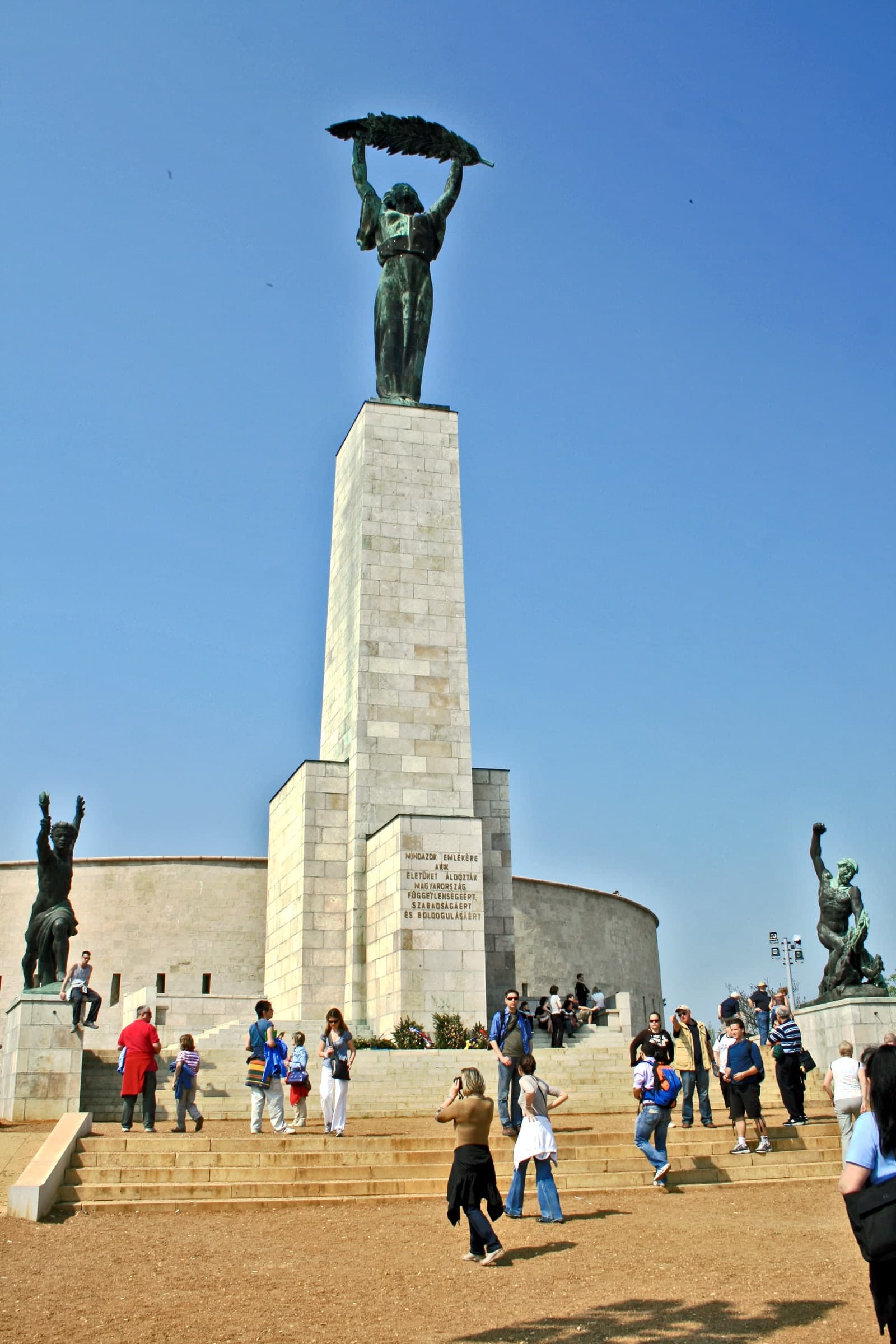
A commemorative figure stands at the east end of the Citadella, high enough to command the city below. Close looking begins with height, material and the weight of a name.
At a glance
- Creator
- Zsigmond Kisfaludi Strobl
- Materials
- Bronze and stone
- Height
- 40 metres (131 ft 3 in)
- Type
- Sculpture / monument
- Site
- Citadella, Gellért Hill, Budapest
Look closer
Height as argument
Forty metres is not a casual measurement. At that scale the sculpture stops being an object you walk up to and becomes part of the city’s vertical profile. From the east end of the Citadella it reads first as a mark on the skyline, and only later as a figure with a body and a purpose. The height is doing commemorative work before any surface detail comes into focus.
Bronze on stone
The materials are given as bronze and stone — a pairing that divides labour. Stone typically carries mass, plinth and permanence; bronze takes the modelled form that catches light and weather. Without forcing a studio anecdote the eye can still hold that split: a dark, worked metal figure raised on a lighter, heavier base, the whole stack locked into the hilltop.
A name that doubles
In English the work is called both Liberty Statue and Freedom Statue; in Hungarian it is Szabadság-szobor. The doubled English title is not ornament. It points to a single Hungarian idea of szabadság that English splits, and it sits beside a dedication that itself runs to three terms — independence, freedom and prosperity — rather than one.
The story
The Liberty Statue stands at the east end of the Citadella on Gellért Hill in Budapest. It is a sculpture, not a building and not a relief: a freestanding commemorative monument whose height is recorded at forty metres and whose materials are bronze and stone. Its maker is the sculptor Zsigmond Kisfaludi Strobl.
What the monument sets out to do is stated plainly in its brief. It commemorates those who sacrificed their lives for the independence, freedom and prosperity of Hungary. That is a wide commemorative field. Independence, freedom and prosperity are not interchangeable words; laid side by side they ask the sculpture to hold political sovereignty, personal and civic liberty, and material well-being in a single upright form. The English titles used for the work — Liberty Statue and Freedom Statue — and the Hungarian name Szabadság-szobor all point back to that claim.
Composition, at this scale, begins with siting. The Citadella occupies high ground; the statue is placed at its east end, so that the figure is not lost inside a courtyard but pushed to the edge where it can be seen against open air and the city below. A forty-metre stack of bronze and stone on that ridge does not wait for the visitor who has already climbed the hill. It addresses the wider basin of Budapest first, as silhouette, and only second as a work to be inspected at arm’s length.
Close looking therefore has two distances. From afar the sculpture is almost pure proportion: a vertical accent, dark metal above pale mass, fixed to the hill. Nearer to, the division of materials becomes legible as craft. Stone holds the load and supplies the architectural foot; bronze takes the modelling of the figure and any smaller forms that rise with it. The facts do not oblige us to invent a studio story about how the metal was cast or how the stone was dressed. They do allow us to notice that the monument is built from two substances with different weights, different surfaces and different habits under weather, and that the whole depends on their join.
Kisfaludi Strobl’s task was public and declarative. A commemorative statue of this height cannot afford private ambiguity about why it is there; the dedication does the speaking. At the same time the work remains a sculpture — a body in space, a set of contours, a relationship between figure and plinth — and not merely a caption in metal. The tension between those roles is part of what there is to look at. The monument must be readable as remembrance from the river and the streets; it must also reward the person who has come up Gellért Hill and stopped at the foot of the stone.
Nothing in the verified record requires us to overstate consensus about every iconographic detail. What is firm is the ensemble: a named sculptor, a measured height, a bronze-and-stone construction, a precise hilltop address, and a commemorative charge that runs to independence, freedom and prosperity together. Looking closely means holding those facts in view at once — not separating “art” from “monument,” but watching how scale, material and site carry a public meaning that English needs two titles to name.
Why it mattered then
In its own moment the statue had a job that was civic before it was aesthetic. Raised on the Citadella, it gave physical height to a claim about national sacrifice and about the ends of that sacrifice — independence, freedom and prosperity. A hilltop monument of forty metres turns remembrance into something the city cannot easily look away from. Bronze and stone were not neutral choices either; they are the traditional materials of lasting public sculpture, chosen so that the dedication would outlast a single generation of viewers. Kisfaludi Strobl’s figure had to work as a skyline sign and as a focus for those who climbed to it. The doubled English name, Liberty and Freedom, and the Hungarian Szabadság-szobor, show how tightly the work was bound to a political vocabulary rather than to private allegory alone.
Why it matters now
The statue still occupies the same ridge and the same east end of the Citadella. Height and material have not changed; what shifts is the company the words keep. Independence, freedom and prosperity remain ordinary political terms, yet each has been argued over in Hungary and beyond since the monument was set in place. Standing before a forty-metre commemorative figure forces a simple question that has not gone stale: what, exactly, is being remembered, and which of those three aims is being given priority when the others fall into tension. The work also remains a lesson in how public sculpture operates — less as a portable image than as a fixed intervention in a city’s vertical order, readable from a distance and only slowly from below.
The surprising detail
The commemorative brief is broader than the English titles suggest. Liberty and Freedom both translate the Hungarian Szabadság, but the monument is dedicated not only to freedom or independence. It commemorates those who died for independence, freedom and prosperity — three ends, not one. Prosperity is the unexpected third term: a material and social aim set beside the more familiar political pair, and carried by the same bronze-and-stone figure on the hill.
What is disputed
The verified record used here establishes creator, height, materials, site and commemorative purpose, but does not fix a date of unveiling or a detailed inventory of every secondary figure or attribute on the monument. Iconographic particulars beyond those facts should not be asserted as certain.
Remember this
A forty-metre bronze-and-stone figure by Kisfaludi Strobl turns a three-part dedication — independence, freedom, prosperity — into a permanent mark on Budapest’s skyline.
Test yourself
Why does the pairing of bronze and stone matter to how this monument works, beyond simple durability?
Because the two materials divide the labour of the sculpture. Stone supplies mass, plinth and the sense of something rooted in the hill; bronze takes the modelled figure that catches light and defines the silhouette at forty metres. The monument is not one substance pretending to do everything. It is a stack in which weight and modelling are assigned differently, so that from a distance you read height and outline, and from below you read the join between base and figure. That split is part of the composition, not only a technical footnote.
Go deeper
Image: Karelj, Public domain. Licence: Public domain. Source.