I · THE OBJECT · BRITISH MUSEUM
Virgin and Child
▶ Listen · narrated
Private devotion once needed small, portable images. This panel may be Mantegna’s hand or a follower’s copy — either way, it shows how Renaissance piety took domestic form.
At a glance
- Date
- c. 1460
- Material
- Tempera on panel
- Dimensions
- 44.1 × 28.6 cm (11 in)
- Creator
- Attributed to Andrea Mantegna
- Inventory
- 32.100.97
- Genre
- Religious art
Look closer
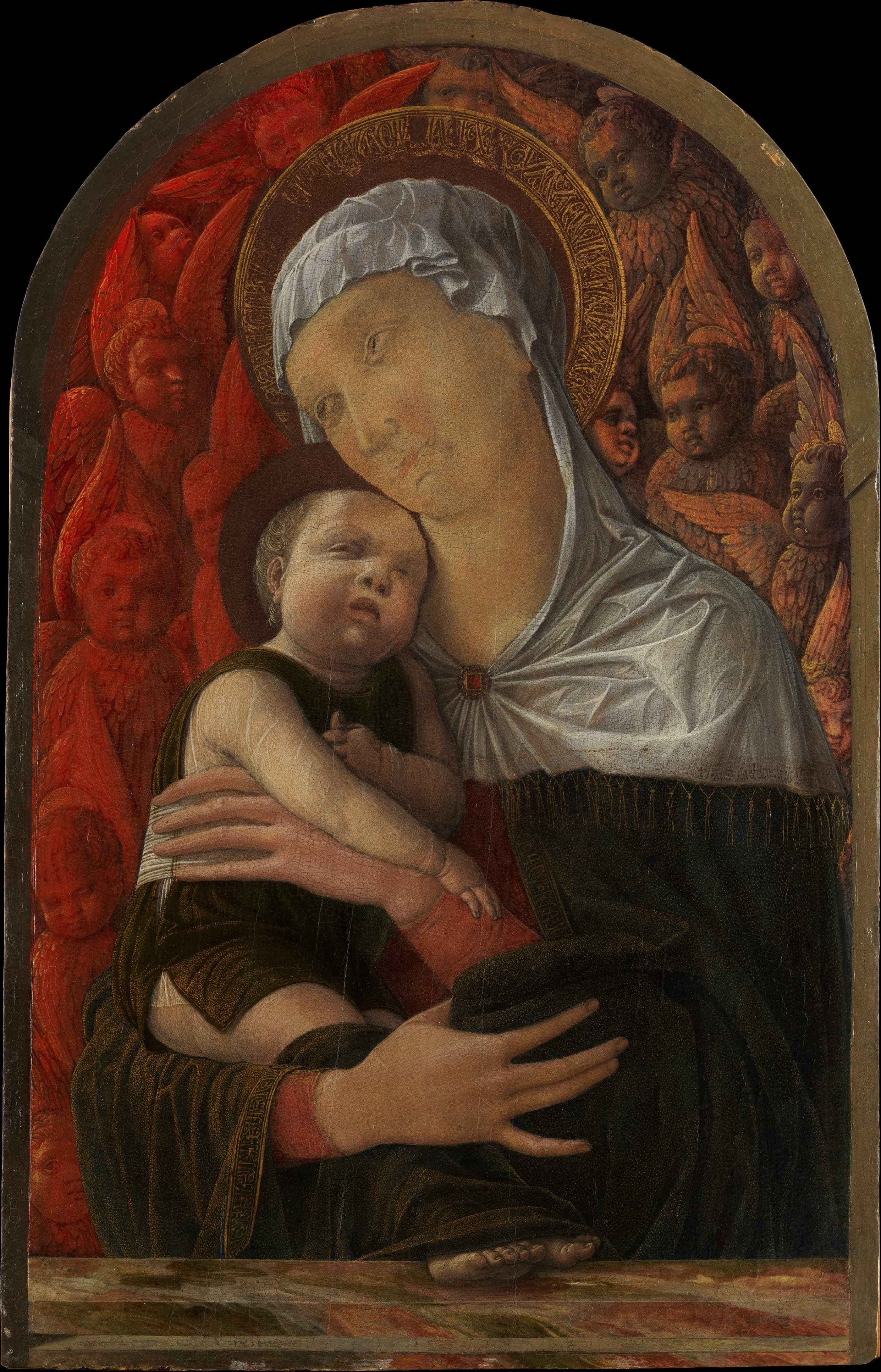
Blue cherubim, red seraphim
The surrounding angels are not a single choir. The cherubim are painted in blue and the seraphim in red — a traditional colour coding that separates ranks of the heavenly host. On a panel this small the distinction is easy to miss at a glance, yet it is deliberate: the Virgin and Child sit inside a graded celestial hierarchy rather than a decorative frieze.
The incline of Mary’s face
Mary turns her head down toward her son, a gesture that follows Donatello’s example in sculpture. The contact is intimate rather than frontal; mother and child form a closed diagonal within the rectangle. The effect is tender, but it also concentrates the composition: the eye is led along the line of her cheek into the infant’s face, then held there by the press of surrounding heads.
A fictive marble frame
In the foreground the painter has suggested a marble ledge or frame, a device comparable to the one in Mantegna’s Presentation at the Temple. The painted stone sits between the viewer and the holy group, as if the image were a shallow relief set into architecture. On a work made for private rooms, that fiction turns a domestic wall into a small chapel.
The story
This is a tempera painting on panel, only 44.1 centimetres (1 ft 5 in) high and 28.6 centimetres (11 in) wide, now in the Metropolitan Museum of Art. It shows the Virgin and Child crowded by cherubim and seraphim, and it is attributed to Andrea Mantegna, with a date around 1460. The subject is among the most familiar in Christian art; the interest here lies in scale, setting, and the unresolved question of whose hand actually painted it.
The work belongs to a group of small-format Madonnas associated with Mantegna and made for private devotion. Related examples include the Madonna with Sleeping Child in Berlin, the Poldi Pezzoli Madonna, and the Bergamo Madonna. These were not altarpieces for public liturgy. They were objects for a household or a private oratory — images meant to be lived with at arm’s length rather than seen across a nave.
If the panel is an autograph work, it is usually placed after Mantegna’s journey to Rome and toward the end of his Paduan period, around 1460. That dating rests partly on comparison with the Presentation at the Temple, which shares a similar fictive marble frame in the foreground. The cherubim are blue and the seraphim red. Mary’s face inclines toward her son in a manner that draws on Donatello’s sculptural example: affection rendered as a physical turn of the head, not as a distant emblem.
The picture’s condition complicates every claim about authorship. Conservation has been poor, and Mary’s face in particular has suffered over-harsh restoration. Because of that damage, some art historians cannot accept the panel as an autograph Mantegna. They argue instead that it was produced by a follower after an original by the master. The dispute is not a minor footnote; it sits at the centre of how the object is read. What remains visible is a tightly packed sacred group on a small support, painted in tempera, and shaped for private looking — whether by Mantegna himself or by someone working in his orbit after his design.
Nothing is known of the painting’s earlier life before 1891, when it appeared for sale at a London art dealer. Charles Butler bought it; from him it passed to the Metropolitan Museum of Art in 1926, where it remains. The gap in the record is ordinary for works of this size and type, but it leaves the original commission and first owner out of reach.
Why it mattered then
In the mid-fifteenth century a painting of this size answered a specific need. Devotion was not confined to the church. Households and private chapels required images that could sustain prayer at close range, without the architecture of an altar. Mantegna and his circle produced a series of such Madonnas; this panel sits among them. The crowded angels, the colour distinction between cherubim and seraphim, and the incline of Mary’s face toward the child all work at intimate distance. So does the painted marble ledge: it pretends the holy figures occupy a shallow niche, turning a domestic wall into something like a carved shrine. If the work dates from around 1460, after Mantegna’s Roman journey and near the close of his Paduan years, it also belongs to a moment when his treatment of stone, relief, and classical framing was especially sharp. Whether painted by him or by a follower after his design, the panel shows how a major workshop’s language of sacred intimacy circulated in small, portable form.
Why it matters now
The painting still matters because it holds two live problems at once: how Renaissance piety took private, domestic shape, and how far damaged surfaces allow secure attribution. Viewers who come for a famous name meet a more careful claim — attributed to Andrea Mantegna, dated around 1460, contested by some scholars precisely because Mary’s face has been restored too harshly. That uncertainty is useful. It keeps attention on what can actually be seen: tempera on a small panel, blue cherubim and red seraphim, a mother turning toward her child in a Donatellesque incline, a fictive marble edge at the front. The object also stands for a whole class of works — the small Madonna for private devotion — that shaped daily religious life as much as any public altarpiece. Its path from an unknown past through a London sale in 1891 to Charles Butler and then the Metropolitan Museum of Art in 1926 is a reminder that many such images entered public collections late, with thin paper trails, and that their meaning now includes that incomplete history.
The surprising detail
For a painting tied to one of the most studied names of the Italian Renaissance, the trail goes cold almost immediately. Its provenance is unknown before 1891. It simply appeared for sale at a London art dealer, was bought by Charles Butler, and reached the Metropolitan Museum of Art in 1926. Everything before that London sale — patron, original setting, early owners — remains blank. The blank is not trivial: on a work whose authorship is already debated because of harsh restoration to Mary’s face, the missing early history removes one of the usual checks against the connoisseur’s eye.
What is disputed
Attribution is disputed. The panel is given to Andrea Mantegna and dated around 1460, but its poor conservation, including over-harsh restoration to Mary’s face, leads some art historians to reject it as an autograph work and to propose instead a follower working after a Mantegna original. If accepted as autograph, the date is linked to the end of his Paduan period by comparison with the Presentation at the Temple; that comparison is suggestive rather than proven.
How it got here
Nothing is recorded of the painting before 1891, when it appeared for sale at a London art dealer. It was purchased by Charles Butler and passed from him to the Metropolitan Museum of Art in 1926, where it remains (inventory number 32.100.97). No contested-ownership or repatriation claim is attached to the work in the sources used here; the chief gap is simply the lost earlier history.
Remember this
A small tempera Madonna for private devotion, dated around 1460 and attributed to Mantegna — though damage to Mary’s face leaves some scholars unconvinced it is his own hand.
Test yourself
Why does the harsh restoration of Mary’s face matter for more than appearance?
Because attribution depends heavily on the quality of the painting, and Mary’s face is a primary site of that judgement. Once restoration has been over-harsh, some art historians can no longer accept the panel as an autograph Mantegna and instead see a follower working after an original. The damage does not merely dull the image; it weakens the evidence on which the name itself rests.