III · THE WORK · ART HISTORY
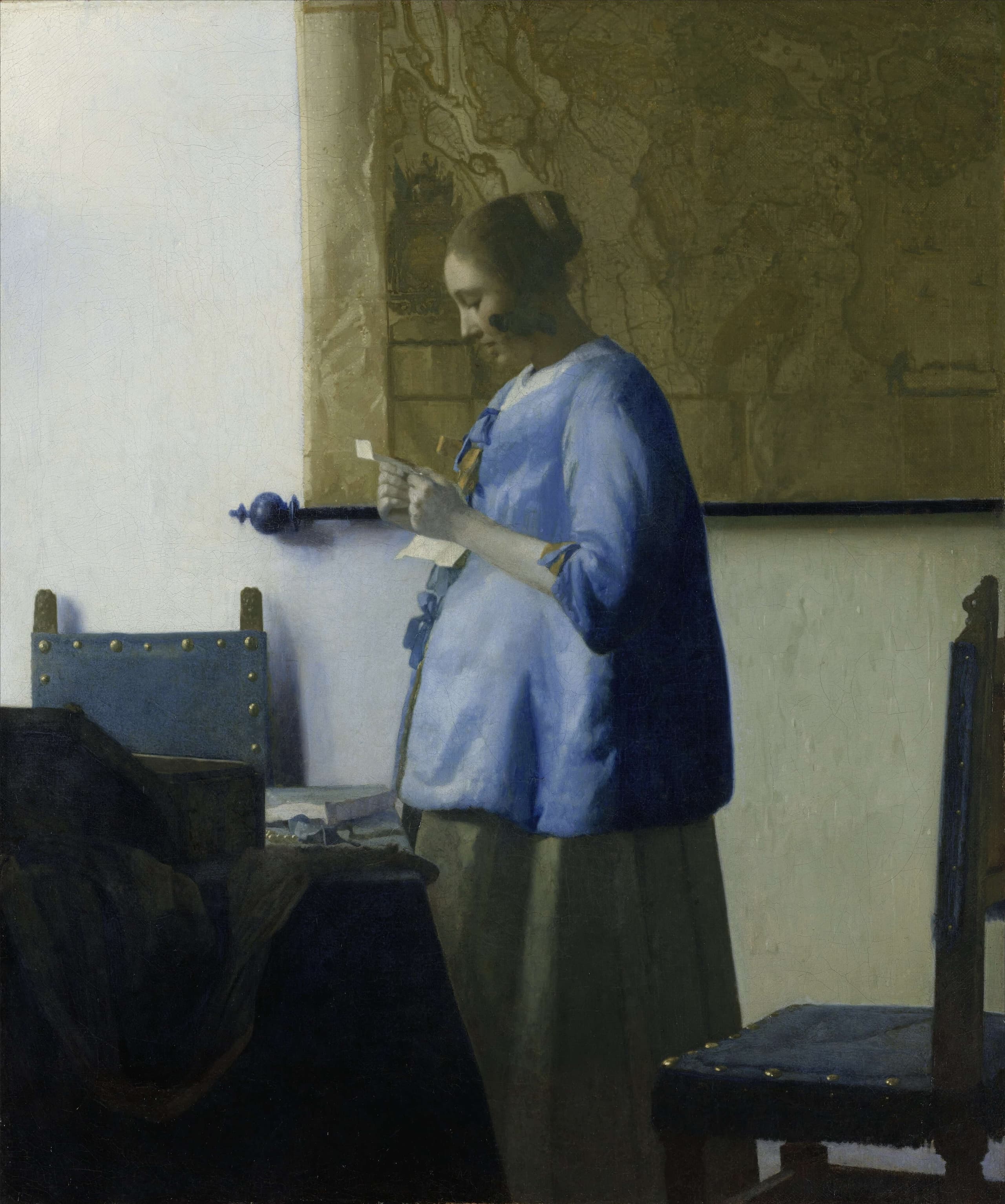
Woman in Blue Reading a Letter
▶ Listen · narrated
At just under half a metre high, this small canvas asks you to lean in. What holds the eye is not action but attention — hers, and then yours.
At a glance
- Artist
- Johannes Vermeer
- Date
- 1664
- Medium
- Oil on canvas
- Dimensions
- 46.6 × 39.1 cm (1 ft 3 in)
- Location
- Rijksmuseum, Amsterdam
- Genre
- Genre art
Look closer
Blue as structure
The title’s colour is not decoration. The blue of the woman’s garment is the largest calm field in the picture, a single tonal mass that keeps the figure steady while almost everything around her stays subordinate. It gathers the light, fixes her outline, and makes the small white of the letter feel sharper by contrast. Vermeer builds the whole balance of the composition around that one sustained colour.
Reading as the only event
She is not writing, sealing, or handing anything over. The letter is already open; the work of the picture is the work of reading. Her head tips toward the paper, and the hands hold it with a care that suggests both the object’s lightness and its importance. No second figure interrupts. The narrative stops at attention itself.
A format that insists on nearness
At 46.6 by 39.1 centimetres (1 ft 3 in) the painting is intimate by design. It does not broadcast across a room; it rewards the distance at which you might notice the edge of a sleeve or the angle of a wrist. The physical size matches the social size of the subject — a private act, shown without spectacle, on a surface meant to be met quietly.
The story
Johannes Vermeer’s Woman in Blue Reading a Letter is an oil painting on canvas, 46.6 centimetres (1 ft 6 in) high and 39.1 centimetres (1 ft 3 in) wide. The inception date recorded for it is 1664. It belongs to Dutch Golden Age painting and to genre art: a scene drawn from ordinary domestic life rather than from scripture, myth, or formal state portraiture. It is now in the Rijksmuseum in Amsterdam.
The subject is exactly as spare as the title. A woman in blue reads a letter. That is the action, and almost the whole of it. She stands with the paper before her; her attention has gone down into the words. Vermeer does not supply a messenger at the door, a companion waiting for news, or any other figure who might turn the moment into dialogue. The letter has arrived. Reading is what remains.
In the Dutch seventeenth century, genre painting often lingered on such interior pauses — a person alone with a task small enough to be overlooked and precise enough to hold a composition. Letter-reading belonged naturally to that world. Letters crossed distances that people could not; they carried business, affection, instruction, and rumour into rooms that otherwise looked still. A painter did not need to spell out the contents. The bent head and the held sheet were already a full situation.
What Vermeer does with that situation here is a matter of reduction. Colour does structural work. The blue garment is the painting’s largest steady shape, a field against which the pale letter can register as a small, sharp fact. Light falls in a way that clarifies without theatrics. The figure is centred not by drama but by how completely the surrounding space consents to stay quiet around her. Nothing in the verified making of the picture points to an unusual support or a documented change of format; it is oil on canvas, the ordinary ground of the period, used with uncommon economy of incident.
The object’s later life is clearer than many details of its first one. It formed part of the collection of Adriaan van der Hoop. With his bequest it passed to the City of Amsterdam in 1854, and it has been in the Rijksmuseum since that museum opened in 1885. It was the first Vermeer the Rijksmuseum acquired. The inventory numbers SK-C-251 and SA 8335 mark the double administrative life the painting still carries — museum and civic collection — even as it hangs in one place.
Close looking does not require a solved story. The painting withholds the sender, the message, and any aftermath. What it offers instead is the visible fact of concentration: a body arranged around a sheet of paper, a colour that holds the room together, and a scale that brings the viewer into something like the same privacy. The composition means what it shows. The rest is left outside the frame.
Why it mattered then
In the Dutch Golden Age, genre painting gave serious pictorial attention to rooms, tasks, and social habits that earlier hierarchies of subject had treated as minor. A woman reading a letter fitted that interest exactly. Letters were ordinary objects with outsized reach; they linked households to trade, family, and news from elsewhere. To paint the act of reading one was to paint a modern kind of interior life — not heroic, not sacred, but weighted. Vermeer’s picture belongs to that moment without advertising a moral or a caption. It does not tell the viewer what the letter says or whether the news is welcome. In a market and a culture that already understood domestic scenes as worthy of careful making, that restraint could still feel pointed. The meaning sits in posture, colour, and scale: a private act rendered with the finish once reserved for grander themes, on a canvas small enough to keep the encounter personal.
Why it matters now
The painting still works because it trusts a single human behaviour to carry a whole surface. In a visual culture crowded with explanation, a composition that refuses to decode its own letter remains quietly demanding. You are left with what can actually be seen — garment, stance, paper, light — and with the knowledge that the most important sentences are the ones not given. It also still matters as an object with a public afterlife. From a private collection to a civic bequest to the Rijksmuseum, it traces one common modern path for Dutch Golden Age pictures: out of the house and into shared looking. Standing before it now, the old premise holds. Genre art does not need spectacle to be exacting. It needs attention equal to the attention it depicts.
The surprising detail
For a painter now treated as central, this picture’s institutional arrival was almost modest. It reached the Rijksmuseum only when the museum opened in 1885, as the first Vermeer in that collection, and it came not by dramatic discovery but by the earlier civic path of the Adriaan van der Hoop bequest to the City of Amsterdam. The painting keeps two inventory numbers — SK-C-251 and SA 8335 — a dry reminder that even a work this private in subject has a double public identity.
What is disputed
Some accounts place the painting around 1663; the inception date used here is 1664, as recorded in the verified data. The precise contents of the letter, and any fuller narrative around the figure, are not documented and should not be treated as known.
Remember this
Vermeer builds a complete drama from one sustained action: a woman in blue, a letter, and the decision to show nothing else.
Test yourself
The painting never reveals what the letter says. How does that omission change the kind of looking the composition asks for?
It shifts attention from plot to presence. Without a readable message, the viewer cannot solve the scene as news or anecdote and is left with what is actually painted: the blue mass of the garment, the angle of the head, the small pale sheet, the quiet around the figure. The picture becomes less a story to finish than a state to notice — concentration itself, held long enough to become the subject.
Go deeper
- Woman Reading a Letter (Vermeer) · Wikipedia
- Woman in Blue Reading a Letter — Wikidata · Wikidata
- Woman in Blue Reading a Letter — collection record · rijksmuseum.nl
Image: Johannes Vermeer, Public domain. Licence: Public domain. Source.