II · THE DISCOVERY · HISTORY OF SCIENCE
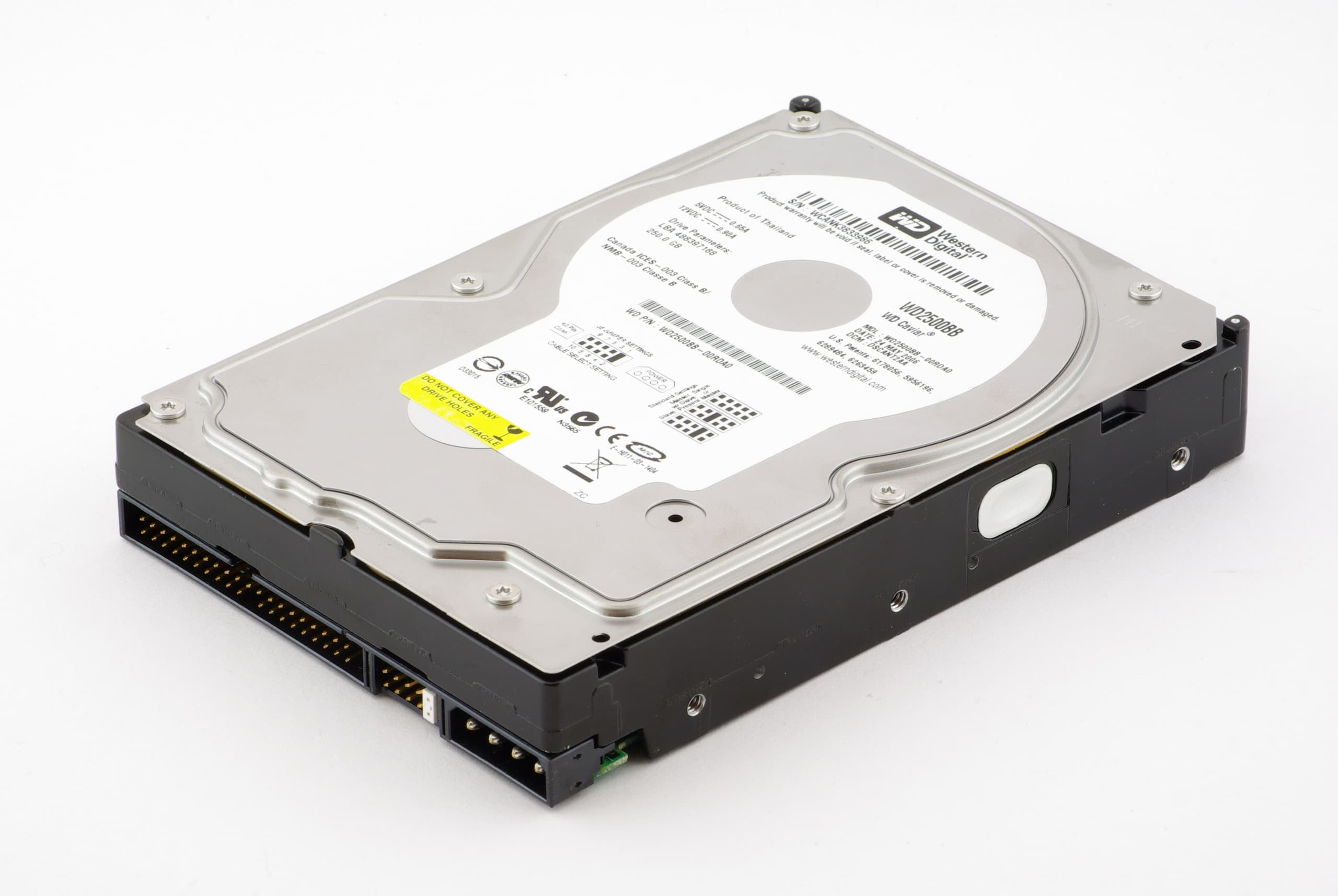
Hard disk
Before hard disks, computer storage meant magnetic tape or punched cards. The 1956 disk drive brought random access: any piece of data, retrieved in any order, without spooling through everything else first.
At a glance
- Introduced
- 1956
- Type
- Electro-mechanical data storage device
- Storage method
- Magnetic material on rigid rotating platters
- Access pattern
- Random access — any data block retrieved in any order
Look closer
The platters spin, the heads move
A hard disk has one or more rigid platters coated with magnetic material, spinning rapidly. Magnetic heads — the components that read and write data — sit on a moving actuator arm. The arm positions the heads over different tracks on the platter surface. Because the platters rotate and the heads move independently, the device can jump to any location on the disk without reading through everything in between. That property — random access — distinguishes it from magnetic tape, where you must wind through the reel to reach a particular spot.
Non-volatile storage
Hard disks are non-volatile storage, meaning they retain data when the power is turned off. That quality made them suitable for storing programs and files that needed to persist between sessions. The alternative at the time — core memory or vacuum tubes — either lost data when powered down or required continuous power to hold it.
Modern disks are sealed units
Modern hard disks do not have removable media. The platters stay inside a sealed rectangular box. That design contrasts with the disk drives common in the 1960s and 1970s, where the storage medium could be removed and replaced, much like a floppy disk. The sealed enclosure protects the platters and heads from dust and contamination, which would interfere with the tiny distances between them.
The story
IBM introduced a disk drive in 1956. It was called the 350, made for the 305 RAMAC system. The device used rigid platters coated with magnetic material, spinning continuously. Magnetic heads mounted on a moving arm read and wrote data to the platter surfaces. The arrangement allowed the machine to access any piece of stored data without reading through everything else — a property called random access.
Before the hard disk, computer storage meant magnetic tape or punched cards. Tape required winding through the reel to reach a particular spot. Cards had to be sorted and fed through readers. Both were sequential: you moved through the data in order. The hard disk changed that. Because the platters rotated and the heads moved independently, the device could jump to any location on the disk. That made it faster for tasks that required retrieving scattered pieces of information.
The basic mechanism has remained stable. A modern hard disk still uses spinning platters and moving heads. The platters are rigid — hence the name hard disk, distinguishing it from floppy disks, which used flexible media. The heads do not touch the platter surface; they float on a cushion of air created by the platter's rotation. Data is stored as magnetic patterns on the platter coating. The heads change the magnetisation to write data and sense it to read.
Hard disks became the dominant secondary storage device for general-purpose computers beginning in the early 1960s. They held that position through the era of personal computers and servers. More than 224 companies have produced hard disk drives historically, though the industry has consolidated. As of the reference material's date, most units were manufactured by Seagate, Toshiba, and Western Digital.
The technology's dominance has shifted. Solid-state drives — which use flash memory rather than spinning platters — have higher data-transfer rates, higher storage density per unit area, somewhat better reliability, and much lower latency and access times. Flash storage products had more than twice the revenue of hard disk drives as of 2017, and revenues for SSDs slightly exceeded those for HDDs in 2018. Hard disks still dominate the volume of storage produced per year for servers, measured in exabytes, though unit shipments and sales revenues are declining. SSDs cost more per bit of storage, but they are replacing hard disks in applications where speed, power consumption, small size, and durability matter more than cost.
A hard disk's capacity is specified in unit prefixes corresponding to powers of 1000: a 1-terabyte drive has a capacity of 1,000 gigabytes, where 1 gigabyte equals 1,000 megabytes. Some of the stated capacity is unavailable to the user because it is used by the file system, the operating system, and possibly inbuilt redundancy for error correction. There can be confusion because manufacturers state capacities in decimal gigabytes — powers of 1000 — whereas operating systems commonly report capacities in powers of 1024, which results in a smaller number than advertised.
Performance is specified as the time required to move the heads to a track, the time it takes for the desired sector to rotate under the head, and the speed at which data is transmitted. The second of those — latency — is a function of the physical rotational speed, measured in revolutions per minute. The faster the platters spin, the shorter the wait for a particular sector to come around.
Why it mattered then
Before 1956, computers stored data on magnetic tape or punched cards. Both were sequential: to reach a particular piece of information, you had to read through everything before it. That made certain tasks slow. If a program needed to retrieve scattered records — say, customer accounts in no particular order — the machine spent most of its time winding tape or sorting cards. The hard disk brought random access. The spinning platters and moving heads meant the device could jump to any location without reading through the intervening data. That made it faster for tasks that required retrieving information in an unpredictable order. By the early 1960s, hard disks had become the dominant secondary storage device for general-purpose computers. They held programs and data that needed to persist when the machine was turned off, and they did so with access times that tape could not match.
Why it matters now
Hard disks still store much of the world's data, particularly in servers. They dominate the volume of storage produced per year, measured in exabytes. The technology is mature, and the cost per bit is lower than solid-state alternatives. That said, solid-state drives are replacing hard disks in applications where speed and durability matter more than cost. Personal computing devices produced in large volume — mobile phones, tablets, many laptops — rely on flash memory rather than spinning platters. SSDs have higher data-transfer rates, lower latency, and no moving parts to fail. The revenue for SSDs exceeded that for hard disks in 2018, and the gap has widened since. The hard disk's persistence in data centres reflects a different set of priorities. When you need to store vast amounts of data and access it less frequently, the lower cost per bit matters more than the faster access times of an SSD. The technology that IBM introduced in 1956 — spinning platters, moving heads, magnetic storage — remains in use because it still solves a particular problem more cheaply than the alternatives.
The surprising detail
More than 224 companies have produced hard disk drives over the decades, but the industry has consolidated sharply. As of the reference material's date, most units were manufactured by just three companies: Seagate, Toshiba, and Western Digital. That consolidation reflects the maturity of the technology and the difficulty of competing on cost at scale. The basic mechanism has not changed — spinning platters, moving heads — but the engineering required to pack more data into smaller spaces, at lower cost, has become a specialist's game.
Remember this
Random access: the ability to retrieve any piece of data without reading through everything else. That is what the hard disk brought in 1956, and it is still what distinguishes it from tape.
Test yourself
Solid-state drives are faster and more reliable than hard disks, yet hard disks still dominate the volume of storage produced for servers. What explains that?
Cost per bit. Hard disks store data more cheaply than solid-state drives, even though SSDs are faster and have no moving parts to fail. In a data centre, where you are storing vast amounts of data and accessing it less frequently, the lower cost per bit matters more than the faster access times. That is why hard disks persist in servers while SSDs have taken over in laptops and mobile devices, where speed, power consumption, and durability are more important than cost.
Go deeper
Image: Christian Jansky, CC BY-SA 3.0. Licence: CC BY-SA 3.0. Source.