I · THE OBJECT · BRITISH MUSEUM
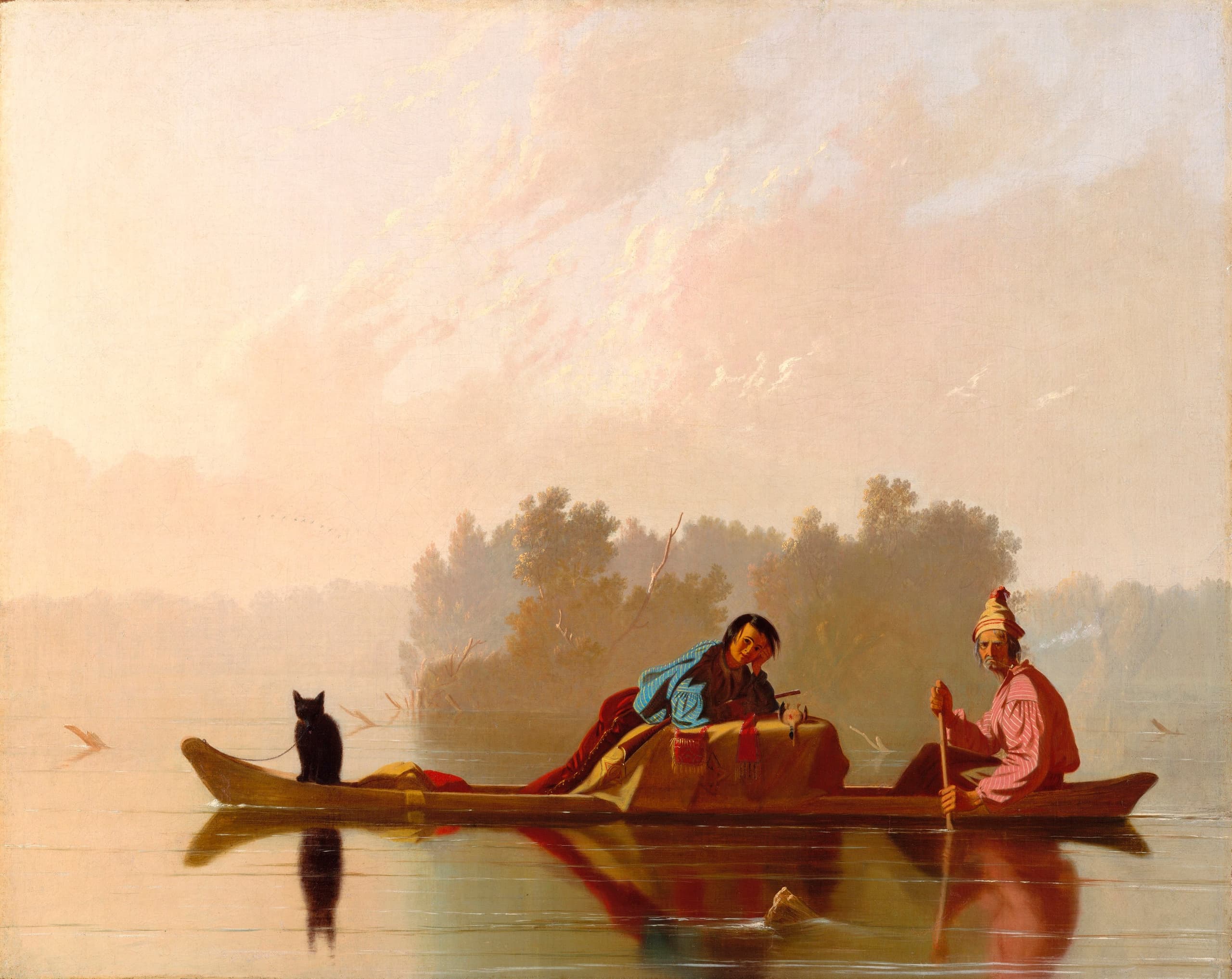
Fur Traders Descending the Missouri
▶ Listen · narrated
Long before photography fixed the look of the frontier, Bingham painted the Missouri’s working river traffic. This canvas is why we still think we know what that trade looked like.
At a glance
- Date
- 1845
- Artist
- George Caleb Bingham
- Material
- Oil paint on canvas
- Dimensions
- 73.7 × 92.7 cm (3 ft)
- Inventory
- 33.61
- Genre
- Genre art
Look closer
Genre, not grandeur
This is genre art: a scene of ordinary work rather than a battle, a portrait commission, or a biblical subject. Bingham chose fur traders on the Missouri — men engaged in commercial river traffic — and treated that labour as worthy of a finished oil on canvas. The choice matters because mid-nineteenth-century American painting was still sorting out which parts of national life counted as art. Everyday river commerce was not an obvious candidate.
Three later labels
Art historians have linked the picture to luminism, the Hudson River school, and French Realism. Those are overlapping, retrospective tags rather than a single programme Bingham announced. Luminism points to still water and diffused light; the Hudson River school to American landscape as a serious subject; French Realism to ordinary labour painted without overt moralising. None of the three fully contains the work, and the fit of each is a matter of scholarly emphasis.
Descending, not arriving
The title specifies direction. The traders are descending the Missouri — moving with the current, carrying goods toward market rather than pushing upstream. That single word fixes the painting in a commercial logic: the river as a one-way conveyor for pelts and provisions. Bingham’s broader river subjects often turn on just such practical facts of traffic, leisure, and exchange before the steamboat era fully remade the waterways.
The story
Fur Traders Descending the Missouri is an oil painting on canvas made in 1845 by George Caleb Bingham. It measures 73.7 by 92.7 centimetres (3 ft) and belongs to the Metropolitan Museum of Art, where it is held under inventory number 33.61. It is a work of genre art: a composed scene of ordinary life rather than a portrait, an allegory, or a history subject. Its country of origin is the United States.
Bingham (1811–1879) was known in his lifetime as the Missouri artist. He belonged to the first generation of painters who took the early American West as a sustained subject, drawing narrative scenes from observation and from the river culture he knew. His best-known pictures chronicle aspects of westward expansion and daily life along the Mississippi and Missouri — fur trappers, boatmen, politicians, settlers — rendered as genre rather than as epic. This canvas is among the works that secured that reputation.
The subject is commercial river traffic in the years when the fur trade still shaped movement on the Missouri, and when the steamboat had not yet wholly displaced older ways of travelling and hauling. Bingham’s river pictures are often read as records of that moment: the politics, commerce, and social relations of frontier life set down before the traffic patterns changed. How much documentary weight any single painting can bear is open to argument; what is clearer is that he treated these scenes as serious material for oil painting at a time when American art was still defining its subjects.
Later classification has placed the work in relation to luminism, the Hudson River school, and French Realism. Those labels describe affinities — calm light, American landscape tradition, unsentimental attention to labour — more than a manifesto. Bingham was also a prolific portraitist, producing as many as five hundred portraits of Missourians, politicians, and national figures. The genre scenes and the portraits belong to the same career: a painter making a living from likenesses while building a parallel body of narrative river subjects.
All of Bingham’s known paintings, including works found later, are now gathered in the George Caleb Bingham Catalogue Raisonné, a public electronic catalogue launched in 2018 and built on the earlier scholarship of E. Maurice Bloch. That project underlines how incomplete the public record of even a well-known nineteenth-century American painter can remain until systematic cataloguing catches up.
The painting’s path into the Metropolitan Museum of Art is not detailed in the sources used here. What is certain is its present home, its date, its medium, and its place among Bingham’s river subjects. It stands as a finished studio picture of frontier commerce, made by an artist who lived within reach of the world he painted and who chose genre as the form in which that world would be remembered.
Why it mattered then
In 1845 the Missouri River was still a working corridor for the fur trade and for the mixed traffic of a frontier not yet fully absorbed into steamboat schedules and rail. Bingham’s decision to paint traders descending that river treated contemporary commercial life as a fit subject for exhibition painting. Genre scenes of boatmen and trappers offered eastern and urban viewers a composed image of the West at a moment when expansion, land, and river commerce were live political and economic facts. The picture belonged to a broader effort, in Bingham’s career and among his peers, to give American subjects a classical narrative clarity without borrowing European history painting wholesale. It mattered locally as the work of “the Missouri artist,” and more widely as evidence that the rivers of the interior could sustain a serious pictorial programme.
Why it matters now
The painting still shapes how the pre-steamboat river West is visualised. Because Bingham fixed traders, boatmen, and river leisure in clear, legible compositions, later audiences have often taken his genre scenes as a default memory of that traffic — vivid, selective historical records rather than neutral documents. The work also sits at a crossroads of American art-historical labels: luminism, Hudson River school, French Realism. Those overlapping categories keep the canvas useful in teaching how nineteenth-century American painting has been sorted after the fact. Finally, its presence in the Metropolitan Museum of Art, under a stable inventory number and within a completed catalogue raisonné tradition, makes it a public reference point for debates about frontier imagery, commerce, and who gets remembered as ordinary in national art.
The surprising detail
Bingham is now best known for a handful of river genre scenes, yet he was also a working portrait factory. He is estimated to have produced as many as five hundred portraits — Missouri pioneers, state politicians, and figures such as John Quincy Adams and Daniel Webster. The famous Missouri canvases sit beside a much larger, quieter output of likenesses that paid the bills and tied him to the political class of his region. The imbalance between what he painted most and what he is remembered for is easy to miss.
What is disputed
The associations with luminism, the Hudson River school, and French Realism are retrospective art-historical classifications; scholars differ on how tightly each applies. The reference material describes layers of symbolism and socio-political commentary in Bingham’s genre scenes, but specific symbolic readings of this canvas are not settled fact and are omitted here. How the painting entered the Metropolitan Museum of Art is not recorded in the sources supplied for this lesson.
Remember this
A genre painting of Missouri river commerce, made in 1845 by George Caleb Bingham and now at the Met — ordinary trade fixed in oil before the steamboat era closed.
Test yourself
Art historians have associated Fur Traders Descending the Missouri with luminism, the Hudson River school, and French Realism at once. What does that triple labelling actually tell you about the painting?
That no single movement fully owns it. The three tags are later scholarly tools pointing to different qualities — still light, American landscape seriousness, and unsentimental attention to ordinary labour. Bingham did not issue a manifesto under those names. When one picture attracts several overlapping classifications, the useful response is not to pick a winner but to notice which features each label is trying to explain, and where the fit remains partial.
Go deeper
Image: George Caleb Bingham, Public domain. Licence: Public domain. Source.